'%3E%3Cpath d='M16.3574 35.6519H12.9537L15.0491 18.8873L16.3574 35.6519ZM30.4229 54.0093L22.309 0.994385H7.91795L0 54.0093H10.6634L11.5802 46.3855H17.4014L17.9914 54.0093H30.4229Z' fill='%23971B20'/%3E%3Cpath d='M48.2073 41.8813C48.2073 43.4049 47.4892 44.0011 46.1144 44.0011H43.7595V11.0687H46.1144C47.4892 11.0687 48.2073 11.6636 48.2073 13.1885V41.8813ZM59.5273 43.6695V11.3326C59.5273 3.71323 53.5729 0.994385 47.8157 0.994385H31.7213V54.0093H47.8157C53.5729 54.0093 59.5273 51.29 59.5273 43.6695Z' fill='%23971B20'/%3E%3Cpath d='M90.183 0.994385H78.6039L75.0711 30.6157L71.9955 0.994385H59.4346L69.2474 54.0093H80.373L90.183 0.994385Z' fill='%23971B20'/%3E%3Cpath d='M107.063 42.3448C107.063 43.7359 105.951 44.5974 104.643 44.5974C103.269 44.5974 102.157 43.7359 102.157 42.3448V12.658C102.157 11.2676 103.269 10.4058 104.643 10.4058C105.951 10.4058 107.063 11.2676 107.063 12.658V42.3448ZM119.233 43.2723V11.7312C119.233 6.36384 112.952 -3.8147e-06 104.643 -3.8147e-06C96.2667 -3.8147e-06 89.9867 6.36384 89.9867 11.7312V43.2723C89.9867 48.6393 96.2667 55 104.643 55C112.952 55 119.233 48.6393 119.233 43.2723Z' fill='%23971B20'/%3E%3Cpath d='M150.976 43.9349V33.7309H139.069V42.3448C139.069 43.7359 137.957 44.5974 136.582 44.5974C135.076 44.5974 133.964 43.7359 133.964 42.3448V12.658C133.964 11.2676 135.076 10.4058 136.582 10.4058C137.957 10.4058 139.069 11.2676 139.069 12.658V21.2723H150.976V11.0687C150.976 5.70107 145.283 -3.8147e-06 136.582 -3.8147e-06C127.75 -3.8147e-06 121.796 5.70107 121.796 11.0687V43.9349C121.796 49.3022 127.75 55 136.582 55C145.283 55 150.976 49.3022 150.976 43.9349Z' fill='%23971B20'/%3E%3Cpath d='M167.478 35.6519H164.076L166.17 18.8873L167.478 35.6519ZM181.544 54.0093L173.432 0.994385H159.037L151.123 54.0093H161.785L162.704 46.3855H168.523L169.114 54.0093H181.544Z' fill='%23971B20'/%3E%3Cpath d='M205.412 10.4058V0.994385H177.081V10.4058H185.392V54.0093H197.428V10.4058H205.412Z' fill='%23971B20'/%3E%3Cpath d='M230.002 54.0093V43.9349H218.914V31.8746H226.635V21.8028H218.914V10.4058H230.002V0.994385H206.875V54.0093H230.002Z' fill='%23971B20'/%3E%3C/g%3E%3Cdefs%3E%3CclipPath id='clip0_260_7080'%3E%3Crect width='230' height='55' fill='white'/%3E%3C/clipPath%3E%3C/defs%3E%3C/svg%3E)
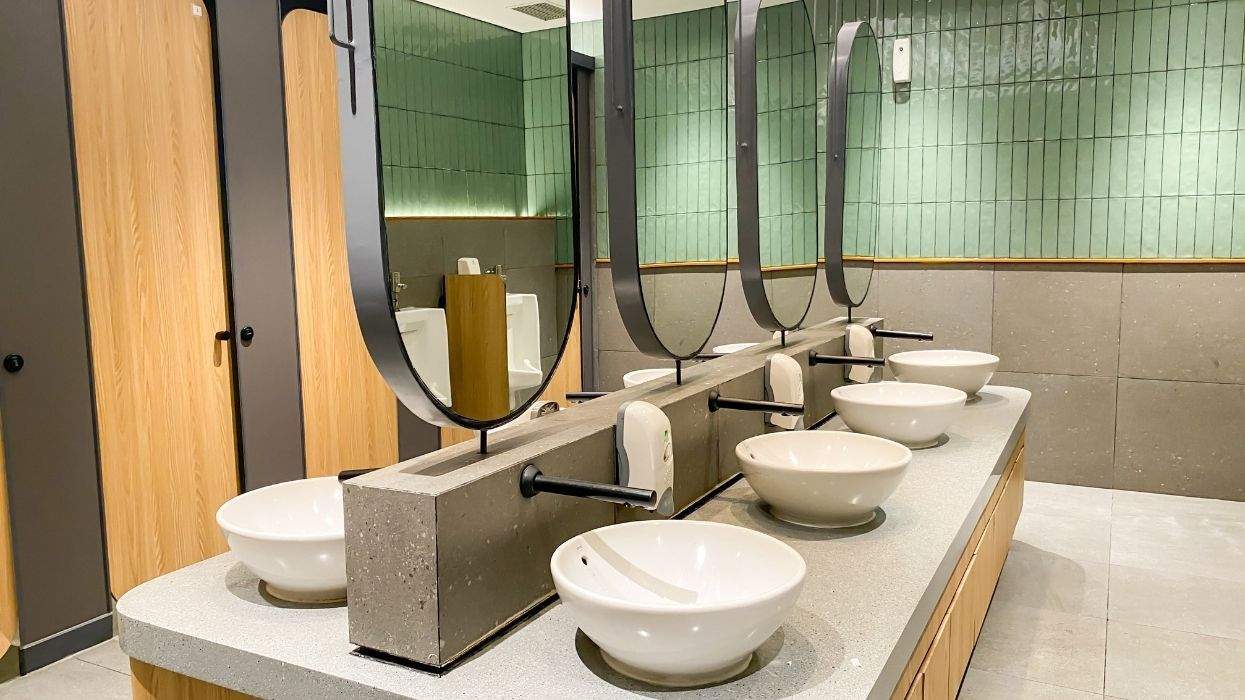
A federal judge has blocked Idaho's transgender bathroom ban before it can take effect, ruling that key provisions of the law are likely unconstitutional and questioning whether police could realistically enforce it without arbitrary or discriminatory action.
In a 30-page decision issued Tuesday, U.S. District Judge Amanda K. Brailsford granted a preliminary injunction against House Bill 752, one of the nation's strictest bathroom restrictions targeting transgender people. The judge also provisionally certified a statewide class of transgender Idahoans, extending the ruling's protections beyond the handful of plaintiffs who brought the lawsuit.
The decision marks a significant setback for Idaho officials and anti-LGBTQ+ activists who championed the measure as a way to protect women and children in public restrooms. Instead, the court concluded that the law's enforcement mechanisms are so unclear as to likely violate the Constitution's due process guarantee.
Related: Trans man forced to leave Idaho to use public bathrooms joins lawsuit against state
"Different officers could reasonably reach different conclusions regarding identical conduct, not because the facts differ, but because the statute furnishes no standards by which those facts are to be evaluated," Brailsford wrote.
The lawsuit was filed by transgender Idahoans represented by the American Civil Liberties Union, the ACLU of Idaho, and Lambda Legal.
The ACLU called the ruling "a win for trans rights" in a post on Bluesky.
“Our Constitution provides critical protections against laws that are unclear and that call on officers to make arbitrary judgments about how to enforce them, especially when the law threatens imprisonment,” Kell Olson, counsel with Lambda Legal, said in a statement. “The court recognized that threat in providing relief to plaintiffs today. This ruling will allow transgender people throughout Idaho to find and use a public restroom, without the fear of arrest looming over them, while we continue the longer fight to permanently defeat this discriminatory law in court.”
Lambda Legal CEO Kevin Jennings called the ruling a major victory against what he described as an unprecedented escalation in efforts to restrict transgender people's access to public life.
"Idaho's law represents a truly dangerous escalation of the war on trans people and is the most extreme we have ever seen on the subject of bathrooms," Jennings told The Advocate in an interview. "So it is an enormous relief to have a judge who saw the light and who agreed with us and issued today's ruling."
Jennings said Idaho's decision to attach criminal penalties to restroom use set the measure apart from other bathroom restrictions enacted around the country.
"Bathroom bans are problematic period, but when you start throwing criminal penalties, which involve multiple years of incarceration, into the mix as Idaho did, we’re talking about a truly dangerous escalation," he said.
Signed into law by Republican Gov. Brad Little in March, HB 752 made it a crime to knowingly enter a restroom or changing room in a government-owned building or place of public accommodation (including private businesses) that is designated for use by the "opposite biological sex." A first violation is punishable by up to one year in jail. A second offense can be prosecuted as a felony, carrying a potential five-year prison sentence.
BREAKING: A federal judge temporarily blocked a bathroom ban in Idaho that threatened transgender people with up to 5 years in prison for using a bathroom that aligns with their gender identity.This is a win for trans rights.
— ACLU (@aclu.org) June 16, 2026 at 11:15 AM
Critics argued that the law would criminalize ordinary activities by transgender people while creating impossible enforcement challenges for police and business owners. Those concerns became central to Brailsford’s ruling.
At issue were two exceptions written into the law. One allows a person to use a restroom that would otherwise be prohibited by the statute if it is the only facility "reasonably available." Another permits someone to use a restroom if they are in "dire need of urinating or defecating” and no other restroom is reasonably available.
The judge found neither phrase is adequately defined.
The statute provides no standards for determining what qualifies as a "dire need" or whether another restroom is "reasonably available." It does not explain whether availability depends on distance, occupancy, functionality, location, or any other factor. As a result, Brailsford concluded, enforcement would be left largely to the discretion of individual officers.
Related: Idaho says it can use DNA testing to enforce anti-trans bathroom ban
Without objective standards, she wrote, the law invites arbitrary enforcement. The opinion repeatedly cites concerns raised by Idaho law enforcement organizations that opposed the legislation during the legislative process.
The Idaho Chiefs of Police Association warned lawmakers that the bill would create "significant practical enforcement challenges" and leave officers struggling to determine whether a person qualified for one of the statute's exceptions. The Idaho Fraternal Order of Police similarly questioned whether the law could be effectively enforced.
The judge also raised concerns about how authorities would determine a person's sex assigned at birth. "Defendants responded to this issue during oral argument that law enforcement could use DNA testing to prove biological sex," Brailsford wrote.
The judge noted that, absent consent, a warrant, or other legal authority, law enforcement generally cannot simply collect a person's DNA. While the court did not ultimately rule on the legality of such testing, Brailsford said the discussion reinforced concerns that the statute invites arbitrary enforcement.
“The Supreme Court has repeatedly emphasized that the vagueness doctrine guards against laws that permit enforcement based on ‘personal predilections’ rather than objective standards,” the judge wrote.
The ruling also rejected Idaho's argument that the law is necessary to protect public safety. Brailsford noted that Idaho already criminalizes assault, battery, rape, indecent exposure, trespassing, harassment, and other misconduct cited by supporters of the measure.
The court further questioned whether HB 752 meaningfully advances the state's stated objectives. According to the opinion, plaintiffs identified only one Idaho incident in ten years involving a transgender person that supporters cited in defense of the legislation, and that conduct was already prosecutable under existing law.
The decision comes as states across the country continue to enact laws regulating where transgender people can use restrooms, locker rooms, and other sex-segregated facilities. Idaho has already adopted separate restrictions affecting public schools, colleges, and certain state facilities.
In another significant aspect of Tuesday's ruling, Brailsford provisionally certified a class consisting of transgender people who seek to use restrooms in government-owned buildings and places of public accommodation consistent with their gender identity. That means the injunction extends beyond the named plaintiffs and temporarily protects transgender people statewide while the litigation proceeds.
The injunction itself is narrower than some early descriptions suggested. Brailsford barred enforcement of HB 752 against transgender people using single-user restrooms consistent with their gender identity and when no single-user restroom is available on the same floor because none exists, all are occupied, or they are out of service. The ruling does not address changing rooms or locker rooms, which were not part of the plaintiffs’ request for preliminary relief.
The scope of the ruling quickly became the subject of discussion among legal observers. On Bluesky, civil rights attorney Alejandra Caraballo noted that the injunction is not a complete block of the law. "Only enjoins when there isn't a single user restroom on the same floor," she wrote. "So a trans person using a multi stall bathroom if there's a single user bathroom nearby can still be charged. It also doesn't apply to locker rooms or changing rooms."
Olson told The Advocate that the narrower relief reflects the preliminary stage of the litigation rather than the full scope of the challenge. "The lawsuit asks for the law to be blocked as to all restrooms, period," Olson said. "The preliminary relief is slightly narrower.” He said attorneys sought immediate protection in situations where transgender people otherwise would have no practical alternative. "If you do not have a gender neutral option that is available nearby, then you can access the restroom consistent with your gender identity," Olson said. "That was our main concern: to make sure that people had a ready and safe option anywhere they found themselves."
Olson acknowledged that some enforcement scenarios remain possible while the case proceeds. "Technically, there will still be the ability for enforcement," he said, pointing to locker rooms and situations where a gender-neutral option is immediately available. But he said the ruling removes enforcement in a substantial number of circumstances and ensures transgender people have a restroom option throughout the state.
“This ruling means trans folks in Idaho can continue participating in public life without the threat of being arrested for using the bathroom,” said Paul Carlos Southwick, ACLU of Idaho Legal Director. “Trans Idahoans have been understandably anxious about the disruption this unconstitutional law would cause in their daily lives. This ruling will relieve that anxiety for our trans friends and neighbors.”