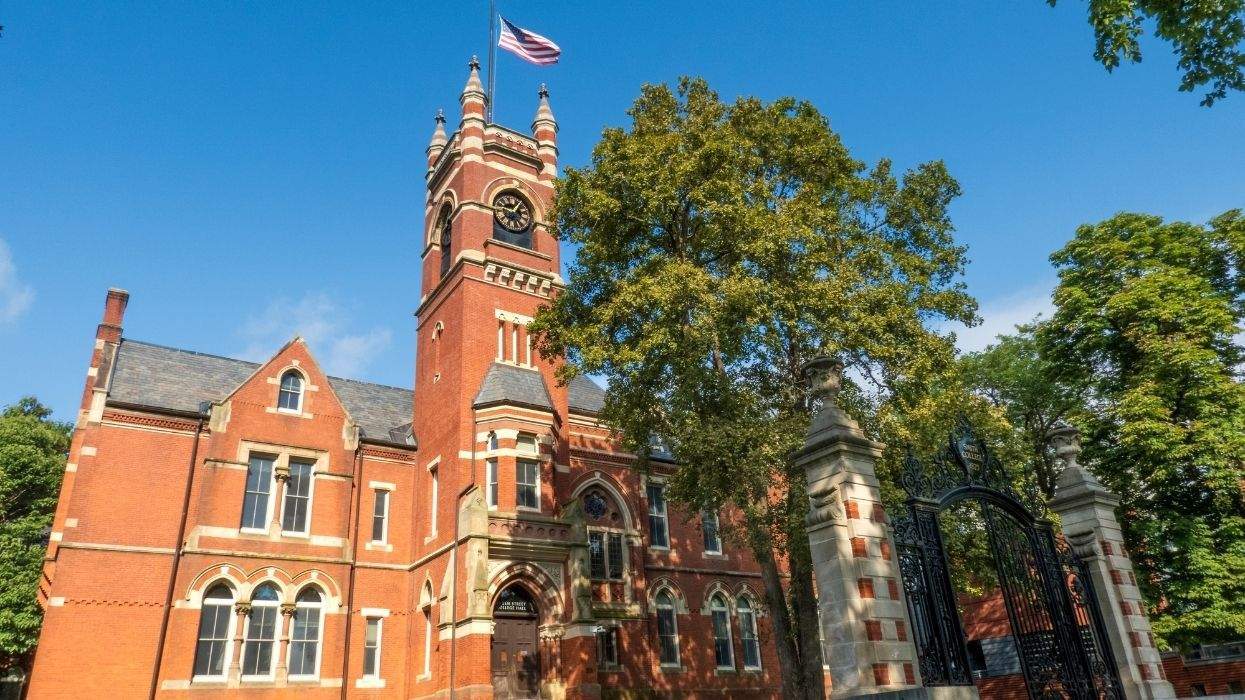
When the University of the Cumberlands in Williamsburg, Ky., expelled sophomore Jason Johnson for revealing he’s gay on his MySpace profile, a political firestorm ensued that pitted school officials and Kentucky governor Ernie Fletcher against a growing number of Kentuckians who oppose using state money to fund the Southern Baptist college, including a recent appropriation of $10 million for a new pharmacy school building and $1 million in scholarships. State senator Ernesto Scorsone, Kentucky’s only openly gay elected official, is at the forefront of the fight to overturn Governor Fletcher’s decision to approve funding for the school. He spoke with The Advocate about the controversy, the governor’s record of discrimination, and what’s at stake for both gay and straight Kentuckians.
Does the University of the Cumberlands have the right to discriminate?
Legally, as long as it’s a private school
they’re allowed to be selective. But this
year’s budget embarked the state on a totally new
venture—putting public money into a private religious
school. When you go back to Kentucky’s last
constitutional convention, in 1890, the delegates made
it clear they did not want public money to go to private
schools. They felt we gave them enough of a break by
not taxing them. Morally, though, it’s
inconsistent with the concept of higher education to be
exclusive. The value of education is to have an exchange of
ideas, which is hard to do if you only hear one side.
How does the proposed scholarship program factor in?
This is a new million-dollar program which says
we will give free tuition to pharmacy students, but
only if they’ll attend the University of the
Cumberlands. Well, guess what, gay kids can’t go to
this school. So all of a sudden you have a state
program that’s only available to heterosexuals.
That’s absolutely unacceptable and absolutely
unconstitutional.
The governor approved the budget for the pharmacy school
but filed a lawsuit asking the courts to rule on
its constitutionality. Is he playing both sides?
Since we have line-item vetoes in Kentucky,
Governor Fletcher could’ve just vetoed the
program, but he chickened out and said ‘Let the
courts decide.’ In reality, though, it’s
a smoke screen. It’s just someone in his
cabinet suing someone else in the executive branch, asking
the courts to go ahead and approve it. The irony is
the governor’s used his veto power to cut many
programs at state institutions, including over $200
million of bonding issues.
What can be done to stop it?
Christina Gilgor, the director of the Kentucky
Fairness Alliance, filed a suit even before the
governor did, asking the courts not to approve the
appropriations. We’re speaking out and we’re
getting more groups involved in this lawsuit. There
was a rally last month across from the university and
there will be more.
This isn’t the only antigay move Governor Fletcher
has made.
On April 11, Diversity Day, he took away the protections
we had established for LGBT state employees with a
previous executive order I helped draft with former
Democratic governor Paul Patton. He worded the new
order so it hid what he was trying to do, but we realized
immediately he had stricken protections for LGBT
people. I spoke out, calling it callous and
mean-spirited. It sets the state back and damages our
reputation.
How has this damaged the state’s reputation?
There was a wonderful story in the Lexington
Herald-Leader about how it’s bad for
business for the state to be seen as antigay.
Cincinnati learned the hard way when they passed antigay
legislation. They lost convention business and certain
companies refused to do business with the city.
We’re in a knowledge- and information-based
economy, so if you’re accepting and tolerant, that
fosters an environment of creativity and development.
Are you concerned your involvement will jeopardize your
political career?
Well, I don’t think there was any question that I
was going to get involved. I’ve been involved
in civil rights for a very long time and this is such
a blatant act of discrimination. And I think my district
appreciates the role that I play.
When did you come out?
I made a statement three years ago, around the time we
signed the last executive order, but I think a lot of
people already knew. I’ve lived with my partner
for over 12 years and I’ve been very up front on
gay issues, both as an attorney and a legislator.
I’ve never lied about my sexual
orientation—I just didn’t have a big press
conference or anything. The response from my
constituents has been overwhelmingly positive.
What would you tell people on the East and West coasts
who have a preconceived notion of what it’s
like to be gay in Kentucky?
I think in rural areas and smaller cities there’s
a greater sense of community among LGBT folks than you
find in a big city. Maybe it’s because we feel
we need to stick together. But I also think there’s a
strong feeling here to protect our own. Even in small
communities, it’s often worse to be from out of
town than to be gay.
To help defend gay rights in Kentucky, contact the Kentucky Fairness Alliance at www.kentuckyfairness.org.
These comments are reproduced as written by visitors to this Web site. They have not been edited for content, grammar, or spelling. The viewpoints appearing here are those of the writer, and do not necessarily reflect the opinion or views of advocate.com, The Advocate, or its affiliates.
Be the first to comment on this story.
If you would like to submit a comment for posting, please fill out the form above.
All comments submitted via this form are subject to posting or publication. (To send a private letter to an Advocate editor or writer, please use the e-mail button at the top of the page, or use snail mail.) If you would like your comment considered for publication in The Advocate magazine, please include your full name, your city of residence, and a phone number where you can be reached during business hours so that we can confirm your identity. Your e-mail address and telephone number are strictly confidential and will not be shared or used for any purpose other than to contact you about your comment.
Comments that do not concern specific articles in The Advocate or on Advocate.com will not be posted or published. See the Contact page for sending comments for reasons other than responding to Advocate editorial and news stories.
Please note that comments sent by fax or snail mail are unlikely to be posted, although they will be considered for publication along with all letters received via e-mail or via this Web page. Comments that chiefly concern Advocate.com content will be considered for posting only on the Web site. The Advocate reserves the right to edit submitted comments for grammar, spelling, obscenities, or libel; we will, however, do our best to preserve the original comment's style and intent. Comments considered for publication in The Advocate magazine may also be edited for length.