'%3E%3Cpath d='M16.3574 35.6519H12.9537L15.0491 18.8873L16.3574 35.6519ZM30.4229 54.0093L22.309 0.994385H7.91795L0 54.0093H10.6634L11.5802 46.3855H17.4014L17.9914 54.0093H30.4229Z' fill='%23971B20'/%3E%3Cpath d='M48.2073 41.8813C48.2073 43.4049 47.4892 44.0011 46.1144 44.0011H43.7595V11.0687H46.1144C47.4892 11.0687 48.2073 11.6636 48.2073 13.1885V41.8813ZM59.5273 43.6695V11.3326C59.5273 3.71323 53.5729 0.994385 47.8157 0.994385H31.7213V54.0093H47.8157C53.5729 54.0093 59.5273 51.29 59.5273 43.6695Z' fill='%23971B20'/%3E%3Cpath d='M90.183 0.994385H78.6039L75.0711 30.6157L71.9955 0.994385H59.4346L69.2474 54.0093H80.373L90.183 0.994385Z' fill='%23971B20'/%3E%3Cpath d='M107.063 42.3448C107.063 43.7359 105.951 44.5974 104.643 44.5974C103.269 44.5974 102.157 43.7359 102.157 42.3448V12.658C102.157 11.2676 103.269 10.4058 104.643 10.4058C105.951 10.4058 107.063 11.2676 107.063 12.658V42.3448ZM119.233 43.2723V11.7312C119.233 6.36384 112.952 -3.8147e-06 104.643 -3.8147e-06C96.2667 -3.8147e-06 89.9867 6.36384 89.9867 11.7312V43.2723C89.9867 48.6393 96.2667 55 104.643 55C112.952 55 119.233 48.6393 119.233 43.2723Z' fill='%23971B20'/%3E%3Cpath d='M150.976 43.9349V33.7309H139.069V42.3448C139.069 43.7359 137.957 44.5974 136.582 44.5974C135.076 44.5974 133.964 43.7359 133.964 42.3448V12.658C133.964 11.2676 135.076 10.4058 136.582 10.4058C137.957 10.4058 139.069 11.2676 139.069 12.658V21.2723H150.976V11.0687C150.976 5.70107 145.283 -3.8147e-06 136.582 -3.8147e-06C127.75 -3.8147e-06 121.796 5.70107 121.796 11.0687V43.9349C121.796 49.3022 127.75 55 136.582 55C145.283 55 150.976 49.3022 150.976 43.9349Z' fill='%23971B20'/%3E%3Cpath d='M167.478 35.6519H164.076L166.17 18.8873L167.478 35.6519ZM181.544 54.0093L173.432 0.994385H159.037L151.123 54.0093H161.785L162.704 46.3855H168.523L169.114 54.0093H181.544Z' fill='%23971B20'/%3E%3Cpath d='M205.412 10.4058V0.994385H177.081V10.4058H185.392V54.0093H197.428V10.4058H205.412Z' fill='%23971B20'/%3E%3Cpath d='M230.002 54.0093V43.9349H218.914V31.8746H226.635V21.8028H218.914V10.4058H230.002V0.994385H206.875V54.0093H230.002Z' fill='%23971B20'/%3E%3C/g%3E%3Cdefs%3E%3CclipPath id='clip0_260_7080'%3E%3Crect width='230' height='55' fill='white'/%3E%3C/clipPath%3E%3C/defs%3E%3C/svg%3E)
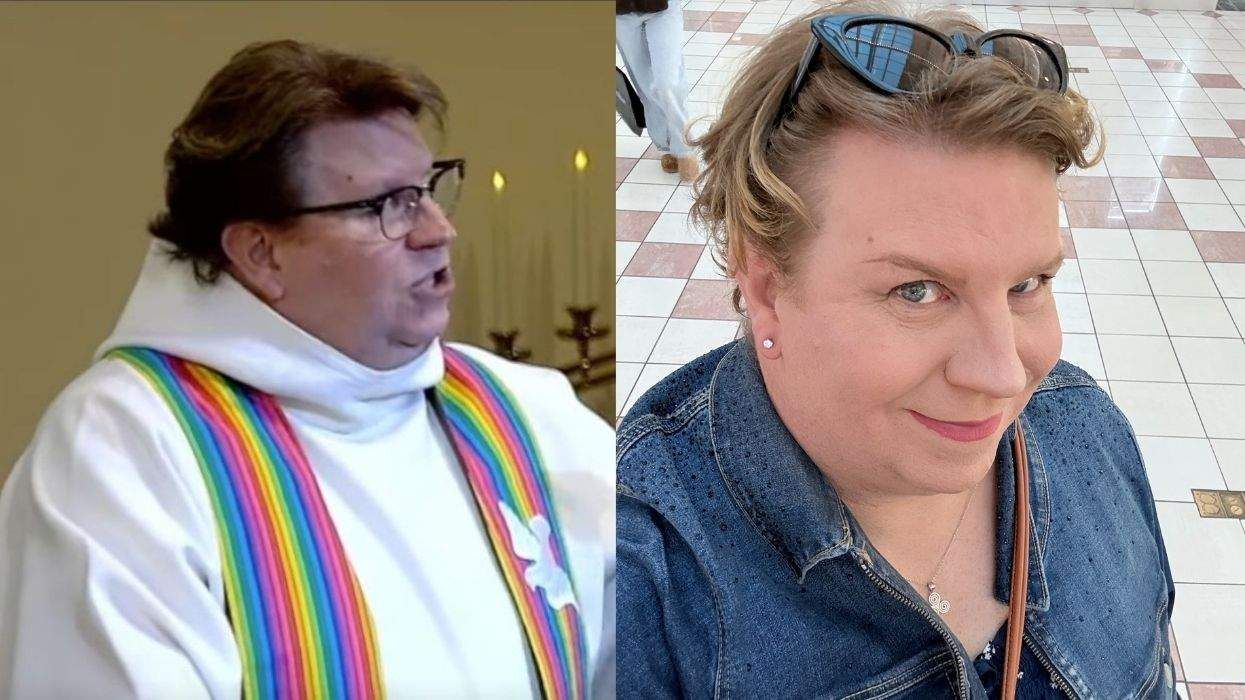

When Rev. Dr. Phillippa “Pastor Phil” Phaneuf stood before her New York congregation at North Chili United Methodist Church outside Rochester on the Sunday before the first Advent and came out as transgender, she believed she was making an announcement primarily for the people she had pastored for six years.
She expected the news might ripple through the congregation, perhaps the district. She did not expect it to reach the national spotlight.
Keep up with the latest in LGBTQ+ news and politics. Sign up for The Advocate’s email newsletter.
“I thought maybe something in the North Chili News,” she told The Advocate in an interview on Wednesday. “This is not what I was expecting to happen.”
Meanwhile, the 12-minute video clip of her announcement—“I’m not becoming a woman but giving up pretending to be a man”—had circulated widely online, drawing attention from faith communities, LGBTQ+ advocates, conservative media, and denominations across the country.
Related: Upstate New York Methodist minister comes out as transgender to congregation during Sunday service
Across the sanctuary that Sunday, congregants’ cheers and words of encouragement rose as Phaneuf spoke. In the days afterward, she said, the affirming messages “far exceed the other kinds of comments that are out there.” She noted that many who reached out shared that they, too, were LGBTQ+ or allies—some writing lengthy emails describing their relief at seeing a transgender pastor speak with such clarity and grace.
Phaneuf told The Advocate that her announcement was not part of her sermon; instead, it was the last thing she shared during the service announcements that day.
“I’m surrounded by loving kindness,” she said. “The affirmations have been amazing.”
Support from church leadership
Phaneuf said that some congregants told her they were moved to tears during the announcement, and others said the explanation — especially the side-by-side lists of “what changes” and “what stays the same” — grounded them in a moment that could have otherwise felt overwhelming. “I think there were definitely some people who were moved by the presentation and found that to be very helpful,” she said.
Still, she is clear-eyed that not everyone processes change at the same pace. Some, she said, may need more time, not because they reject her, but because deep transitions, even when welcomed, unfold unevenly inside any faith community. Phaneuf said she is holding space for those congregants with patience, just as she would accompany people through grief, reconciliation, or any other significant turning point.“There are some people you’re still holding out hope for,” she said. “When you do it in this sort of way, there’s not a lot of angst or anger that you have to then work through when it comes time for reconciliation.”
The Upper New York Conference issued a statement of support on Wednesday. Bishop Héctor A. Burgos-Núñez affirmed Phaneuf’s ministry, calling her announcement “a significant step in her journey of authenticity and faith.”
“I give thanks for Rev. Dr. Phil Phaneuf’s courage and honesty in embracing the fullness of who God created her to be,” the bishop said, adding that she “continues to enrich our connection.”
His statement also emphasized what made this moment possible: a sweeping transformation inside the United Methodist Church. At its 2024 General Conference, the UMC removed its prohibitions on LGBTQ+ clergy, lifted bans on same-sex marriages, and struck language declaring homosexuality “incompatible with Christian teaching.” The denomination now affirms that all people, regardless of “sexual orientation or gender identity,” are of “sacred worth.”
The conference has also created an LGBTQ+ Inclusion Team to support queer clergy and help congregations strengthen their own inclusion practices.
For Phaneuf, these shifts were not abstract. They grounded her decision.
“Knowing that my denomination updated our language to be more inclusive was absolutely reassuring,” she said. “The support I’ve received within the denomination has been phenomenal.”
A journey toward joy
Phaneuf, who began hormone replacement therapy three months before the announcement, told The Advocate that she felt an almost immediate emotional shift.
“Within that first week, it was like night and day in terms of happiness,” she said. “I could feel joy in a way I hadn’t in a very long time.” Last week, at 51, she got her ears pierced and experienced trans joy once more.
Her 12-year-old daughter, whom she describes as a “fierce ally,” is her strongest source of support. But her parents’ reaction has been the opposite. After coming out to them by phone two days before the Sunday announcement, she sensed the conversation might require time to process, and she held on to a cautious hope that space and time might soften their stance. That hope evaporated on Sunday morning when her phone lit up with the message they sent just before she walked into the sanctuary.
In the interview, she said the timing felt intentional, arriving at a moment when she was preparing to preach and least able to absorb emotional upheaval. “They knew quite well not to mess with the pastor on Sunday morning right before the pastor preaches,” she said.
Related: Why is the United Methodist Church meeting over LGBTQ+ rights?
Their message instructed her to “tell people, make sure that the people know where we stand on this.” She read it as a statement less about their relationship with her and more about how others would perceive them as news of her transition spread. “They were more concerned then about how they were being perceived by people rather than how I was perceiving them,” she said. “Or where our relationship was.”
Phaneuf included their rejection in her announcement, not to shame them, she said, but because they had asked her to make their position known. At the time, she believed that communication would reach only her own congregation, not a national audience. As attention intensified and comments began appearing online, she decided to block them.
“I’m not in a spot, nor do I want to be in a spot where I have to debate my existence,” she said, adding that she would only take that step if she believed there was no realistic possibility that they might change their minds.
The rest of her family, she said, responded with compassion. Siblings, nieces, and nephews reached out with affirmations. Surrogate parental figures in the congregation, many near her parents’ age, filled the emotional gap.
“Friends are the ones giving you the support and the affirmation,” she said. “And so then any kind of strangers’ hate comments pale in comparison. It just doesn’t match up.”
A safe place to worship
Phaneuf said she was deliberate about every detail of how she disclosed her transition on November 23. The tone and the pacing of her voice, the visual clarity of her slides, all of it was rooted in the same pastoral instinct that guides the sermons she crafts each week. She approached the announcement as she would a homily: beginning with what she calls “the good news,” then gently naming “the human condition,” which in this case was not sin or sorrow but the congregation’s understandable fear of the unknown.
“I thought about what people would need to feel grounded,” she explained. “Most of what keeps us together is in the ‘stays the same’ column. What changes is my appearance.”
She knew that her congregation was already an affirming one — a place where people show up for one another in practical, unglamorous ways. Still, she wanted her announcement to land with steadiness rather than shock. That meant careful preparation: meeting with leadership before Sunday, ensuring her daughter felt supported, and crafting a clear visual presentation so that congregants could absorb the information without confusion.
Related: Inside the fight against Trump in red states: It 'isn't just about Pride. It's about power'
The pastor hoped that clarity would also help those tuning in online — the extended community who watch services digitally each week. “Some people only know me through the livestream,” she said. “I wanted to make sure they weren’t blindsided the next Sunday when I appeared as myself.”
Her deeper hope, though, reaches beyond her own congregation.
As the congregation looks toward the second Sunday after her announcement, Phaneuf said she hopes the service will offer what she called “gentle wake-up calls” — the kind that appear throughout the Advent scriptures. She plans to preach from a passage in which an angel appears to announce a pregnancy. Angels, she noted, nearly always begin with the same words: “Don’t be afraid.”
That theme of reassurance will guide the message she intends to offer this weekend. She described it as an invitation to “prepare room” — to wake up to compassion, to empathy, to joy, and to the possibility of seeing one another anew. “There are so many different ways that people wake other people up,” she said, adding that God often chooses gentleness rather than shock. She wants the congregation to reflect on where those wake-up calls might be emerging in their own lives as the season moves toward Christmas.
“If someone can see even a glimpse of themselves in me,” she said, “maybe they’ll feel there’s a place for them too. That’s what church is supposed to be.”
The next chapter
The Human Rights Campaign, the largest LGBTQ+ civil rights organization, praised Phaneuf’s courage and the congregation’s response.
In a statement to The Advocate, HRC national press secretary Brandon Wolf said, “Being our authentic selves takes vulnerability, tenacity, and courage. Reverend Phaneuf’s coming out and the support she has received is a testament to the power of stepping into our truth and sharing our stories, and a reminder that LGBTQ+ people are in every community and part of the fabric of every piece of society. Thank you to the reverend for inviting us to be a part of her journey and for changing the world from the pulpit.”
As national attention continues to grow, Phaneuf says she remains grounded in the calling that brought her into ministry.
“My greatest hope,” she said, “is that we can create an even safer space for people to know they belong. That’s what life is all about.”
She paused, as if returning to the moment in the sanctuary when she first stepped into the fullness of her identity, surrounded by people cheering her on.
“God loves us beyond all measure, exactly the way we are,” she said. “That’s the good news.”