'%3E%3Cpath d='M16.3574 35.6519H12.9537L15.0491 18.8873L16.3574 35.6519ZM30.4229 54.0093L22.309 0.994385H7.91795L0 54.0093H10.6634L11.5802 46.3855H17.4014L17.9914 54.0093H30.4229Z' fill='%23971B20'/%3E%3Cpath d='M48.2073 41.8813C48.2073 43.4049 47.4892 44.0011 46.1144 44.0011H43.7595V11.0687H46.1144C47.4892 11.0687 48.2073 11.6636 48.2073 13.1885V41.8813ZM59.5273 43.6695V11.3326C59.5273 3.71323 53.5729 0.994385 47.8157 0.994385H31.7213V54.0093H47.8157C53.5729 54.0093 59.5273 51.29 59.5273 43.6695Z' fill='%23971B20'/%3E%3Cpath d='M90.183 0.994385H78.6039L75.0711 30.6157L71.9955 0.994385H59.4346L69.2474 54.0093H80.373L90.183 0.994385Z' fill='%23971B20'/%3E%3Cpath d='M107.063 42.3448C107.063 43.7359 105.951 44.5974 104.643 44.5974C103.269 44.5974 102.157 43.7359 102.157 42.3448V12.658C102.157 11.2676 103.269 10.4058 104.643 10.4058C105.951 10.4058 107.063 11.2676 107.063 12.658V42.3448ZM119.233 43.2723V11.7312C119.233 6.36384 112.952 -3.8147e-06 104.643 -3.8147e-06C96.2667 -3.8147e-06 89.9867 6.36384 89.9867 11.7312V43.2723C89.9867 48.6393 96.2667 55 104.643 55C112.952 55 119.233 48.6393 119.233 43.2723Z' fill='%23971B20'/%3E%3Cpath d='M150.976 43.9349V33.7309H139.069V42.3448C139.069 43.7359 137.957 44.5974 136.582 44.5974C135.076 44.5974 133.964 43.7359 133.964 42.3448V12.658C133.964 11.2676 135.076 10.4058 136.582 10.4058C137.957 10.4058 139.069 11.2676 139.069 12.658V21.2723H150.976V11.0687C150.976 5.70107 145.283 -3.8147e-06 136.582 -3.8147e-06C127.75 -3.8147e-06 121.796 5.70107 121.796 11.0687V43.9349C121.796 49.3022 127.75 55 136.582 55C145.283 55 150.976 49.3022 150.976 43.9349Z' fill='%23971B20'/%3E%3Cpath d='M167.478 35.6519H164.076L166.17 18.8873L167.478 35.6519ZM181.544 54.0093L173.432 0.994385H159.037L151.123 54.0093H161.785L162.704 46.3855H168.523L169.114 54.0093H181.544Z' fill='%23971B20'/%3E%3Cpath d='M205.412 10.4058V0.994385H177.081V10.4058H185.392V54.0093H197.428V10.4058H205.412Z' fill='%23971B20'/%3E%3Cpath d='M230.002 54.0093V43.9349H218.914V31.8746H226.635V21.8028H218.914V10.4058H230.002V0.994385H206.875V54.0093H230.002Z' fill='%23971B20'/%3E%3C/g%3E%3Cdefs%3E%3CclipPath id='clip0_260_7080'%3E%3Crect width='230' height='55' fill='white'/%3E%3C/clipPath%3E%3C/defs%3E%3C/svg%3E)
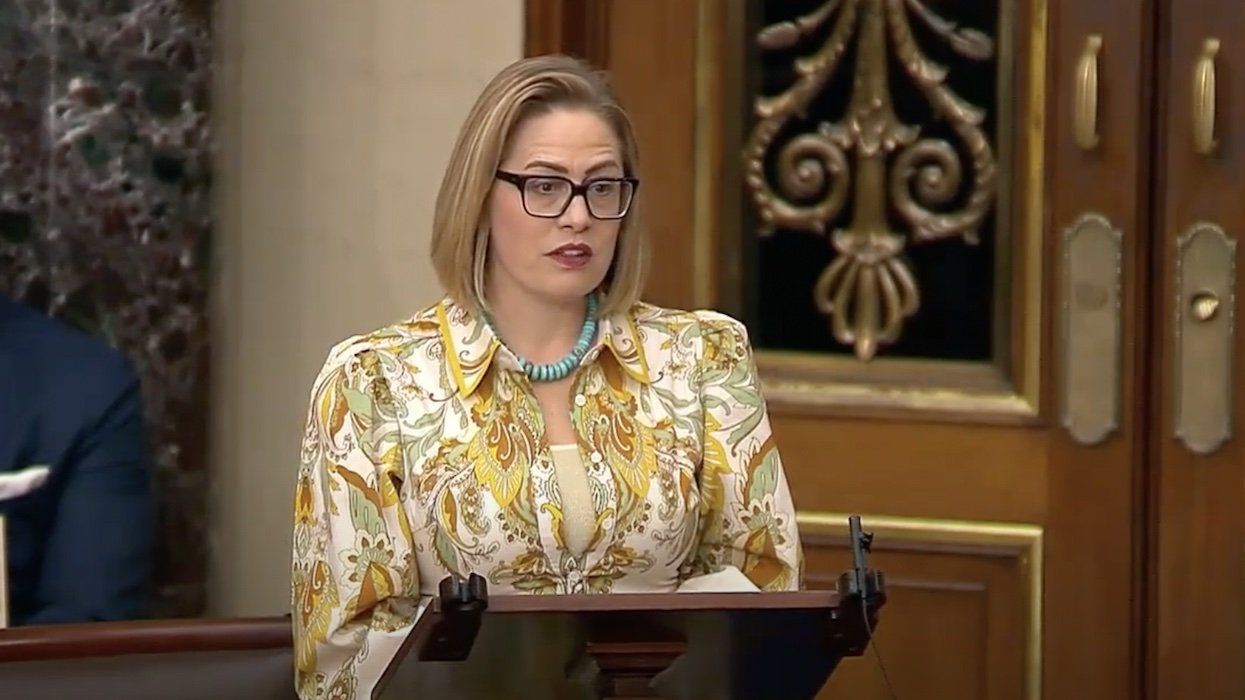

Former U.S. Sen. Kyrsten Sinema is now spending her time promoting psychedelic drugs and artificial intelligence — and touting her closeness with the Trump administration.
Sinema, of Arizona, remains the first out bisexual person ever elected to Congress. She was an Arizona state legislator and then a member of the U.S. House of Representatives before being elected to the Senate in 2018. A Democrat turned independent, she did not seek reelection after her first term, in which she disappointed many progressives with her embrace of some conservative positions and her defense of the filibuster. It’s a rule by which it takes 60 votes to end debate on a bill and move to a vote on the bill itself, and it stalled some liberal legislation.
Related: Eight times Kyrsten Sinema let us down
Related: How Bisexual Sen. Kyrsten Sinema Is Endangering LGBTQ+ Rights
Sinema has joined the law and lobbying firm Hogan Lovells as a senior adviser. She is doing pro bono work to push for research on the psychedelic drug ibogaine, with hopes of eventually having it approved by the Food and Drug Administration to treat mental health disorders.
Embracing RFK Jr.’s “Make America Healthy Again”
“We are in this magical, unique time,” Sinema has said of the current Department of Health and Human Services, led by Secretary Robert F. Kennedy Jr. He is controversial for his opposition to many traditional medical interventions, including vaccines. But Sinema said his “Make America Healthy Again” agenda is “amazing,” and he’s also a supporter of psychedelic drugs as a mental health treatment, so she sees an opportunity to get ibogaine approved. She spoked at a recent conference of Americans for Ibogaine and gave an interview to Politico there.
Donald Trump has filled his second administration with “disruptors,” she told Politico. “Robert Kennedy is a disruptor and he supports psychedelic medicine. The possibility is ripe in this administration, and we should strike while the iron is hot,” she said.
She’s “close” to Kennedy and has spoken to him, she said, but she declined to reveal the content of their conversations. Veterans Affairs Secretary Doug Collins has come to support psychedelics as well after hearing about them from Sinema, she added. Collins is a conservative, but both conservatives and “full-on hippies” are interested in psychedelics, she said.
Americans for Ibogaine was cofounded by Republican Rick Perry, a former Texas governor who was secretary of Energy in the first Trump administration. Current Texas Gov. Greg Abbott, also a Republican, has signed a bill into law allocating $50 million for ibogaine research, and Democratic Gov. Katie Hobbs of Arizona has included $5 million for this research in the state budget.
Sinema tried ibogaine in Mexico and didn’t enjoy it, she told Politico. “My experience was 15 hours long,” she said. “That’s a long time. There was a noise in my head for the entire 15 hours that sounded like a little machine clunking around.” But she believes in it and will do it again, she said. Her grandmother was recently diagnosed with dementia, and Sinema fears having memory issues herself. “I have a very sharp memory, but my number one fear in life is losing it,” she said. “My mind is my favorite thing about me. It’s what makes me who I am. I would like to keep it.” Right now her mind is “snappy,” she noted.
Pushing an AI data center in Arizona
Sinema and former U.S. Rep. Garret Graves of Louisiana, a Republican, are founders of the AI Infrastructure Coalition, which is supported by Hogan Lovells and major tech and energy companies such as Microsoft, Meta, ExxonMobil, and Pinnacle West. The latter owns Arizona’s largest utility.
In an October meeting of the Planning and Zoning Commission in Chandler, a suburb of Phoenix, Sinema urged the rezoning of a parcel of land so New York-based developer Active Infrastructure’s can build an AI data center. She warned that the federal government may intervene if the city doesn’t go along. “Chandler right now has the opportunity to determine how and when these new, innovative AI data centers will be built,” she said, according to the Deseret News. “When federal preemption comes, we’ll no longer have that privilege. It will just occur.” She also said her coalition is “working hand in glove with the Trump administration to ensure American AI dominance.”
Some area leaders objected to her comments. “As a local official, we never appreciate when a county, a state or a federal official attempts to insert their authority into our local process,” Chandler City Council member O.D. Harris told Politico. “We represent what the voters want because we’re closest to the people.” The City Council will consider the zoning change December 11.
It's uncertain if the federal government actually could supersede local regulations on data centers, Politico reports. Trump has been considering an executive order that would challenge state laws on AI, but that’s on hold now, according to Reuters. And whether the City Council will approve the change will likely depend on how many jobs members think the center will generate.
Earlier, she had told CNN’s Jake Tapper that the Trump administration’s AI plan “is well-reasoned, it is well-thought, it is ambitious. It really strikes a path for us to win the AI race against China, which I think is of national security importance but also kind of an existential threat that we face as a country.” She and Graves further touted their coalition and their “hand in glove” relationship with the administration in a Friday appearance on Fox Business.
- YouTube youtu.be
Sinema is also founder of the Spark Center at Arizona State University, “a partnership with AI product ChatGPT aimed at supporting neurodivergent individuals though technological solutions,” as the Deseret News puts it. She donated $3 million from her campaign account to the Spark Center.
Still spending campaign funds
In addition to the $3 million for the Spark Center, Sinema has been using her campaign funds on security, travel, hotels, restaurants, and makeup services, the New York Post reported in October after reviewing Federal Election Commission documents. Her campaign account had $4 million at the end of 2025. This spending may not be legal, campaign finance expert Brett Kappel of Harmon Curran told the Post.
“Ex-lawmakers are permitted to donate their accounts to party committees or to charity, refund money to donors, or may give it to a political action committee that can support other office seekers,” the paper reported, adding that “with the FEC hobbled by a lack of commissioners and unable to meet, Sinema has escaped any possible consequences.” She did not respond to the Post’s request for comment.
Her spending had already come under scrutiny. Late last year, a watchdog group called Citizens for Responsibility and Ethics in Washington filed a complaint with the FEC over the expenditures Sinema had made after announcing that she wouldn’t seek reelection.