Sharon Bottoms
Bottoms v. Bottoms
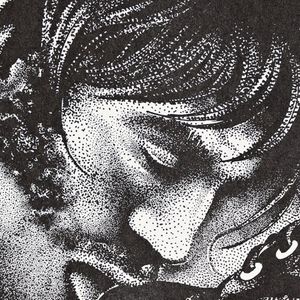
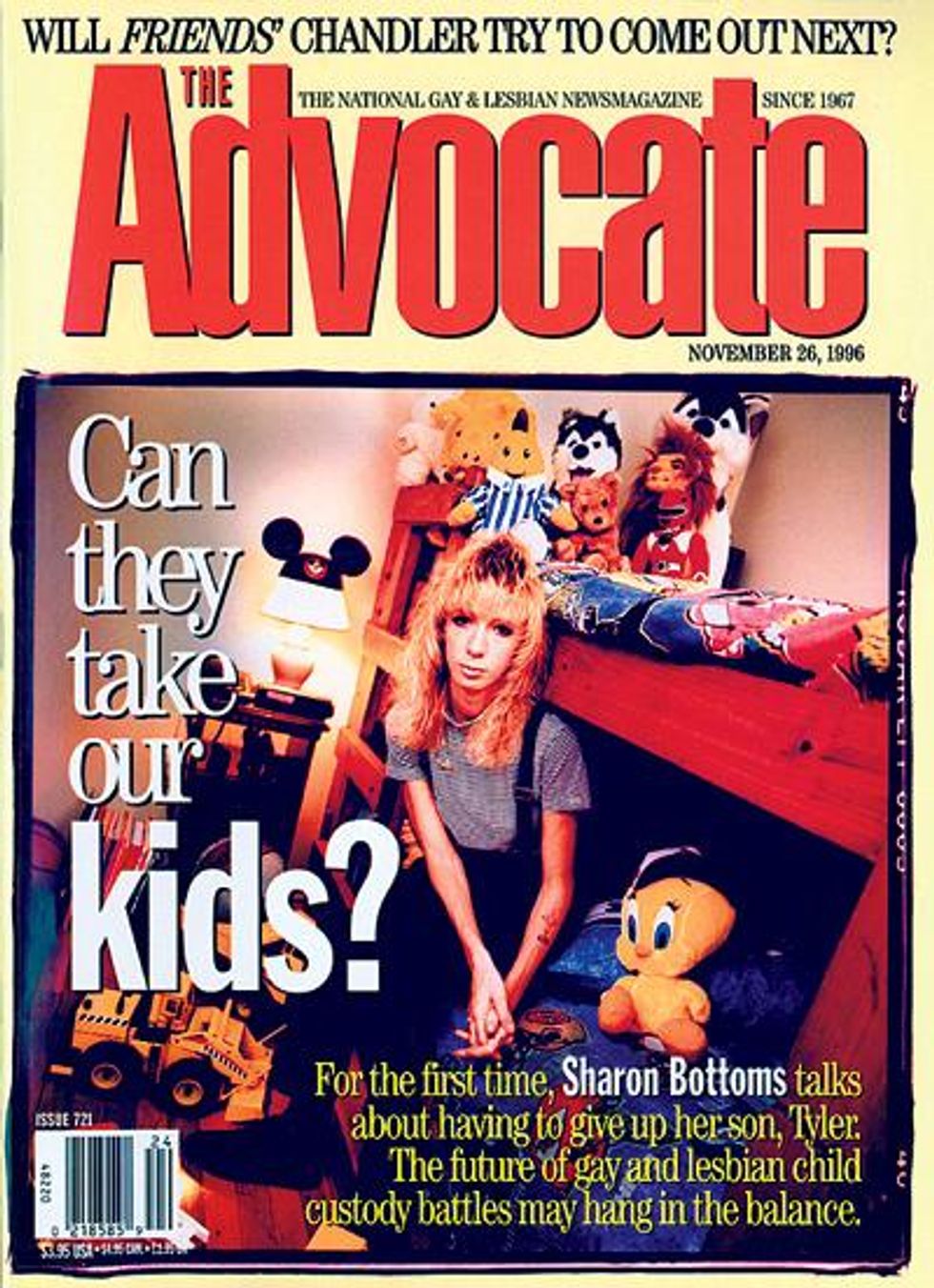
The landmark 1993 ruling by a Virginia judge that denied a lesbian custody of her biological son because her sexual orientation made her "unfit" as a parent focused national media attention on same-sex-headed families. The court battle was a crucial early test of legal equality and gay parents' rights. In Bottoms v. Bottoms, custody of Tyler Doustou was awarded not to his mother, Sharon Bottoms, but to his grandmother, Kay Bottoms, who was "sickened" by the fact that her daughter was a lesbian and had had a commitment ceremony with another woman, April Wade. Numerous witnesses testified that Sharon, a grocery store cashier at the time, was a good mother; Sharon's ex-husband, Dennis Doustou, even testified on her behalf, later telling reporters that Kay was "totally wrong" to take Tyler from his mother. Sharon also testified that her mother's live-in boyfriend had molested her as a child.
Still, Judge Buford Parsons forced Sharon to explain on the witness stand what lesbians do in bed, and then Parsons ruled that Sharon was an unfit mother because she and Wade had oral sex, illegal in Virginia at the time. Sharon was given two days a week of visitation with Tyler, but he was not allowed in Sharon's home and not allowed to have any contact with Wade, with whom he had already bonded.
The ruling galvanized gay activists -- many of them lesbian moms like Sharon -- who held stroll-ins (rallies with empty baby strollers) and protests in Virginia and outside the state. While Sharon became the unexpected poster child for gay custody issues, she wasn't the first lesbian seeking custody of her child. In 1972, Camille Mitchell of San Jose, Calif., became the country's first acknowledged lesbian to win custody of her children. The victory came in divorce proceedings against her husband of 15 years. Sharon's case resonated, though, because of the ordinariness of Sharon and Wade, two working-class women who wanted the American dream more than they sought headlines and activist mantles.
A year later an appeals court ruled in Sharon's favor, overturning Parsons's verdict. Sadly, in 1995, the Virginia Supreme Court took on the case, ruling in favor of the grandmother, citing that Sharon and Wade's relationship involved "fondling" and "oral sex" and concluding that "the record shows a mother who, although devoted to her son, refuses to subordinate her own desires and priorities to the child's welfare." The court also ruled that "living daily under conditions stemming from active lesbianism practiced in the home may impose a burden upon a child by reason of the 'social condemnation' attached to such an arrangement, which will inevitably afflict the child's relationships with its 'peers and with the community at large.'"
Media attention around the case, though, helped move courts and advocates on lesbian custody issues. Bottoms's story because a TV movie, Two Moms for Zachary, and though she never regained custody of her son (she was granted very limited visitation), there was significant movement on custody issues following the case. In 1970, in only 1% of contested cases involving the children of a lesbian and a straight husband was custody awarded to the gay parent.
 Michael Hardwick Bowers v. Hardwick
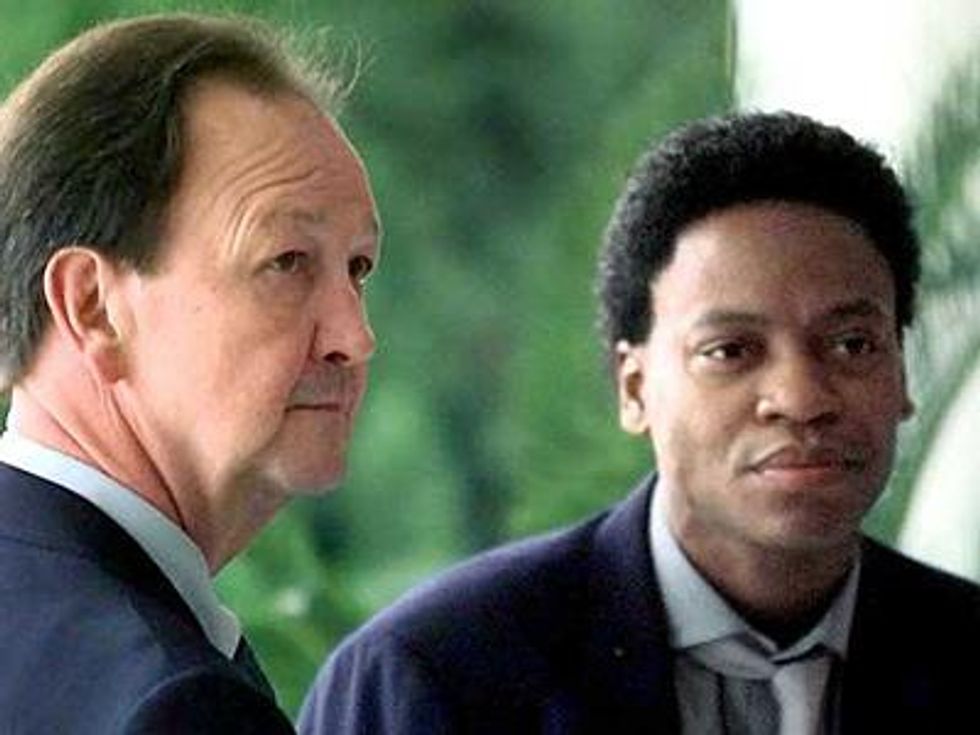
 John Geddes Lawrence and Tyron Garner (pictured at left)
Lawrence v. Texas
In 1990, Michael Hardwick told The Advocate, "When people hear my name they think of a radical cocksucker. People don't know anything else about me." Indeed, Hardwick was known until his death in 1991 as the man at the center of one of the biggest antigay legal cases in U.S. history: Bowers v. Hardwick, the 1986 Supreme Court decision that said the Georgia sodomy law criminalizing anal and oral sex between people of the same gender was indeed constitutional. Justice Byron White said the constitution did not give citizens "a fundamental right to engage in homosexual sodomy."
The case was set in motion in 1982 when Hardwick, then working at a gay bar in Atlanta, was arrested for "drinking in public," essentially for walking out of the club with a bottle of beer and tossing it in the garbage. After he missed a court date but paid the fine, police came to his home with an invalid warrant and ended up finding him having oral sex with another man. He was arrested for a felony that could then put him away for 20 years. "They kept moving me from cell to cell and announcing that I was in for cock sucking," Hardwick told us in 1990. "I was already in shock and was having to physically defend myself from these prison brutes. I was like an animal -- just thinking about survival."
After the local district attorney dropped the case, lawyers from the American Civil Liberties Union and elsewhere called Hardwick and told him they wanted to make his a test case, to overturn a law most thought violated privacy rights. Harnessing his anger, Hardwick recalled, "I knew then I couldn't walk away." Indeed, Bowers v. Hardwick ended up being fought (and appealed) all the way to the U.S. Supreme Court, which ruled in a 5-4 decision that oral and anal sex between consenting adults in the privacy of their own homes could be criminalized. The dissenting opinion from Justice Harry Blackmun was written by his law clerk, out lesbian Pamela Karlan, who is now a Stanford Law School professor and codirector of the school's Supreme Court Litigation Clinic. Blackmun told historian Harold Koh in 1995, "I owe a lot to her and her ability in getting that dissent out. She felt very strongly about it, and I think is correct in her approach to it. I think the dissent is correct."
It wasn't until 2003's Supreme Court ruling in Lawrence v. Texas, a decision that reversed Bowers v. Hardwick, that state sodomy laws were deemed unconstitutional. Justice Anthony Kennedy wrote in the majority opinion that "Bowers was not correct when it was decided, is not correct today, and is hereby overruled."
Of course, the story of how Lawrence came to be is apocryphal, according to Dale Carpenter, author of Flagrant Conduct: The Story of Lawrence v. Texas. The lore is that someone called the police on September 17, 1998, complaining that a black man with a gun was going crazy at a Houston apartment. Police entered the apartment and found John Geddes Lawrence and Tyron Garner having sex and arrested them both for "deviate sexual intercourse, namely anal sex, with a member of the same sex (man)." When the Supreme Court finally ruled in the men's favor, it did so based on the men's right to express intimate conduct as a necessary part of a relationship (according to The New Yorker, the opinion used the word "relationship" 11 times).
The problem, says Carpenter, is that there never was a relationship -- or sex -- between Lawrence and Garner, the latter of whom was 24 years younger than Lawrence. The two men had been drinking in Lawrence's home that evening with two other men, one of whom was Garner's boyfriend. The boyfriend thought Garner and Lawrence were flirting, left the party, and called police to falsely report a crazy black man with a gun; Garner is African-American. Carpenter says the police who were on scene that night never agreed on what they saw: One said he witnessed anal sex, another claimed to view oral sex, and two said they didn't see any sex. Regardless of what happened that night in Houston, civil rights lawyers trumpeted the men's case as adding much-needed legitimacy to same-sex relationships. Lawrence and Garner, though, mostly stayed out of the public eye until the final verdict came down and the nation's centuries-old sodomy laws were finally overturned.
 Scott ThorsonThorson v. Liberace
He was only 16 when he met Wladziu Valentino Liberace, but Scott Thorson soon became the famously flamboyant musician's (paid) romantic companion. Liberace reportedly showered Thorson with gifts, and the younger man had extensive plastic surgery (chin implant, raising of his cheekbones, and rhinoplasty) to look more like Liberace -- at the latter's request. When the two broke up in 1982, Thorson filed a $113 million palimony suit against the singer, alleging that Liberace hadn't lived up to his promises to take care of him; allegedly Liberace had promised to adopt Thorson so he'd be the musician's legal heir. Four years later the two men settled on a paltry $95,000 payment, and Thorson got to keep the two family dogs and two cars.
The two men reunited shortly before Liberace's 1987 death from AIDS complications, and Thorson later wrote a book about their relationship, which is being made into a Steven Soderbergh movie starring Matt Damon as Thorson and Michael Douglas as Liberace. He also told reporters that their relationship ended because of his drug use and Liberace's philandering.
Thorson was a magnet for trouble and continued to make headlines. In 1990 he testified against mobster Eddie Nash (accused of masterminding the infamous 1981 Wonderland murders in Los Angeles) and was placed in witness protection. He was shot five times the day after he left the program. In 2008 he went to prison on drug and burglary charges. After getting out of the slammer earlier this year, Thorson, who reportedly has lived with a woman for over a decade now, told reporters that he slept with Michael Jackson as well but refused to leave Liberace for him. Most media observers dismissed the story as more fantasy than reality.
 Karen Thompson and Sharon KowalskiGuardianship of Kowalski
By 1983, Karen Thompson and Sharon Kowalski had been together for four years, had been united in a private commitment ceremony, and worked together at the St. Cloud State University in Minnesota. The one thing they hadn't done, though, is come out to their families.
"We didn't understand that as long as we were invisible we were vulnerable," Thompson says.
That year Kowalski sustained serious injuries a drunk driver hit the car she was driving. She fell into a coma, later waking but with an irreversible brain injury that disabled her dramatically. Thompson, a teacher, had to tell Kowalski's parents that the two women were partners; she was met with disbelief and anger. Kowalski's father, Donald, gained legal custody of Kowalski, moving her into a nursing home 200 miles away from her home with Thompson, and barring Thompson from visiting his daughter.
A decade-long battle began for the guardianship of Sharon Kowalski became a landmark case of relevance to same-sex couples, especially during the height of the AIDS crisis, when gay men in particular were increasingly concerned about their right to visit with and care for their dying partners.
Thompson wrote about the exhaustive tribulations in her book Why Can't Sharon Kowalski Come Home? while The Sharon Kowalski Case by Casey Charles used the case to talk about the rights of same-sex partners within social, political, and historical contexts.
For Thompson, the case pushed her out of the closet and into a national spotlight over the issue of self-determination for LGBT individuals. She went around the country speaking at LGBT Pride events, at schools, and to gay groups -- both to raise money for the legal battle (which reportedly cost hundreds of thousands of dollars) and to encourage same-sex couples sign to durable power of attorney forms, which allowed partners to name each other as guardians if one is incapacitated.
Perhaps most important, the Thompson-Kowalski case made same-sex couples aware that they could protect themselves only by giving their chosen families legal status. After the accident, Kowalski learned to communicate by typing out messages; she repeatedly told everyone she wanted to live with Thompson, but the courts determined she was too disabled to make that decision, which led disability rights activists to rally behind the women.
Five years after the accident, in 1988, the courts decided to address Kowalski's wishes. Beginning the following year, Thompson was allowed to see her partner twice a month. In 1991, Thompson finally won the right to "bring Sharon home" (as was a protest motto those days) after the Minnesota Court of Appeals ruled in Guardianship of Kowalski that Thompson could be Kowalski's legal guardian.
The long court battle affected both women greatly. Kowalski's health worsened during those neglected early years without physical or occupational therapy; she requires a wheelchair and communicates using a speech pack. She has short-term memory loss to the extent that when she meets new people she can't remember who they are. But her recovery accelerated after she returned home and in the years since she has become as much an advocate as Thompson. The two jointly won an award from the National Organization for Women.
The two women continue to live together, along with another woman, in what Thompson calls her "family of affinity," and they all continue to speak out about LGBT and disability rights. Their story has been documented in the film Lifetime Commitment: A Portrait of Karen Thompson.
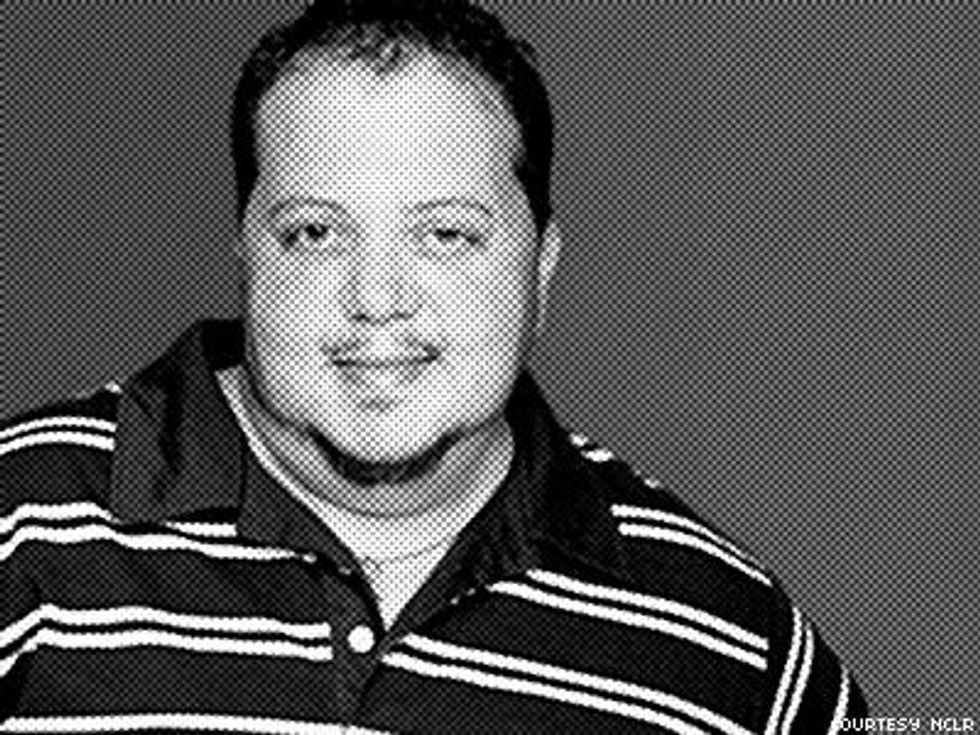
Michael KantarasKantaras v. KantarasWhen Michael Kantaras, a transgender man, and his wife, Linda Forsythe, split up in 1998, a long custody battle ensued over their marriage and their children: Matthew (Forsythe's child from a previous marriage, whom Kantaras had adopted) and Irina (whom the couple had together using alternative insemination). The ex-wife argued that their marriage was invalid because Kantaras had been born female, but the initial trial judge ruled in favor of Kantaras, who had already come out as trans, had top surgery, and begun hormone therapy two years before he even met his wife.
Much of Forsythe's argument -- and the media's inflammatory speculation -- centered on whether or not Kantaras had had bottom surgery and if not, whether a man can be a man without a penis.
In 2003, Pinellas County, Fla., judge Gerard O'Brien ruled that Michael was a man, therefore had been legally married to Forsythe and the children's legal father, and awarded him custody. "Chromosomes are only one factor in the determination of sex, and they do not overrule gender or self identity, which is the true test or identifying mark of sex," O'Brien wrote in his ruling. "Michael has always, for a lifetime, had a self-identity of a male."
Sadly, the Florida Supreme Court reversed the ruling in a unanimous 2004 verdict, ruling that Kantaras was still a woman, so the marriage was null and void because same-sex marriages were illegal in the state. It not only robbed Kantaras of his children (the voided marriage put his custody claims in jeopardy) and his personhood, but it also set a precedent in Florida that no marriages between people of the same birth gender were legal.
The custody case went back to trial court and the whole fiasco dragged on as Kantaras's two children became teenagers. Then an unlikely hero intervened: Dr. Phil McGraw. In 2005 the Oprah acolyte brought Kantaras and Forsythe on the Dr. Phil show, where he convinced the couple to go through two and a half days of intense mediation to reach a custody agreement. Kantaras's lawyer, Karen Doering of the National Center for Lesbian Rights, supported him through the long battle and told the Tampa Bay Times at the time of the show's taping, "We're optimistic that we're going to be able to work something out. It never would have happened without the Dr. Phil show."
The couple soon agreed on a shared custody arrangement, which allowed them both to have time with the children and share decision-making regarding the kids' lives. The legal implications of the case are still debated, though Doering told reporters that she'd take "a happy family over a precedent any day." Officials with the right-wing Liberty Counsel, however, called it a victory for their side. Liberty Counsel president Mathew Staver told Court TV, "The trial court established a precedent in which gender was ruled a product of one's mind that could change through a medical procedure. But when it was reversed, it was established that being a male or a female is still a matter of law for the legislature to decide."
"I am very happy and pleased to say that both children are doing great!" says Kantaras now. "We continue to have a very close and loving relationship. I am also very excited to say that I am able to see both Matthew and Irina pursuing their goals and what amazing young adults they both are. Matt will be heading to Fort Benning in September, he will be serving in our U.S. Army! Irina is starting her junior year at a university in Florida, in the honors program, studying psychology. Yes! I am extremely proud and very blessed! As for myself, I have decided to begin publicly speaking to help change things in the courts. My family is amazing! I believe that other transgender parents should have the chance to be a part and raise awesome children ... just like mine!"
 Norma McCorvey Roe v. Wade
One of the most famous cases involving a lesbian has little to do with sexual orientation -- but it effected a sea change in women's rights for a lifetime. Norma McCorvey was a part-Cajun high school dropout who grew up a Jehovah's Witness in Louisiana and Texas. She dropped out of high school at 14, married at 16, and divorced her abusive husband soon after. Pregnant, she resumed living with her mother in Dallas, and she eventually gave birth to a daughter. McCorvey's mother, however, kicked her out and took custody of the daughter away after McCorvey confessed that she was attracted to women. Her occasional relationships with men led to a second pregnancy at 19, and she gave the child up for adoption. In 1969, when she was 21, she became pregnant again and tried to obtain an abortion in Texas first by claiming rape, which failed because there were no police reports. Later she attempted to visit an illegal clinic, but also failed because the clinic had been shut down recently by police.
She hired an attorney and sued for the right to an abortion, and her case became known as the landmark Roe v. Wade, the U.S. Supreme Court case that broke new ground regarding women's reproductive rights. After the Supreme Court handed down its decision January 22, 1973, it ruled all anti-abortion laws unconstitutional, thus nullifying them in every state. After the ruling, McCorvey told the Baptist Press, a news service, that she was the "Jane Roe" of Roe v. Wade, saying she initiated the case, she had no job, a 10th-grade education, and no money to travel to a jurisdiction where abortions were legal. "I felt there was no one in the world who could help me," she said.
In her 1994 memoir, I Am Roe, McCorvey discussed being a lesbian, and after the book's publication she talked to dozens of reporters from mainstream and LGBT media about her longtime partner, Connie Gonzales, and their life together in Texas. "We're not like other lesbians, going to bars. We're lesbians by ourselves. We're homers," she told The New York Times.
But soon after, McCorvey sang a different tune. First she converted to Christianity and became a part of the anti-abortion movement, telling reporters she was sorry about the precedent she set with Roe v. Wade. Then she was baptized as Catholic and told reporters she was also no longer a lesbian, even though she continued to live with Gonzales.
The anti-abortion movement was galvanized by McCorvey's changed tune and she became a public leader on the issue, speaking at ministries, colleges, and rallies against abortion. In 2005 she petitioned the Supreme Court to overturn Roe v. Wade, but the court refused to take the case.
In 2006, however, The Washington Times reported that she was caring for her "longtime friend Connie Gonzales" who had suffered a stroke, and destitute because she could no longer travel for speaking engagements (her main source of income for many years). But by 2009 she was back on the circuit, with Randall Terry's Operation Rescue and her own organization Roe No More, even getting booted by cops while protesting at a confirmation hearing for then-Supreme Court nominee Sonia Sotomayor.


 Sharon Bottoms
 Michael Hardwick
  Scott Thorson
 Karen Thompson and Sharon Kowalski
 Michael Kantaras
 Norma McCorvey