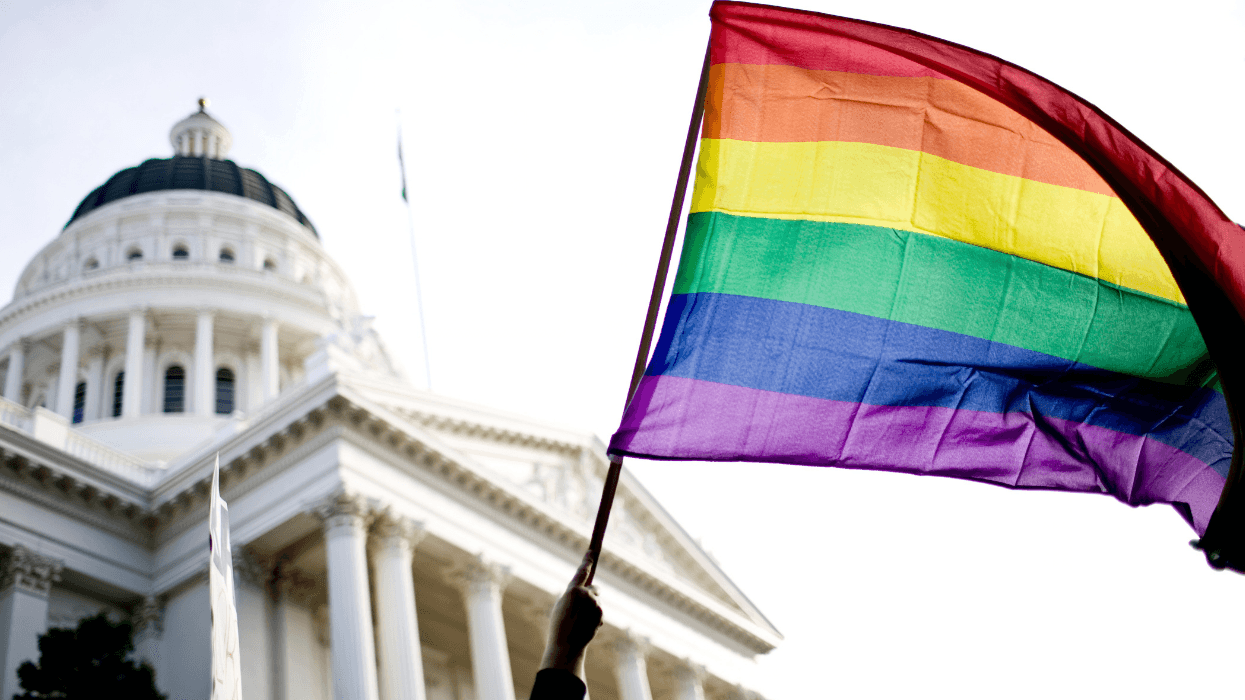
The California
assembly on Monday gutted a bill that would have required
state textbooks to include the historical contributions of
gay people, amending it to say only that school
material should not be discriminatory toward gays.
Lawmakers voted 56–2 to delete the provision at the
request of the bill's author, Sen.Sheila Kuehl, who
had feared a gubernatorial veto.
Her bill instead would prohibit any negative
portrayal of gay people in textbooks and other
instructional material, expanding current
antidiscrimination laws that apply to minorities. "I'm not
really someone who wants to plop something down on his desk
for him to veto," said Kuehl, a Democrat from Santa
Monica. "I want a signature."
She said she was upset that Schwarzenegger had
taken the unusual step of issuing an opinion about a
bill before it reached his desk. Kuehl said
Schwarzenegger chief of staff Susan Kennedy told her
privately that the governor "has been getting a lot of
heat about your bill when he goes to speak to
conservatives. He just doesn't want to sign it."
Schwarzenegger spokeswoman Margita Thompson on
Monday declined to comment on the amendments to the
bill but reiterated concerns about the measure. "The
governor will not sign a bill that micromanages curriculum
that is better left with the state board of
education," she said.
Asked for a response, Kuehl said
antidiscrimination language is a question of fairness
and equality. "Antidiscriminatory provisions in state
law have never been seen as 'micromanaging' education
decisions," she said.
Although many assembly Republicans voted for the
amendments, they remain opposed to the underlying
bill, which continues to elicit opposition from
conservative groups. "We took a terrible bill and took some
of the sting out of it," Bob Huff, a Republican from
Diamond Bar, said in an interview after the vote.
"It's still a bad bill."
Huff, a member of the assembly education
committee, said additional antidiscriminatory language
is not needed because any teacher promoting an antigay
message would be sued.
Republican assemblyman Dennis Mountjoy said the
proposed changes are "nothing more than putting
perfume on a pig."
Randy Thomasson, president of the Campaign for
Children and Families, called upon Schwarzenegger to
keep his promise to veto the bill. "SB 1437 still
requires all teachers, all textbooks, and all instructional
materials to positively portray cross-dressing, sex-change
operations, bisexuality, and homosexuality, including
homosexual 'marriages,'" Thomasson said of the amended bill.
State law prohibits textbooks from portraying
people negatively because of their race, sex, color,
creed, handicap, national origin, or ancestry. Geoff
Kors, executive director of Equality California, said gays
and lesbians should be added to the list. "Youth in
schools should be able to come to school and not feel
disparaged," Kors said.
With the amendments passed Monday, the assembly
next will vote on the full bill. If approved, it would
be sent back to the senate, which approved the bill in
its original form in May.
Assembly speaker Fabian Nunez, a Democrat from
Los Angeles who presented Kuehl's amendments, said he
expected a spirited floor debate on the bill. "We're
removing provisions of the bill that have proactive mandates
but keeping the bill intact where it relates to
antidiscrimination," he said. "Antigay literature
ought not to be presented to our children." (AP)
These comments are reproduced as written by visitors to this Web site. They have not been edited for content, grammar, or spelling. The viewpoints appearing here are those of the writer, and do not necessarily reflect the opinion or views of advocate.com, The Advocate, or its affiliates.
Be the first to comment on this story.
If you would like to submit a comment for posting, please fill out the form above.
All comments submitted via this form are subject to posting or publication. (To send a private letter to an Advocate editor or writer, please use the e-mail button at the top of the page, or use snail mail.) If you would like your comment considered for publication in The Advocate magazine, please include your full name, your city of residence, and a phone number where you can be reached during business hours so that we can confirm your identity. Your e-mail address and telephone number are strictly confidential and will not be shared or used for any purpose other than to contact you about your comment.
Comments that do not concern specific articles in The Advocate or on Advocate.com will not be posted or published. See the Contact page for sending comments for reasons other than responding to Advocate editorial and news stories.
Please note that comments sent by fax or snail mail are unlikely to be posted, although they will be considered for publication along with all letters received via e-mail or via this Web page. Comments that chiefly concern Advocate.com content will be considered for posting only on the Web site. The Advocate reserves the right to edit submitted comments for grammar, spelling, obscenities, or libel; we will, however, do our best to preserve the original comment's style and intent. Comments considered for publication in The Advocate magazine may also be edited for length.