'%3E%3Cpath d='M16.3574 35.6519H12.9537L15.0491 18.8873L16.3574 35.6519ZM30.4229 54.0093L22.309 0.994385H7.91795L0 54.0093H10.6634L11.5802 46.3855H17.4014L17.9914 54.0093H30.4229Z' fill='%23971B20'/%3E%3Cpath d='M48.2073 41.8813C48.2073 43.4049 47.4892 44.0011 46.1144 44.0011H43.7595V11.0687H46.1144C47.4892 11.0687 48.2073 11.6636 48.2073 13.1885V41.8813ZM59.5273 43.6695V11.3326C59.5273 3.71323 53.5729 0.994385 47.8157 0.994385H31.7213V54.0093H47.8157C53.5729 54.0093 59.5273 51.29 59.5273 43.6695Z' fill='%23971B20'/%3E%3Cpath d='M90.183 0.994385H78.6039L75.0711 30.6157L71.9955 0.994385H59.4346L69.2474 54.0093H80.373L90.183 0.994385Z' fill='%23971B20'/%3E%3Cpath d='M107.063 42.3448C107.063 43.7359 105.951 44.5974 104.643 44.5974C103.269 44.5974 102.157 43.7359 102.157 42.3448V12.658C102.157 11.2676 103.269 10.4058 104.643 10.4058C105.951 10.4058 107.063 11.2676 107.063 12.658V42.3448ZM119.233 43.2723V11.7312C119.233 6.36384 112.952 -3.8147e-06 104.643 -3.8147e-06C96.2667 -3.8147e-06 89.9867 6.36384 89.9867 11.7312V43.2723C89.9867 48.6393 96.2667 55 104.643 55C112.952 55 119.233 48.6393 119.233 43.2723Z' fill='%23971B20'/%3E%3Cpath d='M150.976 43.9349V33.7309H139.069V42.3448C139.069 43.7359 137.957 44.5974 136.582 44.5974C135.076 44.5974 133.964 43.7359 133.964 42.3448V12.658C133.964 11.2676 135.076 10.4058 136.582 10.4058C137.957 10.4058 139.069 11.2676 139.069 12.658V21.2723H150.976V11.0687C150.976 5.70107 145.283 -3.8147e-06 136.582 -3.8147e-06C127.75 -3.8147e-06 121.796 5.70107 121.796 11.0687V43.9349C121.796 49.3022 127.75 55 136.582 55C145.283 55 150.976 49.3022 150.976 43.9349Z' fill='%23971B20'/%3E%3Cpath d='M167.478 35.6519H164.076L166.17 18.8873L167.478 35.6519ZM181.544 54.0093L173.432 0.994385H159.037L151.123 54.0093H161.785L162.704 46.3855H168.523L169.114 54.0093H181.544Z' fill='%23971B20'/%3E%3Cpath d='M205.412 10.4058V0.994385H177.081V10.4058H185.392V54.0093H197.428V10.4058H205.412Z' fill='%23971B20'/%3E%3Cpath d='M230.002 54.0093V43.9349H218.914V31.8746H226.635V21.8028H218.914V10.4058H230.002V0.994385H206.875V54.0093H230.002Z' fill='%23971B20'/%3E%3C/g%3E%3Cdefs%3E%3CclipPath id='clip0_260_7080'%3E%3Crect width='230' height='55' fill='white'/%3E%3C/clipPath%3E%3C/defs%3E%3C/svg%3E)
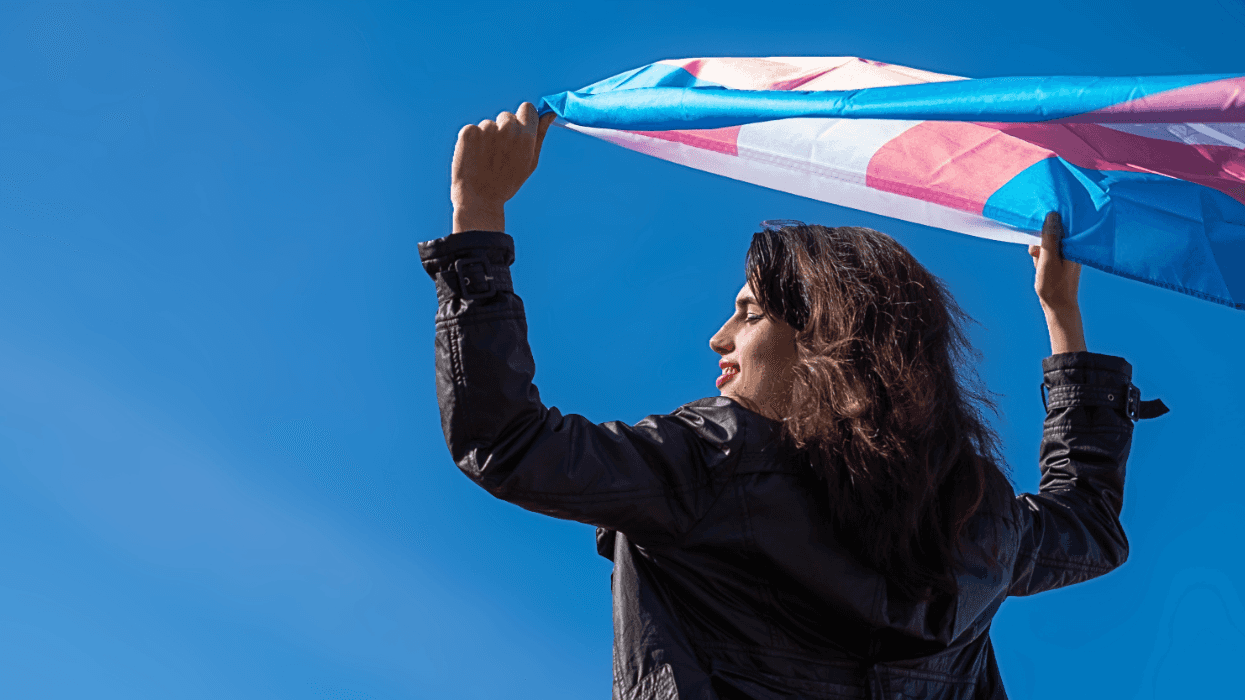

When I was growing up in Appalachia, almost nobody understood the gender spectrum. But I knew my authentic self was as real as anybody else’s. After years of fighting social constructs, I freed myself by socially and hormonally transitioning to female. The journey has taught me that science, rational thought, and one-on-one encounters with other people can break misconceptions about trans people.
Keep up with the latest in LGBTQ+ news and politics. Sign up for The Advocate's email newsletter.
Much of a given community perceives a trans person as being gay during the initial stages of transition, which can slow the path to understanding. This misperception stems from confusion between sexual orientation and gender, as well as the fact that many trans individuals often identify as gay before transition—for various reasons, including safety and fear. People tend to think of you in terms of conditioned binary categories. But after months, or even years, those around you begin to understand: you’re not gay—you’re trans. Understanding the gender binary system, along with one-on-one communication, is among the strongest strategies for dismantling misunderstanding and lack of acceptance.
Some people ask, “What exactly is the gender binary system?”
The gender binary system is a relatively new invention, arising in the 1700s. Humanity has existed for at least 100,000 years. Various examples of gender expansion persist throughout history: transgender gods as early as ancient Egypt, millennia of genderless drawings and dress, Two-Spirit Native Americans, and a continuous stream of individuals who never adhered to gender norms. Trans people have existed—both documented and undocumented, both closeted and open—since the dawn of humanity.
Early aspects of the binary model originated during European colonialism and grew under the reign of Louis XIV, an extravagantly egocentric French king who fancied himself divine. Gendered clothing was normalized under his regime. For most of the history of fabric and fashion, clothing for women and men was sewn by the same tailors and based on similar styles. The gender divide permeated the Western world as a means for wealthy elites to divide and control their populations while increasing profits through gendered consumer markets. Suddenly, if a woman and a man lived together, they needed separate versions of similar products—one for her, one for him. Advertisers, aristocrats, and monarchs reinforced the binary narrative and its marketability. Christian fundamentalists increasingly interpreted this binary model as aligned with biblical scripture.
The “new lie” of the binary began to deteriorate as scientific instruments improved, paving the way for neuroscience, genetics, and endocrinology. However, social constructs continued to influence some researchers and philosophers, and outdated arguments lingered in recycled forms.
Contemporary anti-trans arguments are often recycled and modified versions of Victorian-era rhetoric used to deny equal rights and access to “biological” cisgender women. Many of these arguments are inherently sexist, which is why many cis women recognize their flaws. Some genetic and chromosomal purists, for example, once claimed that females evolved solely for maternity and submission. These ideas were used to deny women equal pay, legal protections, and access to public spaces. These Victorian-era claims were not grounded in real science but in socially constructed beliefs that limited free thought and distorted scientific interpretation. Given enough time, truth prevails.
As early as 1919, sexologist Magnus Hirschfeld founded the Institute for Sexual Science in Berlin, Germany. The institute provided gender-affirming care, including operations and counseling, while pioneering groundbreaking research. It was successful and widely supported until it was destroyed by the Nazi regime in 1933, the year Hitler became chancellor. Authoritarian ideologies—not modernism—were responsible for its destruction. The regime falsely claimed that an international conspiracy sought to corrupt German society. In reality, authoritarian systems often exploit fear of the unknown. There was no such conspiracy. In the end, truth prevailed again. Today, Germany is considered trans-friendly.
Progress continued, albeit slowly. In the 1960s, legal reform emerged following the Compton’s Cafeteria Riot (1966) and constitutional challenges to cross-dressing bans. In 1969, trans women Marsha P. Johnson and Sylvia Rivera were central figures in the Stonewall Uprising. As more Americans met trans people personally, understanding grew. Medical organizations expanded research, support, and training related to gender diversity. By the 1980s, the term “transgender” had been introduced. Advances in neuroscience and genetics in the 1990s provided further evidence challenging the binary model. Imaging technologies like fMRI and MRI showed that sex and gender do not always align. Sex is biological; gender is psychological. One does not determine the other. Nor does genitalia solely define sex. A hormonally transitioned person with female physiology and brain chemistry—including estrogen levels and physical feminization—is not a man. Those who argue otherwise are often misinformed about the complexities of sex and gender.
Even chromosomes are not definitive determinants of sex or gender, nor are they reliable predictors of hormonal makeup. As Scientific American noted in June 2019: “Nearly everyone in middle school biology learned that if you’ve got XX chromosomes, you’re female; if you’ve got XY, you’re male. This simplification is useful for teaching basic concepts but fails to capture the true complexity of biological sex. The popular belief that sex arises solely from chromosomes is incorrect. Biological sex is a dynamic system with the potential for variation.”
As science continues to evolve, gender-nonconforming individuals will be able to align their bodies and identities even more closely. Surgical advancements, such as uterine transplants for trans women, are already on the horizon. The response from reactionary groups will likely be telling.
Significant progress has been made, although some Western governments continue to push back in subtle and covert ways. The rise of Christian nationalism, consumer-driven binary thinking, and billionaire-backed propaganda in the United States has slowed recent gains. However, as more people build personal connections with trans individuals—and as science continues to advance—anti-trans rhetoric will lose its power. The “unknown” will fade. I have witnessed this shift firsthand in my own life in southern West Virginia.
Ultimately, one-on-one conversations about what it means to be trans—especially with those closest to us—can break down deeply ingrained misunderstandings. Not everyone will come around, but many will. I often share that I am now happier and feel more fulfilled. Sometimes, the science behind being trans needs to be explained simply and clearly. I see it as my responsibility to shed light on the ignorance surrounding transphobia. Without that light, misinformation would thrive.
Instead of responding with fear or hate, we should embrace and celebrate the complexity and diversity of human biology and identity. Trans people and gender-nonconforming individuals are part of the natural beauty of humanity—too powerful and too real to ever be erased.
Attie Lee is a trans woman and candidate for the Fayette Democratic Executive Committee in Fayette County, West Virginia. She writes both fiction and nonfiction and has published more than 10 short stories. She is 31 and spends much of her time reading, writing, and connecting with others. Follow her on Facebook.
Opinion is dedicated to featuring a wide range of inspiring personal stories and impactful opinions from the LGBTQ+ community and its allies. Visit Advocate.com/submit to learn more about submission guidelines. We welcome your thoughts and feedback on any of our stories. Email us at voices@equalpride.com. Views expressed in Voices stories are those of the guest writers, columnists, and editors, and do not directly represent the views of The Advocate or our parent company, equalpride.