'%3E%3Cpath d='M16.3574 35.6519H12.9537L15.0491 18.8873L16.3574 35.6519ZM30.4229 54.0093L22.309 0.994385H7.91795L0 54.0093H10.6634L11.5802 46.3855H17.4014L17.9914 54.0093H30.4229Z' fill='%23971B20'/%3E%3Cpath d='M48.2073 41.8813C48.2073 43.4049 47.4892 44.0011 46.1144 44.0011H43.7595V11.0687H46.1144C47.4892 11.0687 48.2073 11.6636 48.2073 13.1885V41.8813ZM59.5273 43.6695V11.3326C59.5273 3.71323 53.5729 0.994385 47.8157 0.994385H31.7213V54.0093H47.8157C53.5729 54.0093 59.5273 51.29 59.5273 43.6695Z' fill='%23971B20'/%3E%3Cpath d='M90.183 0.994385H78.6039L75.0711 30.6157L71.9955 0.994385H59.4346L69.2474 54.0093H80.373L90.183 0.994385Z' fill='%23971B20'/%3E%3Cpath d='M107.063 42.3448C107.063 43.7359 105.951 44.5974 104.643 44.5974C103.269 44.5974 102.157 43.7359 102.157 42.3448V12.658C102.157 11.2676 103.269 10.4058 104.643 10.4058C105.951 10.4058 107.063 11.2676 107.063 12.658V42.3448ZM119.233 43.2723V11.7312C119.233 6.36384 112.952 -3.8147e-06 104.643 -3.8147e-06C96.2667 -3.8147e-06 89.9867 6.36384 89.9867 11.7312V43.2723C89.9867 48.6393 96.2667 55 104.643 55C112.952 55 119.233 48.6393 119.233 43.2723Z' fill='%23971B20'/%3E%3Cpath d='M150.976 43.9349V33.7309H139.069V42.3448C139.069 43.7359 137.957 44.5974 136.582 44.5974C135.076 44.5974 133.964 43.7359 133.964 42.3448V12.658C133.964 11.2676 135.076 10.4058 136.582 10.4058C137.957 10.4058 139.069 11.2676 139.069 12.658V21.2723H150.976V11.0687C150.976 5.70107 145.283 -3.8147e-06 136.582 -3.8147e-06C127.75 -3.8147e-06 121.796 5.70107 121.796 11.0687V43.9349C121.796 49.3022 127.75 55 136.582 55C145.283 55 150.976 49.3022 150.976 43.9349Z' fill='%23971B20'/%3E%3Cpath d='M167.478 35.6519H164.076L166.17 18.8873L167.478 35.6519ZM181.544 54.0093L173.432 0.994385H159.037L151.123 54.0093H161.785L162.704 46.3855H168.523L169.114 54.0093H181.544Z' fill='%23971B20'/%3E%3Cpath d='M205.412 10.4058V0.994385H177.081V10.4058H185.392V54.0093H197.428V10.4058H205.412Z' fill='%23971B20'/%3E%3Cpath d='M230.002 54.0093V43.9349H218.914V31.8746H226.635V21.8028H218.914V10.4058H230.002V0.994385H206.875V54.0093H230.002Z' fill='%23971B20'/%3E%3C/g%3E%3Cdefs%3E%3CclipPath id='clip0_260_7080'%3E%3Crect width='230' height='55' fill='white'/%3E%3C/clipPath%3E%3C/defs%3E%3C/svg%3E)
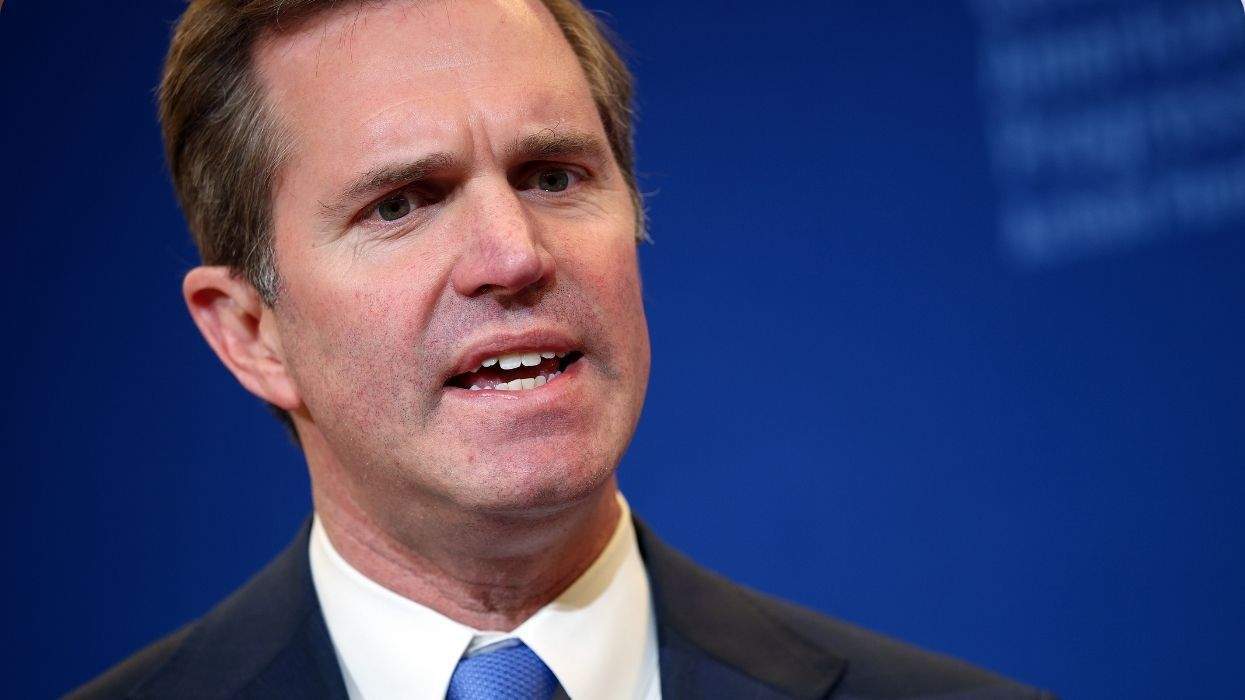
Kentucky Gov. Andy Beshear appeared visibly offended when he sat down for an exclusive interview with The Advocate on Tuesday after the U.S. Supreme Court struck down Colorado’s ban on so-called "conversion therapy" for minors.
Keep up with the latest in LGBTQ+ news and politics. Sign up for The Advocate's email newsletter.
"The Supreme Court is absolutely wrong," Beshear said hours after the ruling. "Torture is never free speech. It’s just torture. And faith has been used at different times to try to justify torture, and it’s always, always been wrong."
The Democratic governor made those remarks hours after the Court handed down its 8-1 decision in Chiles v. Salazar, ruling that Colorado’s prohibition on licensed counselors performing conversion therapy on minors violated the First Amendment. Writing for an 8-1 majority, Justice Neil Gorsuch held that Colorado’s law regulated speech based on viewpoint, permitting therapists to affirm a client’s identity or gender transition while forbidding them from saying anything that might help a client change their sexual orientation or gender identity, and that such restrictions demand the most rigorous First Amendment scrutiny.
Related: Kentucky bans conversion therapy for youth as Gov. Andy Beshear signs 'monumental' order
Related: Kentucky Republicans pass veto-proof bill protecting conversion therapy
The majority rejected Colorado’s argument that the law regulated professional conduct rather than speech, ruling that talk therapy is speech and that the government cannot evade the Constitution by calling it something else. Justice Ketanji Brown Jackson was the lone dissenter, arguing that the majority had misread the Court’s precedents and that states have long held the authority to regulate medical treatments, including those delivered through speech, to protect vulnerable patients. She warned the ruling was "unprincipled and unworkable" and would leave states unable to shield minors from a practice the medical community has broadly condemned as harmful.
Beshear has repeatedly clashed with Kentucky’s Republican-dominated legislature over LGBTQ+ protections. He previously signed an executive order banning conversion therapy in the commonwealth, a measure that was subsequently overridden, and has vetoed every major piece of anti-LGBTQ+ legislation to reach his desk, even knowing those vetoes would be overridden too.
"If a legislature is going to show people hate, a governor's there to show them love. If a legislature's there to show them judgment, a governor's there to show them acceptance," he said. He added that members of the LGBTQ+ community approach him regularly to thank him for speaking out, and that hearing from those constituents is what drives him.
He pointed to the human stakes in deeply personal terms. "We should always be in the suicide prevention business. Never in the suicide causing business," Beshear said. "And in fact, legislation in Kentucky did that very thing to a senator's trans son, who we lost because of how all this feels."
Related: Kentucky Gov. Andy Beshear perfectly explains why he vetoed the 'nastiest' anti-trans bill
Related: Kentucky Gov. Andy Beshear: Democrats don't have to abandon LGBTQ+ people to win
Beshear was referring to Henry Berg-Brosseau, the 24-year-old transgender son of Kentucky state Sen. Karen Berg, who died by suicide in December 2022. Berg-Brosseau, a prominent LGBTQ+ rights activist who worked as a deputy press secretary at the Human Rights Campaign, drafted a final press release just fourteen hours before his death, warning that anti-LGBTQ+ rhetoric had put lives "quite literally on the line," NPR reported.
Beshear, who has won statewide in deeply red Kentucky while defending transgender constituents, addressed his party's ongoing internal debate over how to communicate about trans rights.
"We should always stand up for our convictions, and we should always push back against discrimination," he said. "I don't like bullies, and so I'm always going to push back."
He grounded his position in his Christian faith "I believe all children are children of God," he said. "And I don't want people out there picking on kids, especially kids that already feel marginalized or at higher risk for suicide." Drawing on scripture, he continued: "It says, 'Love your neighbor as yourself, not love your neighbor, unless.'"
When asked what he would say directly to transgender young people in Kentucky in the wake of the ruling, Beshear said, "I see you. I care about you. I know this hurts, but there are people out there that support you and want to lift you up. You are not alone."
He spoke about the concrete reality facing trans Kentuckians with striking specificity, recalling a seventh-grade girl who started a field hockey team at her middle school simply to make friends, who became the subject of a legislative debate. "A general assembly shouldn't be picking on her," he said.
Advocates and survivors were equally forceful in their condemnation of the ruling. Trevor Project CEO Jaymes Black called it "a tragic step backward for our country that will put young lives at risk," while Lambda Legal's Carl Charles, himself subjected to conversion therapy at age 15, said the ruling "gives new legitimacy to a practice that has been widely discredited and condemned" and that for many survivors it is "a reverberating life-long harm." Tim Schraeder Rodriguez, a survivor who spent nearly eight years in conversion therapy and whose debut memoir Conversion Therapy Dropout publishes May 5, called the ruling "not about care — it is about erasure."
The United Nations Independent Expert on sexual orientation and gender identity has formally concluded that conversion therapy practices "are cruel, inhuman and degrading treatment" that "may amount to torture." In 2012, the Pan American Health Organization noted that conversion therapies had no medical justification and represented a severe threat to the health and human rights of victims, and in 2016, the World Psychiatric Association found that "there is no sound scientific evidence that innate sexual orientation can be changed."
Every major medical and mental health association in the United States, including the American Psychiatric Association, the American Psychological Association, and the American Medical Association, has condemned the practice. According to The Trevor Project, LGBTQ+ youth who experienced conversion therapy are more than twice as likely to attempt suicide compared to their peers.
On the broader political moment, Beshear called for electoral action, arguing the midterms are the most urgent path forward. "We have to elect people that are against discrimination," he said. "We have to create a check on the Trump presidency because right now Congress is not doing its job."
He urged LGBTQ+ people to run for office and offered hard-won advice about bringing skeptical voters along by leading with shared economic concerns and being honest about one's convictions.
"When I vetoed that anti-LGBTQ bill in my reelection year, knowing they had tens of millions of dollars ready for terrible, disgusting ads, I talked about my reason that I believe all children are children of God," he recalled. "I'll never forget the next day. I'm opening a factory because you always have to be opening a factory the next day,” he joked. “And a guy in a trucker hat comes up to me, and I thought I knew what was going to happen, but he puts out his hand. He says, 'Governor, I'm not sure I agree with what you did yesterday, but I know you're doing what you think is right.' Patted me on the back, said I support you and walked off."
Beshear said that moment was illuminating and strengthened his resolve.
"I made a decision that I would always do what's right to make sure I could put my head on my pillow at night, having made the decisions that are not just right in my mind, but in my heart and in my soul," Beshear said. "I'm going to continue to stand with our LGBTQ+ community until everyone's rights are recognized and this current discrimination, especially by the very top of our federal government, ends."