'%3E%3Cpath d='M16.3574 35.6519H12.9537L15.0491 18.8873L16.3574 35.6519ZM30.4229 54.0093L22.309 0.994385H7.91795L0 54.0093H10.6634L11.5802 46.3855H17.4014L17.9914 54.0093H30.4229Z' fill='%23971B20'/%3E%3Cpath d='M48.2073 41.8813C48.2073 43.4049 47.4892 44.0011 46.1144 44.0011H43.7595V11.0687H46.1144C47.4892 11.0687 48.2073 11.6636 48.2073 13.1885V41.8813ZM59.5273 43.6695V11.3326C59.5273 3.71323 53.5729 0.994385 47.8157 0.994385H31.7213V54.0093H47.8157C53.5729 54.0093 59.5273 51.29 59.5273 43.6695Z' fill='%23971B20'/%3E%3Cpath d='M90.183 0.994385H78.6039L75.0711 30.6157L71.9955 0.994385H59.4346L69.2474 54.0093H80.373L90.183 0.994385Z' fill='%23971B20'/%3E%3Cpath d='M107.063 42.3448C107.063 43.7359 105.951 44.5974 104.643 44.5974C103.269 44.5974 102.157 43.7359 102.157 42.3448V12.658C102.157 11.2676 103.269 10.4058 104.643 10.4058C105.951 10.4058 107.063 11.2676 107.063 12.658V42.3448ZM119.233 43.2723V11.7312C119.233 6.36384 112.952 -3.8147e-06 104.643 -3.8147e-06C96.2667 -3.8147e-06 89.9867 6.36384 89.9867 11.7312V43.2723C89.9867 48.6393 96.2667 55 104.643 55C112.952 55 119.233 48.6393 119.233 43.2723Z' fill='%23971B20'/%3E%3Cpath d='M150.976 43.9349V33.7309H139.069V42.3448C139.069 43.7359 137.957 44.5974 136.582 44.5974C135.076 44.5974 133.964 43.7359 133.964 42.3448V12.658C133.964 11.2676 135.076 10.4058 136.582 10.4058C137.957 10.4058 139.069 11.2676 139.069 12.658V21.2723H150.976V11.0687C150.976 5.70107 145.283 -3.8147e-06 136.582 -3.8147e-06C127.75 -3.8147e-06 121.796 5.70107 121.796 11.0687V43.9349C121.796 49.3022 127.75 55 136.582 55C145.283 55 150.976 49.3022 150.976 43.9349Z' fill='%23971B20'/%3E%3Cpath d='M167.478 35.6519H164.076L166.17 18.8873L167.478 35.6519ZM181.544 54.0093L173.432 0.994385H159.037L151.123 54.0093H161.785L162.704 46.3855H168.523L169.114 54.0093H181.544Z' fill='%23971B20'/%3E%3Cpath d='M205.412 10.4058V0.994385H177.081V10.4058H185.392V54.0093H197.428V10.4058H205.412Z' fill='%23971B20'/%3E%3Cpath d='M230.002 54.0093V43.9349H218.914V31.8746H226.635V21.8028H218.914V10.4058H230.002V0.994385H206.875V54.0093H230.002Z' fill='%23971B20'/%3E%3C/g%3E%3Cdefs%3E%3CclipPath id='clip0_260_7080'%3E%3Crect width='230' height='55' fill='white'/%3E%3C/clipPath%3E%3C/defs%3E%3C/svg%3E)
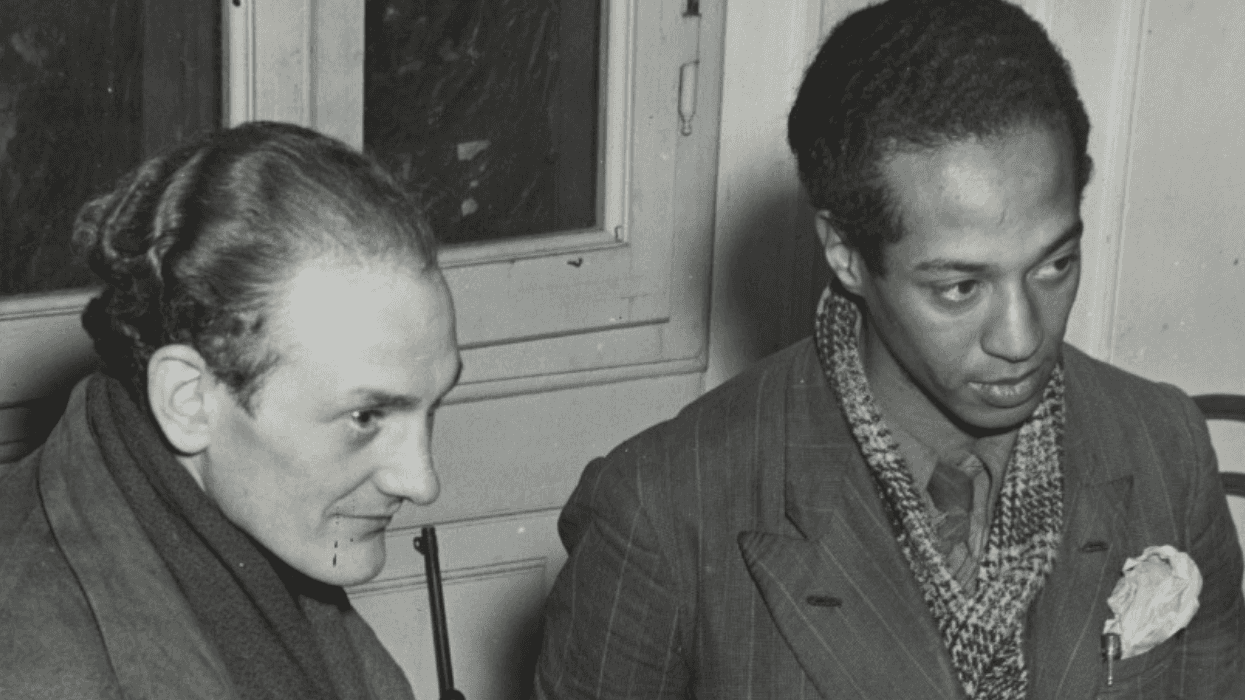

On February 4, 1943, the minister of the interior informed the chief of police in Rome that although no charges were made against African American Reed Edwin Peggram and Dane Arne Gerdahn Hauptmann, their “overly intimate relationship” was deplored but tolerated by the local authorities in Montecarlo. He reported that Reed and Arne were living together in a single room with a single bed. They had only been in Montecarlo for a few months when these accusations surfaced. Who knew this information and who reported it? The record was silent onthe name of the informer. But they were identified as two degenerates engaged in sexual perversion. The minister of the interior proposed to an official, the questore of Lucca, to transferone of them to another municipality in Lucca. Reed was told to leave. He departed Montecarlo two weeks later and was sent to Bagni di Lucca, a commune in Tuscany at the foothills of the Appenine Mountains. In May 1943, Italian officials warned Arne not to go to Bagni di Lucca forany reason.
Who were these men, and why were they in Italy during WWII? Reed Peggram was bornin 1914 in Boston and was raised primarily by his grandmother, a janitor and cleaning lady. Heattended Boston Latin School and Harvard for his undergraduate and master’s degrees. Reed met Arne, born in 1916 in Copenhagen, in May 1939 in Paris while Reed was studying decadence in 19th century French literature at the Sorbonne. He received a Rosenwald fellowship to support hisdissertation research at Harvard where he was a doctoral student in Comparative Literature. Arne was studying fine arts and painting. Reed followed Arne to Copenhagen in August 1939 and wasthere when World War II began. They remained in Denmark for seven months trying to figure out their next move. They finally decided to go to Italy, at the end of March 1940, missing the occupation of Denmark by the Nazis by a couple of weeks. They hoped that Arne would get a visa allowing him to enter the United States. When those plans were thwarted, they remained in Florence. Reed turned down all offers of assistance. He was in love with Arne and would not abandon him despite the danger.
When the United States entered World War II, Reed was suddenly a citizen of an enemy nation, and Arne, a citizen of a German-occupied nation, could potentially report on military movements in a major city such as Florence. They were sent to live in the town of Montecatini Terme, about thirty-seven miles away. They were more easily observed in this small town, particularly Reed, an African American man. Someone reported them to the minister of theinterior suggesting that their relationship was morally suspicious. Arne was forced to move to Borgo a Buggiano. The distance between the two towns was just a little more than two miles, but the authorities hoped it would be just far enough away to prevent the two men from interacting. Reed and Arne were now living apart, and they were in dismal straits financially and mentally.
Their situation took a turn for the worse when on September 8, 1943, Italy surrendered to the Allies following an armistice, but the Germans took over before the Allied forces arrived. Germany now occupied northern Italy, where Reed and Arne resided. Reed was interned at Bagni di Lucca and Arne was sent to the Colle di Compito concentration camp. After all theyhad gone through to remain together, the greatest agony must have been being separated and not knowing when or if they’d survive or see one another again.
Living conditions were wretched in the camps. The tents provided little shelter from the elements and were often flooded. The prisoners suffered during the cold-weather months andduring the heat of the summer. The toilets and showers were filthy, reeking of urine and excrement and sweat. There was barely food to feed the prisoners, “just enough soup to lead amiserable existence,” Reed recalled. The food that they received was of poor quality. But he got used to starving. The days were monotonous as they waited for Red Cross packages containing soap, a few cigarettes, potted ham, cheese, hardtack (a dense biscuit or cracker), sugar, salt, dried fruit, oleomargarine, and powdered milk. Sometimes the prisoners ate margarine by itself to stave off hunger pains. Chicory was used as a coffee substitute. The prisoners were irritable because of hunger and the lack of nicotine. The camps were infested with lice. Books were scarce and were frequently swapped—anything to fill the time. Prisoners were often made to stand outside in the cold weather for the check-parade, which was used to make sure all the prisoners were accounted present. The guards would often lose count and had to start all over again. Reed lost track of time as each day blended into the next. There was nothing to do “but a great deal of time to think about what was in store for us,” said Reed.
In June 1944, the prisoners in Colle di Compito were moved to the Bagni di Lucca campafter a machine-gun attack by Allied forces. Reed and Arne were reunited. They must have beenshocked and relieved to see each other again after being apart for a little over a year.
Suddenly, Allied bombs fell near the Bagni di Lucca camp. The Allies had slowly but determinedly made their way up from southern Italy, capturing towns and pushing the Germansnorth. The attack was a surprise to the prisoners, cut off from the news, who took cover as gunsstrafed the ground. They choked on the smoke and shuddered when the earth shook. The prison guards left their posts unattended to fight the enemy. Reed had trouble seeing through the smoke, but he could hear the planes flying overhead. He looked for Arne. They had been separated in the camp, held in different tents.
Reed’s ears rang, deafened by the sounds of machine guns and bombs. But occasionally there were breaks in the smoke. During the ensuing chaos, many prisoners attempted escape. Amidst the smoke and the explosions, Reed found Arne. They did not have much time to gather their few belongings before they made their way into the mountains, fleeing for their lives. They escaped with just the clothes on their backs. But now what?
Reed and Arne swam across lakes and hiked through the bitter cold, rain, and the snow-covered Apennines, eating chestnuts to stave off hunger. They had escaped but they were not safe. They were still behind German lines without resources or their passports or any identification. During the day they hid in the hills and, if lucky, in the homes of friendly partisans who offered them food, blankets, clothes, and sometimes boots, although those were often impossible to obtain, and a safe, warm place to stay. They had to rely on their instincts to determine who they could trust. Reed recalled, “We can’t explain just how we did it, but soon as we figured that something was fishy, we moved on. So far, our guesses have been right.” At night, they hid in barns, in the woods, and slept near the water, hoping that the Allied forces were near. They discussed where they would live after the war, fantasizing about their future, which they’d always envisioned together.
After months of wandering and hiding, finally, there was a miracle. In December 1944, near collapse from exhaustion and hunger, their clothes dirty, tattered, and torn, Reed and Arneen countered an advance patrol led by Lieutenant James Young of the all–African American 370th Regiment of the 92nd Division near a town on the Fifth Army front. It was pure happenstance. Reed must have thought he was experiencing an illusion. Not only were these American soldiers, but specifically African American soldiers, who surely would help him.
After everything they’d been through, after how hard they’d fought to stay together for nearly five years in Italy, Arne went back to Denmark in August 1945. Reed had no choice but to return to the United States and to an uncertain future. After being hospitalized for a nervous breakdown, Reed boarded the hospital ship USAHS Alonquin in Naples and arrived in Charleston, South Carolina on August 14, 1945. They never saw each other again.
For more on Reed Peggram’s extraordinary life, see Professor Ethelene Whitmire’s book The Remarkable Life of Reed Peggram: The Man Who Stared Down World War II in the Name of Love and visit her website at ethelenewhitmire.com.