'%3E%3Cpath d='M16.3574 35.6519H12.9537L15.0491 18.8873L16.3574 35.6519ZM30.4229 54.0093L22.309 0.994385H7.91795L0 54.0093H10.6634L11.5802 46.3855H17.4014L17.9914 54.0093H30.4229Z' fill='%23971B20'/%3E%3Cpath d='M48.2073 41.8813C48.2073 43.4049 47.4892 44.0011 46.1144 44.0011H43.7595V11.0687H46.1144C47.4892 11.0687 48.2073 11.6636 48.2073 13.1885V41.8813ZM59.5273 43.6695V11.3326C59.5273 3.71323 53.5729 0.994385 47.8157 0.994385H31.7213V54.0093H47.8157C53.5729 54.0093 59.5273 51.29 59.5273 43.6695Z' fill='%23971B20'/%3E%3Cpath d='M90.183 0.994385H78.6039L75.0711 30.6157L71.9955 0.994385H59.4346L69.2474 54.0093H80.373L90.183 0.994385Z' fill='%23971B20'/%3E%3Cpath d='M107.063 42.3448C107.063 43.7359 105.951 44.5974 104.643 44.5974C103.269 44.5974 102.157 43.7359 102.157 42.3448V12.658C102.157 11.2676 103.269 10.4058 104.643 10.4058C105.951 10.4058 107.063 11.2676 107.063 12.658V42.3448ZM119.233 43.2723V11.7312C119.233 6.36384 112.952 -3.8147e-06 104.643 -3.8147e-06C96.2667 -3.8147e-06 89.9867 6.36384 89.9867 11.7312V43.2723C89.9867 48.6393 96.2667 55 104.643 55C112.952 55 119.233 48.6393 119.233 43.2723Z' fill='%23971B20'/%3E%3Cpath d='M150.976 43.9349V33.7309H139.069V42.3448C139.069 43.7359 137.957 44.5974 136.582 44.5974C135.076 44.5974 133.964 43.7359 133.964 42.3448V12.658C133.964 11.2676 135.076 10.4058 136.582 10.4058C137.957 10.4058 139.069 11.2676 139.069 12.658V21.2723H150.976V11.0687C150.976 5.70107 145.283 -3.8147e-06 136.582 -3.8147e-06C127.75 -3.8147e-06 121.796 5.70107 121.796 11.0687V43.9349C121.796 49.3022 127.75 55 136.582 55C145.283 55 150.976 49.3022 150.976 43.9349Z' fill='%23971B20'/%3E%3Cpath d='M167.478 35.6519H164.076L166.17 18.8873L167.478 35.6519ZM181.544 54.0093L173.432 0.994385H159.037L151.123 54.0093H161.785L162.704 46.3855H168.523L169.114 54.0093H181.544Z' fill='%23971B20'/%3E%3Cpath d='M205.412 10.4058V0.994385H177.081V10.4058H185.392V54.0093H197.428V10.4058H205.412Z' fill='%23971B20'/%3E%3Cpath d='M230.002 54.0093V43.9349H218.914V31.8746H226.635V21.8028H218.914V10.4058H230.002V0.994385H206.875V54.0093H230.002Z' fill='%23971B20'/%3E%3C/g%3E%3Cdefs%3E%3CclipPath id='clip0_260_7080'%3E%3Crect width='230' height='55' fill='white'/%3E%3C/clipPath%3E%3C/defs%3E%3C/svg%3E)

This story is part of History is Queer, an Advocate series examining key LGBTQ+ moments, events, and people in history and their ongoing impact. Is there a piece of LGBTQ+ history we should write about? Email us at history@advocate.com.
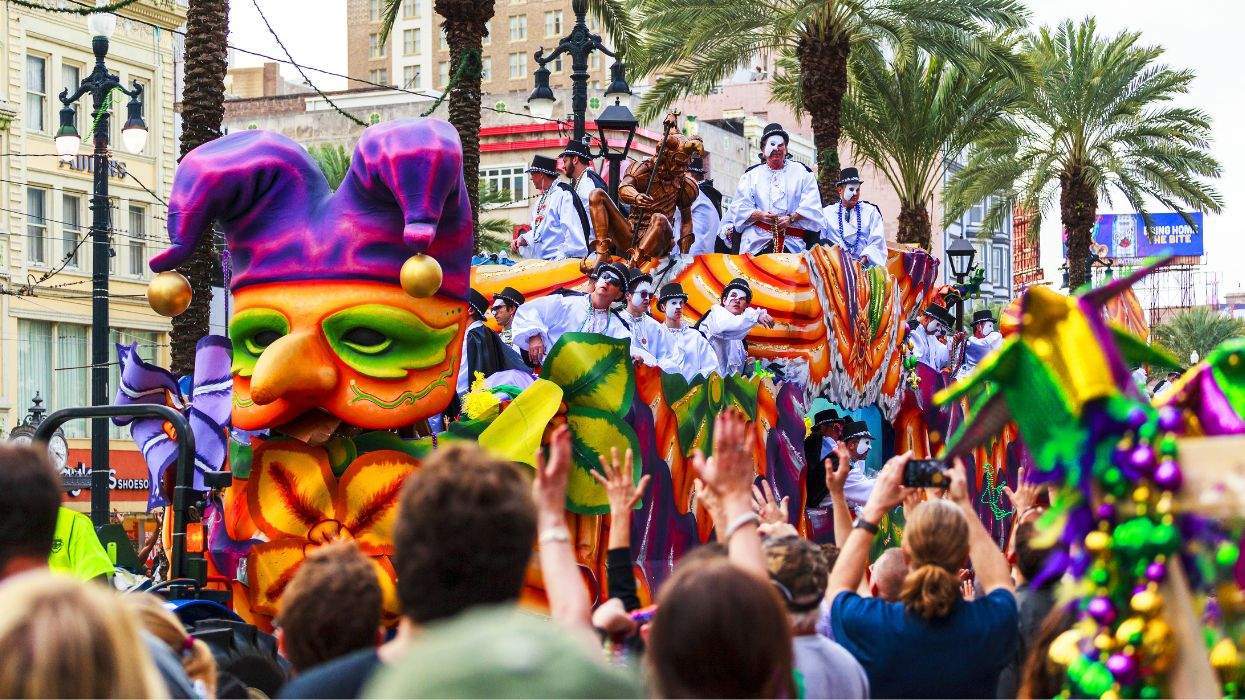
New Orleans is a city that knows how to have a good time — after all, its unofficial motto is “Laissez les bons temps rouler,” which translates to “Let the good times roll.” The LGBTQ+ community knows how to have a good time too, and queer people have long played a key role in the Big Easy's biggest party of the year, Mardi Gras, which falls next Tuesday.
Other cities celebrate Mardi Gras, of course; the most famous event outside of New Orleans is the Sydney Gay and Lesbian Mardi Gras in Australia, running from now until March 1. But in the U.S., New Orleans is the number 1 city for the celebration, and its history is deeply intertwined with that of the queer community.
Related: 18 Beautifully Queer Images From New Orleans's Mardi Gras 2023
Mardi Gras — Fat Tuesday — marks the end of the Carnival season, which begins January 6, a day observed by Christians as Epiphany, marking the arrival of the three wise men bringing gifts to the infant Jesus. There is a religious connection to Mardi Gras; the next day is Ash Wednesday, a day of penitence and the beginning of Lent, a 40-day period of fasting and prayer for Catholics and some other Christian denominations that lasts until Easter. The Carnival season and its culmination in Mardi Gras represent a chance to cut loose and party hearty before settling down for Lent. But you can be a member of any faith or none at all and still enjoy Mardi Gras, as thousands do, even though its roots are in Catholicism.
Mardi Gras celebrations date to medieval Europe, and French people colonizing North America brought the tradition with them. New Orleans was founded in 1718, and the earliest Mardi Gras observances were in the 1730s, according to the official Mardi Gras New Orleans website. At that time, the festivities were high-society balls. By the 1830s, the general population could join in the fun, as there were torchlight street processions through the city, and a few decades later, the parades began, with the elaborate floats that mark Mardi Gras today. There are multiple parades on Mardi Gras and the days leading up to it.
In an era when gay sex was criminalized — and so was cross-dressing — Carnival and Mardi Gras provided a brief time of liberation. It was a time to dress in drag without consequences. “You can’t arrest someone because they’re in costume on Mardi Gras Day, and so they gayed it up,” Howard Phillips Smith, author of Unveiling the Muse: The Lost History of Gay Carnival in New Orleans, told public radio station WWNO in 2018.
It wasn’t just men in drag — it was women too. As far back as the 1850s, women sex workers would impersonate their clients, dressing in suits and top hats, Quinn L. Bishop of Queer Underground Tours explained in an Instagram video. They would smoke cigars and make catcalls to men, she noted. But gender politics being what they were, the women were often arrested, with the authorities saying their conduct went beyond what could be allowed even on Mardi Gras. Of course, not all the women were queer, but some were certainly comfortable in male drag. One, Mina Brown, told police she “made a good fellow” and got sentenced to 60 days in a workhouse. Despite the police harassment, however, the tradition carried on for years.
In 1979, with Mardi Gras cancelled due to a police strike, a group of lesbians decided to stage their own parade, Bishop reported. They costumed themselves as cowboys and flamboyant sex workers and marched into the French Quarter. The police called off their strike long enough to shut the women’s parade down, but the next year several women from the group formed the Krewe of Ishtar, the first lesbian krewe.
“Krewes,” or social clubs, are the organizers of Mardi Gras parades and balls. There were undoubtedly LGBTQ+ people in the krewes for decades, but the first all-gay krewe, the Krewe of Yuga, formed in 1958. It was a refuge for queer people during the conservative 1950s, when the Lavender Scare had seen them purged from the federal government, gay sex remained a crime, and discrimination was rampant.
The Krewe of Yuga didn’t participate in a parade, but it held balls in members’ homes for its first two years. Attendance was so large that the krewe needed a larger venue, so it “bounced around for the next couple years, and then landed a spot in Metairie,” a New Orleans suburb, WWNO notes. “And that sort of worked for a couple of years. But then they had the raid,” Smith told the station.
Police on horseback and with dogs raided the 1962 Krewe of Yuga ball, and they arrested nearly 100 people. The names of those arrested appeared in news articles. Many of them lost their jobs, and the krewe disbanded.
Related: 10 of the Queerest Mardi Gras Houses in New Orleans
But another gay krewe, the Krewe of Petronius, founded around the same time, carried on. It found a home for its balls in the town of Chalmette, just downriver from New Orleans. Chalmette is known for conservatism, “but legend has it that somebody had dirt on somebody, and so Petronius was able to blackmail, and pay, their way in, in 1960,” according to the WWNO report. “And once they got their foot in the door, more krewes emerged, knowing there was a safe space for their balls ... and everybody went to everybody’s balls.” Many of them featured elaborate costumes.
The number of LGBTQ+ krewes grew to more than 20 by the 1980s, but then AIDS devastated the community. After the disease caused the death of so many gay and bisexual men, along with transgender women, the number of LGBTQ+ krewes shrunk to a handful.
Mardi Gras festivities are now generally inclusive of LGBTQ+ people, but those involved in the remaining queer krewes say there’s a place for their organizations. New Orleans is home to the only leather-oriented krewe in the U.S. and possibly the world, the Mystic Mardi Gras Krewe of the Lords of Leather. It will hold its annual Bal Masque Sunday.
The oldest krewe, Petronius, has been trying to attract younger members, for one thing allowing less expensive and less elaborate ball costumes. The krewe is still very much a part of the scene, having held its 64th Bal Masque February 7.
Wayne Phillips, curator of Carnival collections at the Louisiana State Museum, commented on the perseverance of LGBTQ+ krewes to NOLA.com in 2024. “There’s a lot of time and effort that is made to keep it going because the last thing that any of the long-standing gay krewes want to do is fold,” he said. “They want to keep going and bring in new young membership, but they’ve also learned that they have to evolve in their reasons for being and what they bring to the community.”
A gay Carnival ball, he added, “still is one of the best ways that you can be in the community or be accepted into the community and enjoy the fun and flamboyance and unashamed showmanship that you'll only ever see at a gay ball.”
There will also be plenty of fun and flamboyance at an event to be held Tuesday afternoon. The Bourbon Street Awards costume contest will take place from noon to 5 p.m. at the corner of St. Ann and Dauphine Streets. There will be competitions for Best Drag, Best Leather, Best Group, and Best of Show, with first-, second-, and third-place prizes. Varla Jean Merman and Fatsy Cline will host.
Laissez les bons temps rouler!