'%3E%3Cpath d='M16.3574 35.6519H12.9537L15.0491 18.8873L16.3574 35.6519ZM30.4229 54.0093L22.309 0.994385H7.91795L0 54.0093H10.6634L11.5802 46.3855H17.4014L17.9914 54.0093H30.4229Z' fill='%23971B20'/%3E%3Cpath d='M48.2073 41.8813C48.2073 43.4049 47.4892 44.0011 46.1144 44.0011H43.7595V11.0687H46.1144C47.4892 11.0687 48.2073 11.6636 48.2073 13.1885V41.8813ZM59.5273 43.6695V11.3326C59.5273 3.71323 53.5729 0.994385 47.8157 0.994385H31.7213V54.0093H47.8157C53.5729 54.0093 59.5273 51.29 59.5273 43.6695Z' fill='%23971B20'/%3E%3Cpath d='M90.183 0.994385H78.6039L75.0711 30.6157L71.9955 0.994385H59.4346L69.2474 54.0093H80.373L90.183 0.994385Z' fill='%23971B20'/%3E%3Cpath d='M107.063 42.3448C107.063 43.7359 105.951 44.5974 104.643 44.5974C103.269 44.5974 102.157 43.7359 102.157 42.3448V12.658C102.157 11.2676 103.269 10.4058 104.643 10.4058C105.951 10.4058 107.063 11.2676 107.063 12.658V42.3448ZM119.233 43.2723V11.7312C119.233 6.36384 112.952 -3.8147e-06 104.643 -3.8147e-06C96.2667 -3.8147e-06 89.9867 6.36384 89.9867 11.7312V43.2723C89.9867 48.6393 96.2667 55 104.643 55C112.952 55 119.233 48.6393 119.233 43.2723Z' fill='%23971B20'/%3E%3Cpath d='M150.976 43.9349V33.7309H139.069V42.3448C139.069 43.7359 137.957 44.5974 136.582 44.5974C135.076 44.5974 133.964 43.7359 133.964 42.3448V12.658C133.964 11.2676 135.076 10.4058 136.582 10.4058C137.957 10.4058 139.069 11.2676 139.069 12.658V21.2723H150.976V11.0687C150.976 5.70107 145.283 -3.8147e-06 136.582 -3.8147e-06C127.75 -3.8147e-06 121.796 5.70107 121.796 11.0687V43.9349C121.796 49.3022 127.75 55 136.582 55C145.283 55 150.976 49.3022 150.976 43.9349Z' fill='%23971B20'/%3E%3Cpath d='M167.478 35.6519H164.076L166.17 18.8873L167.478 35.6519ZM181.544 54.0093L173.432 0.994385H159.037L151.123 54.0093H161.785L162.704 46.3855H168.523L169.114 54.0093H181.544Z' fill='%23971B20'/%3E%3Cpath d='M205.412 10.4058V0.994385H177.081V10.4058H185.392V54.0093H197.428V10.4058H205.412Z' fill='%23971B20'/%3E%3Cpath d='M230.002 54.0093V43.9349H218.914V31.8746H226.635V21.8028H218.914V10.4058H230.002V0.994385H206.875V54.0093H230.002Z' fill='%23971B20'/%3E%3C/g%3E%3Cdefs%3E%3CclipPath id='clip0_260_7080'%3E%3Crect width='230' height='55' fill='white'/%3E%3C/clipPath%3E%3C/defs%3E%3C/svg%3E)
By the second day, Jared didn’t want to be there. He had seen politicians attack people like him in the news.
He arrived at camp angry at himself, at other trans people, at the idea that he belonged there at all. "I was really hateful and disrespectful towards everyone,” Jared, 15, told The Advocate in an interview.
He mocked the other campers. He resisted the conversations. At one point, staff considered sending him home.
But then something shifted. "Once I learned more about it, I took them more seriously,” he said. “It changed me a lot because I realized that the people around me weren’t disgusting aliens or anything. They’re just normal people.”
By the end of the week, he didn’t want to leave.
(Jared and his father, Rick, are being identified by pseudonyms to protect the minor’s privacy.)
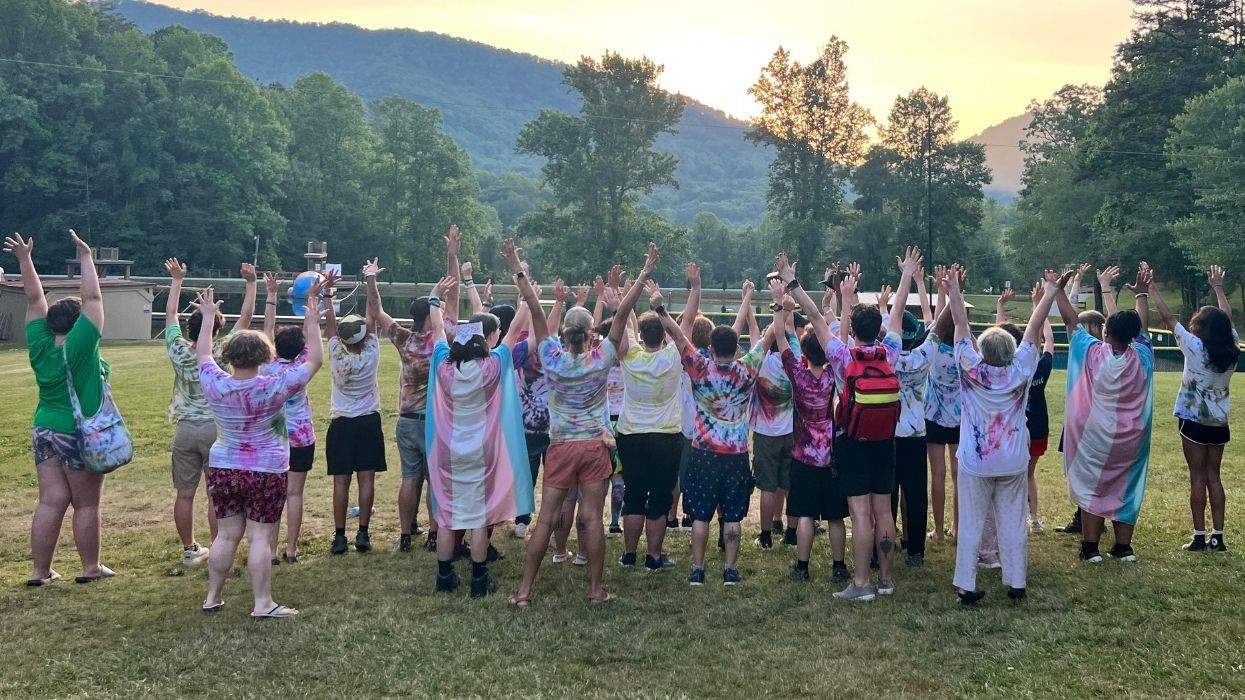
That transformation is the quiet, deliberate work of Transcending Adolescence, a weeklong summer camp for transgender and nonbinary youth that operates in an undisclosed location in the North Carolina mountains, its secrecy a reflection of the moment in which it exists.
Related: The North Face faces conservative boycott for sponsoring a queer summer camp (exclusive)
Founded by Chrissy and Jacob Hofheimer, a married trans couple, the camp is part traditional retreat and part mental health intervention, described by its founders as more like a lifeline.
The need for spaces like this is backed by stark data. According to The Trevor Project’s 2024 U.S. National Survey on the Mental Health of LGBTQ+ Young People, 39 percent of LGBTQ+ youth seriously considered attempting suicide in the past year, including 46 percent of transgender and nonbinary youth, while half of those who wanted mental health care were unable to access it. The survey also found that 90 percent of LGBTQ+ young people said their well-being had been negatively impacted by recent politics, and that access to affirming spaces is associated with significantly lower rates of suicide attempts.
"We're not a regular summer camp," Chrissy Hofheimer told The Advocate. "This is a survival camp."
How the camp began
Chrissy and Jacob met in 2018, working as lifeguards at another summer camp for trans youth in New England. During breaks, they’d sit on the dock and talk about what the kids wanted, what was missing, and what they would do differently if they ever ran a program of their own. The campers, it turned out, were already pitching the idea for them.
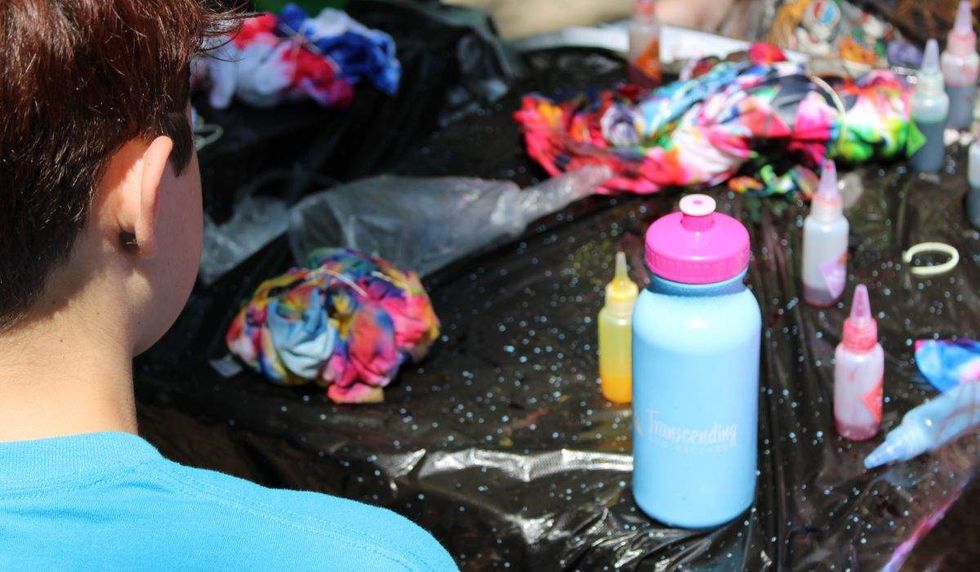 Transcending Adolescence participants enjoy crafts at camp.Chrissy & Jacob Hofheimer/Transcending Adolescence
"They would say, 'Y’all should start a summer camp. We would so totally come to your camp,'" Chrissy recalls.
By the end of 2019, she had decided to do exactly that. Florida, where she was born and raised, would be home. The other camp in New England was barely accessible to her as a trans adult with limited resources. She could only imagine what it took for Southern families to get their children there. She wanted something planted squarely in the region that needed it most.
Related: Scouting America says transgender kids are still welcome after Pete Hegseth claimed they weren’t
"I said, 'I'm going to plop this right in the middle of the Bible belt,'" she says. "And I did."
What they built is structured around a framework Chrissy developed by examining her own survival: SPEAR — support, physical recreation, education, advocacy, and reflection. The five things she concluded had made her a resilient trans adult.
“I kept asking myself, 'How am I still here?'” she says. “'Why am I so strong?' My friends always say, 'You’re the strongest person I know. How do you do it?’ And I started asking myself, 'Well, how in the hell do I do it?'"
The answer became a curriculum. And the curriculum became a camp.
What a day looks like
The COVID-19 pandemic delayed the launch until 2022, but now, in its fifth year, Transcending Adolescence has a rhythm. Jacob, who is completing his degree as an adult gerontology acute care nurse practitioner at Yale, and this spring scrubbed into six gender-affirming surgeries during his urology rotation, runs day-to-day operations with methodical care.
A typical day begins with morning announcements by the lake, followed by community breakfast, then a rotation of activities calibrated to the day’s SPEAR theme. Physical recreation days bring archery, a ropes course, and a perennial favorite: the river, complete with a giant waterslide and trampoline. Swimming happens every single day.
“These trans kids don’t get the opportunity to go swimming in places where there are no cisgender people around," Jacob explains. "It’s literally all trans people. So they really get the opportunity to just be a kid and not have to worry about people staring at them or making fun of them."
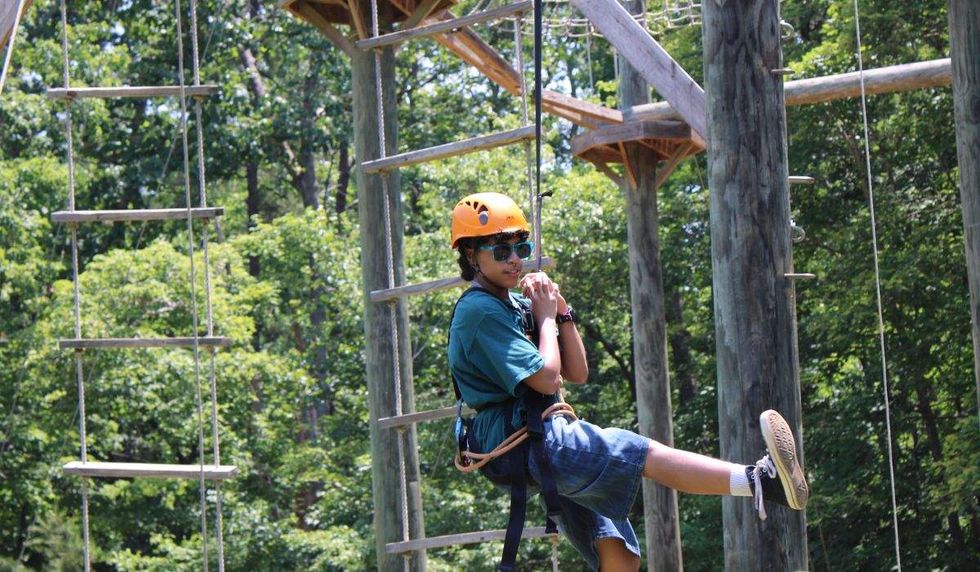 Physical education activities are one of the pillars of Transcending Adolescence's program.Chrissy & Jacob Hofheimer/Transcending Adolescence
Afternoons shift into workshops including yoga, healthcare Q&As led by Jacob, sessions with legal experts on policies affecting trans youth, and age-appropriate conversations covering everything from consent and body autonomy for the youngest campers to PrEP and HIV testing for older ones. After dinner, the campfire conversations begin. These are where, Jacob says, the real work happens: frank, facilitated discussions about gender dysphoria and euphoria, coping with anxiety and depression, navigating transphobia, and building healthy relationships.
The point, Jacob says, is not just escape. It is preparation.
“They need intentional conversations where trans adults can share their tools for resilience with trans youth, and trans youth can share their tools with each other.”
The program has grown to include junior counselors, former campers who are now young adults, who develop their own workshops year-round, transforming their personal coping strategies into curriculum for the next generation.
"It started with me sharing my tools for resilience," Chrissy says, "and now we're getting to see our former campers share their tools for resilience with the next generation."
The feeling of not being hunted
For many campers, the shift is immediate and profound.
"It made me feel like I wasn’t being hunted anymore," Jared says. "Everybody was just acting normal. I wasn’t different or anything."
At home in Austin, Texas, he described harassment that escalated from slurs to physical intimidation. He says that classmates followed him into bathrooms, touching him, threatening violence.
“I would not be surprised if one of those kids brought a gun to school and shot me,” he says. “It’s not like a fairy legend thing where it’s like, ‘I feel so attacked.’ These people are touching me, breaking my shit, threatening me.”
Before camp, Jared had pulled away from everyone: from school, from friends, even from his family. “I didn’t want my parents to know my secret," he says. “I felt so disgusted in myself."
Related: Arizona Summer Camp Turns Away Trans Foster Child
His father, Rick, remembers the moment it became urgent. His older daughter called him at work to warn him. “She just had this immediate instinct," Rick says. “'He needs to be around his people.'" Coworkers helped him find Transcending Adolescence online within the hour.
"At the time we found the organization,” Rick told The Advocate, “it was sort of a life-or-death situation."
The camp also exists against a backdrop of an unprecedented wave of legislation targeting LGBTQ+ people, particularly transgender youth. The American Civil Liberties Union is tracking more than 500 anti-LGBTQ+ bills introduced in state legislatures in 2026 alone, spanning restrictions on health care, school participation, and public life. Even when such measures fail, advocates say the volume and visibility of the proposals contribute to a climate of fear and instability for young people and their families.
A fragile infrastructure of safety
The camp’s secrecy is not aesthetic.
Families must submit photo identification and other methods of verification. The location is shared only two weeks before check-in. Everyone, including campers, parents, and staff, signs a nondisclosure agreement. The registration process is managed manually, with the Hofheimers personally approving each family.
"We’re gathering a very sensitive population, highly targeted, in the middle of North Carolina," Chrissy says. "Safety is our number one priority."
That caution is rooted in hard experience.
In the camp’s first Florida summer, a facility canceled its contract the Monday before staff training was set to begin, sending Chrissy into emergency mode, calling every board member, refusing to fold, and finding a replacement venue within days. Year three brought a campsite in Georgia that seemed promising until, midweek, the facility director asked Chrissy and Jacob to tell their campers to be easier on staff who were misgendering them.
"I said, 'No. I’m not going to tell our kids that they can’t stand up for themselves and their pronouns,’” Jacob says. “The 'A' in SPEAR is advocacy for a reason."
Chrissy says that the same evening, the facility director sent a text claiming the contract had ended a day early and demanding that the group vacate. Staff and campers were left sleeping outdoors. Restrooms were locked. A camper woke in the middle of the night and had an accident in the dark because no one told them which door had been left open. That child never returned.
"We could not let them feel like they were being kicked out of yet another space," Chrissy says.
The current North Carolina facility could not be more different. It has written into its policies that any staff member who discloses the camp’s presence will face immediate termination. When the Hofheimers proposed a cultural humility training, the director requested it not only for staff interacting with campers but also for the facility's entire summer team.
"It was like night and day," Jacob says.
Who gets access
The camp costs $1,975 per participant, covering facility rental ($40,000 alone), food, program supplies, staff certifications, and stipends for trans volunteers. No child is ever turned away for inability to pay. A no-questions-asked financial aid option exists for families whose tax records don't reflect their actual circumstances. A subsidized rate is available. A charter bus transports campers from Florida and North Georgia. A shuttle is being arranged from the Charleston, South Carolina, area. And through a partnership with Elevated Access, a nonprofit that coordinates free flights with volunteer private pilots, campers from Texas, Missouri, Montana, Kansas, and beyond can arrive without TSA screening or ID checks.
"We've had interest from as far as Alaska," Chrissy says.
This summer, the Hofheimers have a capacity for 66 campers and a goal of 42. For the first time in the program's history, registrations hit double digits before April, and more than two-thirds of last summer's campers have already re-enrolled. They are also pursuing accreditation from the American Camp Association, which would make Transcending Adolescence the first exclusively trans overnight camp in the country to achieve it. They'll find out in November.
"Trans kids deserve a program that meets industry standards," Chrissy says. "Which there are not currently."
A week that changed everything
When Rick picked Jared up from the airport after that first summer, his son stepped off the plane a different person.
"He was like, 'I have so much to talk to you about,'" Rick recalls. "All of a sudden, he just had this new community. People he could talk to. Didn't have to feel like he was covering anything up."
What ultimately reached Jared wasn't a gentle affirmation. It was Chrissy's refusal to give him the soft sell.
"Everybody was being like, 'Just accept yourself,' and it was driving me insane," Jared says. "Chrissy was the person who would come to me and tell me what I needed to hear. She'd be like, 'Okay, first of all, stop being an asshole. This is going to work.' And then she'd talk to me like an actual person. She knows how to deal with cases like that because she's been there before."
To see that self-hatred, Rick says, "melted off even just over a week" was something he hadn't been sure he'd get to witness.
Jared is going back this June. When his father confirmed the dates, he lit up.
"Transcending Adolescence legit saved my life," Jared says, without hesitation. "I think it literally saved my life."