'%3E%3Cpath d='M16.3574 35.6519H12.9537L15.0491 18.8873L16.3574 35.6519ZM30.4229 54.0093L22.309 0.994385H7.91795L0 54.0093H10.6634L11.5802 46.3855H17.4014L17.9914 54.0093H30.4229Z' fill='%23971B20'/%3E%3Cpath d='M48.2073 41.8813C48.2073 43.4049 47.4892 44.0011 46.1144 44.0011H43.7595V11.0687H46.1144C47.4892 11.0687 48.2073 11.6636 48.2073 13.1885V41.8813ZM59.5273 43.6695V11.3326C59.5273 3.71323 53.5729 0.994385 47.8157 0.994385H31.7213V54.0093H47.8157C53.5729 54.0093 59.5273 51.29 59.5273 43.6695Z' fill='%23971B20'/%3E%3Cpath d='M90.183 0.994385H78.6039L75.0711 30.6157L71.9955 0.994385H59.4346L69.2474 54.0093H80.373L90.183 0.994385Z' fill='%23971B20'/%3E%3Cpath d='M107.063 42.3448C107.063 43.7359 105.951 44.5974 104.643 44.5974C103.269 44.5974 102.157 43.7359 102.157 42.3448V12.658C102.157 11.2676 103.269 10.4058 104.643 10.4058C105.951 10.4058 107.063 11.2676 107.063 12.658V42.3448ZM119.233 43.2723V11.7312C119.233 6.36384 112.952 -3.8147e-06 104.643 -3.8147e-06C96.2667 -3.8147e-06 89.9867 6.36384 89.9867 11.7312V43.2723C89.9867 48.6393 96.2667 55 104.643 55C112.952 55 119.233 48.6393 119.233 43.2723Z' fill='%23971B20'/%3E%3Cpath d='M150.976 43.9349V33.7309H139.069V42.3448C139.069 43.7359 137.957 44.5974 136.582 44.5974C135.076 44.5974 133.964 43.7359 133.964 42.3448V12.658C133.964 11.2676 135.076 10.4058 136.582 10.4058C137.957 10.4058 139.069 11.2676 139.069 12.658V21.2723H150.976V11.0687C150.976 5.70107 145.283 -3.8147e-06 136.582 -3.8147e-06C127.75 -3.8147e-06 121.796 5.70107 121.796 11.0687V43.9349C121.796 49.3022 127.75 55 136.582 55C145.283 55 150.976 49.3022 150.976 43.9349Z' fill='%23971B20'/%3E%3Cpath d='M167.478 35.6519H164.076L166.17 18.8873L167.478 35.6519ZM181.544 54.0093L173.432 0.994385H159.037L151.123 54.0093H161.785L162.704 46.3855H168.523L169.114 54.0093H181.544Z' fill='%23971B20'/%3E%3Cpath d='M205.412 10.4058V0.994385H177.081V10.4058H185.392V54.0093H197.428V10.4058H205.412Z' fill='%23971B20'/%3E%3Cpath d='M230.002 54.0093V43.9349H218.914V31.8746H226.635V21.8028H218.914V10.4058H230.002V0.994385H206.875V54.0093H230.002Z' fill='%23971B20'/%3E%3C/g%3E%3Cdefs%3E%3CclipPath id='clip0_260_7080'%3E%3Crect width='230' height='55' fill='white'/%3E%3C/clipPath%3E%3C/defs%3E%3C/svg%3E)
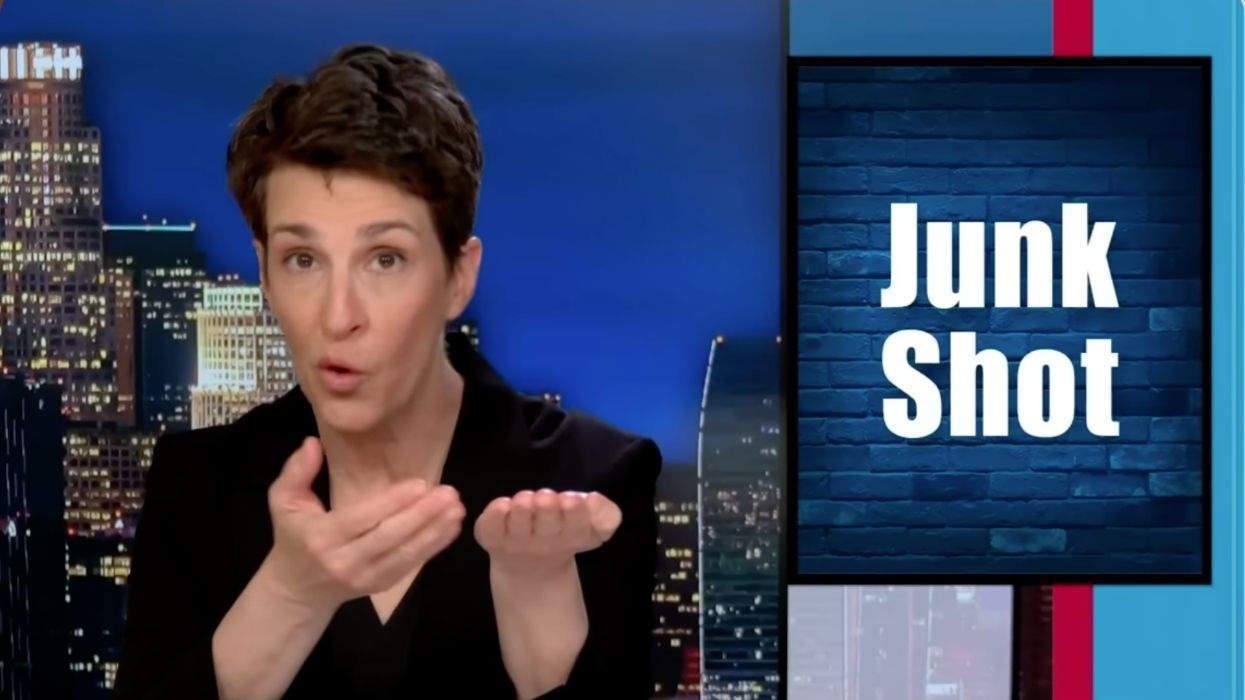
Rachel Maddow came back Monday night to a question she’s been asking since the start of President Donald Trump’s war with Iran, and suggested the answer is starting to reveal itself.
Keep up with the latest in LGBTQ+ news and politics. Sign up for The Advocate's email newsletter.
On MS NOW’s The Rachel Maddow Show, the anchor revisited her early warning: before accepting the stated reasons for the war, ask who actually stands to gain.
Days after the war began in late February, Maddow questioned the administration’s endgame, warning that talk of regime change came with no clear plan for what would follow. Iran’s political system, she noted at the time, is complex, with overlapping centers of power, and destabilizing it wouldn’t be simple, quick, or easily contained.
That warning has only grown more relevant as the war has already upended Iran’s leadership. The country’s longtime supreme leader, Ayatollah Ali Khamenei, was killed in a strike at the outset of the conflict, setting off a rushed succession process that elevated his son, Mojtaba Khamenei, to the role.
Related: Rachel Maddow on standing up to government lies and her Walter Cronkite Award
Since then, even the basic facts about Iran’s leadership have been murky, in part because of conflicting claims from U.S. officials. Trump has publicly questioned the legitimacy of the new supreme leader, calling him “unacceptable” and suggesting he would not last, while also claiming he believes Mojtaba Khamenei is alive but “damaged” after being wounded early in the war.
Defense Secretary Pete Hegseth has gone further, asserting that Iran’s new leader is “wounded and likely disfigured” and suggesting the country’s leadership is in disarray, even as Iranian officials have said his injuries were minor.
At other moments, Trump has suggested the United States itself should have a role in shaping Iran’s leadership. Those remarks have fueled broader concerns about whether the war’s aims extend beyond its stated military objectives.
According to Reuters, the Trump administration has been weighing the deployment of thousands of additional U.S. troops to the Middle East, with options that could include securing shipping routes through the Strait of Hormuz or even sending forces to Iranian territory, such as Kharg Island, a critical oil export hub. Officials told Reuters that even limited ground operations would carry significant risks, both militarily and politically, as the administration considers expanding its campaign.
Now, as the conflict deepens, Maddow argued that the way the war is unfolding looks a lot like what she feared.
Related: Rachel Maddow says we’re in an ‘attempted authoritarian overthrow’
Related: Rachel Maddow urges Americans to consider ‘Who benefits?’ from Trump’s war with Iran
She walked viewers through a series of moments that, taken together, felt less like a coherent strategy than a scramble to keep up with events: Trump reportedly assuming Iran wouldn’t retaliate, only for attacks on shipping to follow; administration officials insisting key waterways were secure even as vessels came under fire; and shifting, sometimes contradictory claims about whether the United States would escort ships through the Strait of Hormuz.
At one point, she noted, the idea of naval escorts was floated publicly while military officials were warning it could put U.S. forces in what they described as a “kill box.”
Maddow also turned to the incentives she described as surrounding the war.
She pointed to Trump’s son-in-law, Jared Kushner, for his role in shaping Middle East policy while maintaining business ties with Saudi Arabia, which has already invested billions in ventures linked to him. That overlap, she argued, raises uncomfortable questions about whether U.S. foreign policy decisions are being driven purely by national interest.
Kushner founded the private equity firm Affinity Partners after leaving the White House in 2021, and within months, it secured a $2 billion investment from Saudi Arabia’s sovereign wealth fund, according to Reuters and congressional investigators. The firm has since relied heavily on funding from Gulf states, including additional backing from investors in the United Arab Emirates and Qatar.
“The interests of the United States are being exchanged for private income for the president’s son-in-law,” Maddow said.
She emphasized the financial stakes, noting that Kushner had already received billions and was seeking more, adding, “Why would they say no?” suggesting Saudi leaders have every reason to keep funding Kushner’s firm if U.S. policy aligns with their interests.
She pointed to an incentive structure shaping policy, telling viewers, “If it isn’t what that country wants it to be, then Jared’s going to be less likely to get the money that he is asking them for.”
Weeks earlier, Maddow pointed to Kushner’s role in prewar diplomacy and his financial ties to Gulf states, arguing that those overlaps raised concerns about motive. “Why do you think he did it?” she asked at the time, after suggesting Trump may see political benefit in launching a conflict amid domestic challenges.
On Monday, Maddow also questioned whether the war itself aligns with U.S. interests at all. “For a war that makes a lot of sense for the leaders of Saudi Arabia and Israel,” she said, "it makes no sense at all for the United States.”
At the same time, she noted broader geopolitical consequences that complicate the administration’s stated goals. Rising oil prices, she said, are benefiting Russia, while Moscow’s relationship with Tehran has deepened even as the United States intensifies its military posture.
That dynamic is already visible in global energy markets. The war has disrupted a significant share of oil flowing through the Middle East, particularly after traffic through the Strait of Hormuz was curtailed, sending crude prices sharply higher and tightening supply worldwide.
For Russia, one of the world’s largest energy exporters, that spike has translated into a financial windfall. Analysts have similarly noted that the war has driven up demand for Russian oil and gas, as countries seek alternative supplies amid disruptions in the Gulf.
At the same time, U.S. policy choices have raised questions about the war’s consequences. In an effort to ease global supply pressures, the Trump administration has issued temporary waivers allowing the purchase of certain Russian oil shipments, a move critics say risks undercutting efforts to limit Moscow’s war funding in Ukraine, the neighbor it invaded on February 24, 2022.
Rather than isolating Iran, Maddow suggested, the conflict may be reshaping global alliances and economic incentives in ways that benefit U.S. adversaries.
Put together, Maddow argued, the disconnect between what the administration says and what it is doing is becoming harder to ignore — and increasingly consequential as the war expands.
“It’s almost like he’s not really doing things for the reason he says he’s doing them.”
Watch Rachel Maddow explain why she says Trump's family is benefiting from the war with Iran below.
- YouTube www.youtube.com