'%3E%3Cpath d='M16.3574 35.6519H12.9537L15.0491 18.8873L16.3574 35.6519ZM30.4229 54.0093L22.309 0.994385H7.91795L0 54.0093H10.6634L11.5802 46.3855H17.4014L17.9914 54.0093H30.4229Z' fill='%23971B20'/%3E%3Cpath d='M48.2073 41.8813C48.2073 43.4049 47.4892 44.0011 46.1144 44.0011H43.7595V11.0687H46.1144C47.4892 11.0687 48.2073 11.6636 48.2073 13.1885V41.8813ZM59.5273 43.6695V11.3326C59.5273 3.71323 53.5729 0.994385 47.8157 0.994385H31.7213V54.0093H47.8157C53.5729 54.0093 59.5273 51.29 59.5273 43.6695Z' fill='%23971B20'/%3E%3Cpath d='M90.183 0.994385H78.6039L75.0711 30.6157L71.9955 0.994385H59.4346L69.2474 54.0093H80.373L90.183 0.994385Z' fill='%23971B20'/%3E%3Cpath d='M107.063 42.3448C107.063 43.7359 105.951 44.5974 104.643 44.5974C103.269 44.5974 102.157 43.7359 102.157 42.3448V12.658C102.157 11.2676 103.269 10.4058 104.643 10.4058C105.951 10.4058 107.063 11.2676 107.063 12.658V42.3448ZM119.233 43.2723V11.7312C119.233 6.36384 112.952 -3.8147e-06 104.643 -3.8147e-06C96.2667 -3.8147e-06 89.9867 6.36384 89.9867 11.7312V43.2723C89.9867 48.6393 96.2667 55 104.643 55C112.952 55 119.233 48.6393 119.233 43.2723Z' fill='%23971B20'/%3E%3Cpath d='M150.976 43.9349V33.7309H139.069V42.3448C139.069 43.7359 137.957 44.5974 136.582 44.5974C135.076 44.5974 133.964 43.7359 133.964 42.3448V12.658C133.964 11.2676 135.076 10.4058 136.582 10.4058C137.957 10.4058 139.069 11.2676 139.069 12.658V21.2723H150.976V11.0687C150.976 5.70107 145.283 -3.8147e-06 136.582 -3.8147e-06C127.75 -3.8147e-06 121.796 5.70107 121.796 11.0687V43.9349C121.796 49.3022 127.75 55 136.582 55C145.283 55 150.976 49.3022 150.976 43.9349Z' fill='%23971B20'/%3E%3Cpath d='M167.478 35.6519H164.076L166.17 18.8873L167.478 35.6519ZM181.544 54.0093L173.432 0.994385H159.037L151.123 54.0093H161.785L162.704 46.3855H168.523L169.114 54.0093H181.544Z' fill='%23971B20'/%3E%3Cpath d='M205.412 10.4058V0.994385H177.081V10.4058H185.392V54.0093H197.428V10.4058H205.412Z' fill='%23971B20'/%3E%3Cpath d='M230.002 54.0093V43.9349H218.914V31.8746H226.635V21.8028H218.914V10.4058H230.002V0.994385H206.875V54.0093H230.002Z' fill='%23971B20'/%3E%3C/g%3E%3Cdefs%3E%3CclipPath id='clip0_260_7080'%3E%3Crect width='230' height='55' fill='white'/%3E%3C/clipPath%3E%3C/defs%3E%3C/svg%3E)

Walking down Santa Monica Boulevard, I pass a man sitting on the fence of a crowded gay bar, a hot pink thong peeking out from his shorts as go-go dancers in Speedos dance for tips inside. To my left, a sign fastened to a light pole reads “Route 66,” surrounded by a burst of rainbow colors. A man jumps into another man’s arms and wraps his legs around the other man's waist. After an intense but brief make-out session, he says to his friends, “What?! We’re just giving them what they want.”
Standing on the final stretch of Route 66, it would be easy to assume queer travelers had always found belonging at the end of the Mother Road’s rainbow. Was this the queer utopia that had drawn LGBTQ+ road-trippers and opportunity seekers west along Route 66?
California without the coast
Related: Dispatches from Route 66: Discover the queer stories hidden along the iconic road trip
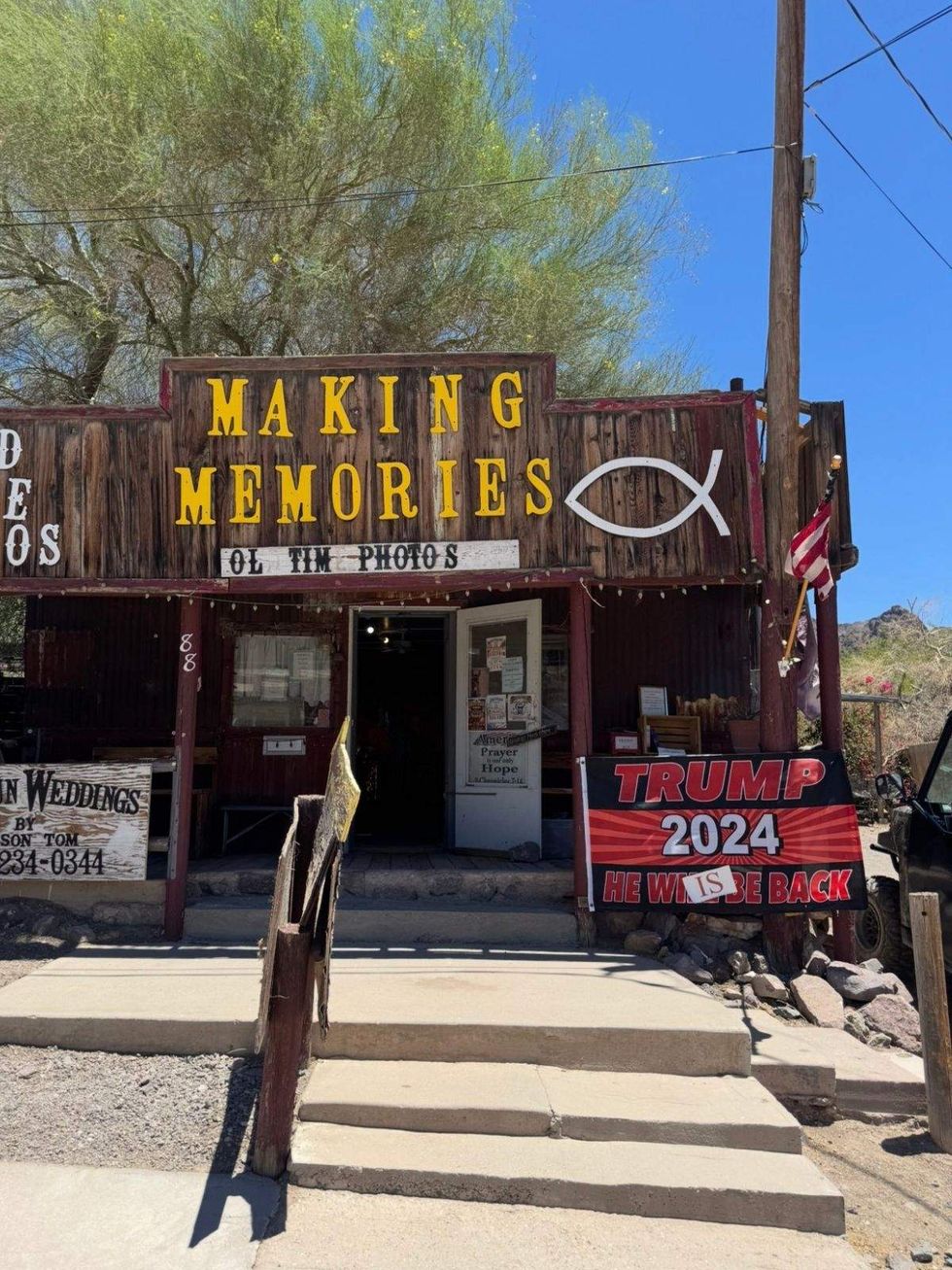 Oatman, ArizonaAlysse Dalessandro for The Advocate
Flying into Los Angeles might leave visitors believing all of California looks like the city. Driving into the state along Route 66 tells a different story. After a brief pit stop in Oatman, Arizona, where I dodged donkey dung and Trump supporters, I crossed the border into Needles. I might have missed the sign announcing my arrival in California had I blinked. The temperature climbed to 120 degrees. There was no ocean breeze like the one I’d come to expect in California. I was very much still in the desert. I arrived at the Needles Regional Museum shortly before its 2 p.m. closing.
The museum showcased china and menus from the El Garces Harvey House, one of the last remaining structures that once housed a Fred Harvey restaurant and hotel along the Santa Fe Railway. Though Harvey Houses served rail passengers, Route 66 often paralleled the railroad through the Southwest, creating a natural overlap between the two.
As I read about the Harvey House, I found myself wondering whether other LGBTQ+ travelers had passed through places like this during Route 66’s earliest years. An interview with Garrett Peck, author of The Bright Edges of the World: Willa Cather and Her Archbishop, pointed me toward my first documented answer.
Queer travelers in the desert
Related: Dispatches from Route 66: How queer communities are rebuilding safety along the Mother Road
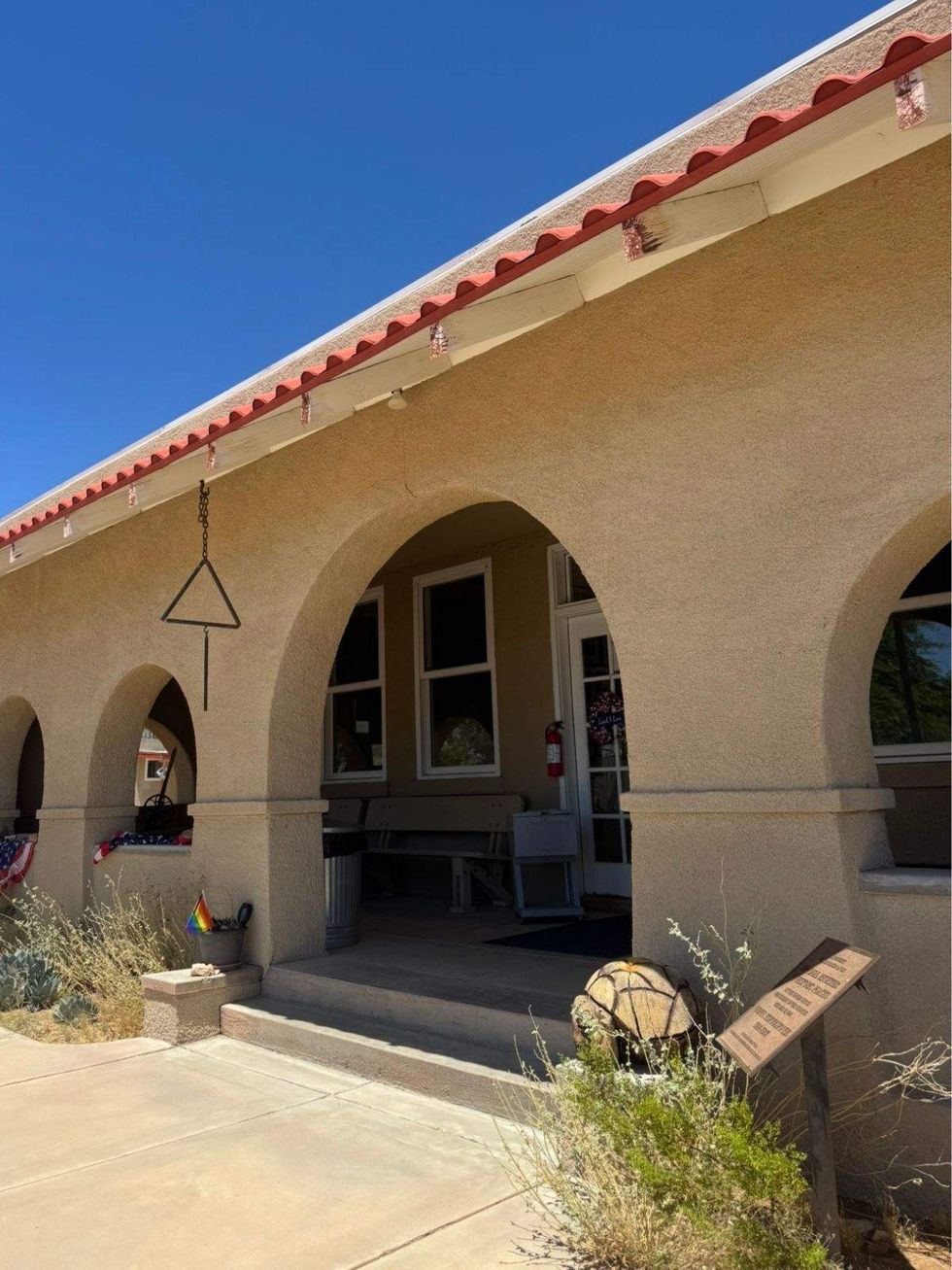 Goffs Schoolhouse MuseumAlysse Dalessandro for The Advocate
Pulitzer Prize-winning author Willa Cather and her life partner, Edith Lewis, traveled together through the Southwest in the 1920s, often staying and dining at Harvey Houses like the one standing across from the museum. Cather’s 1927 novel, Death Comes for the Archbishop, helped romanticize the same Southwestern landscape that Route 66 would soon carry travelers through.
According to Peck, Cather and Lewis lived together in New York City’s West Village starting in 1909. Although Cather first traveled to the Southwest alone, Lewis joined her beginning in 1915, including on a 1925 trip to Santa Fe. After spending weeks tracing LGBTQ+ history along the Mother Road, I had to ask how this couple navigated the landscape that Route 66 would soon run through.
“When the two of them traveled, and they traveled a lot together, Lewis was often mistaken as Cather’s secretary,” said Peck. “In fact, Lewis couldn’t even type. And of course, the two women, while they’re traveling, made no effort to correct other people.”
Listening to Peck, I couldn’t help but compare Cather’s experience with my own and think about the ways I had prioritized my safety as a solo queer traveler on Route 66: staying at Travel Proud-certified properties, leaving my explicitly queer T-shirts in my suitcase, and referring to my wife as my videographer.
After miles of driving through the Mojave Desert with my phone stuck on SOS, I pulled into the Goffs Schoolhouse Museum. A single Pride flag in a planter on the front porch felt like a beacon. Today, this former railroad town is home to the Mojave Desert Heritage and Cultural Association, or MDHCA, whose researchers maintain an extensive archive of the region’s history.
As I walked the grounds with museum director Laura Misajet, she showed me the crumbled roadway from the original 1926-31 alignment of Route 66. For some visitors, that early stretch of Route 66 is reason enough to stop. For me, it was the museum’s extensive archives that piqued my interest.
While the MDHCA’s archives do not yet contain documented LGBTQ+ history, Misajet believes those stories may still be waiting for someone willing to dig through the collection. If Willa Cather and Edith Lewis had traveled through the desert together, I couldn’t help but wonder how many other LGBTQ+ travelers were still waiting to be discovered in forgotten places like Goffs.
I departed Goffs with a dream of returning with enough time to dig through the archives and headed west toward Pasadena. My wife had just landed in California, and no drive felt longer than those 230 miles.
Finding freedom in Southern California
Related: Dispatches from Route 66: Finding queer hope in New Mexico and Arizona
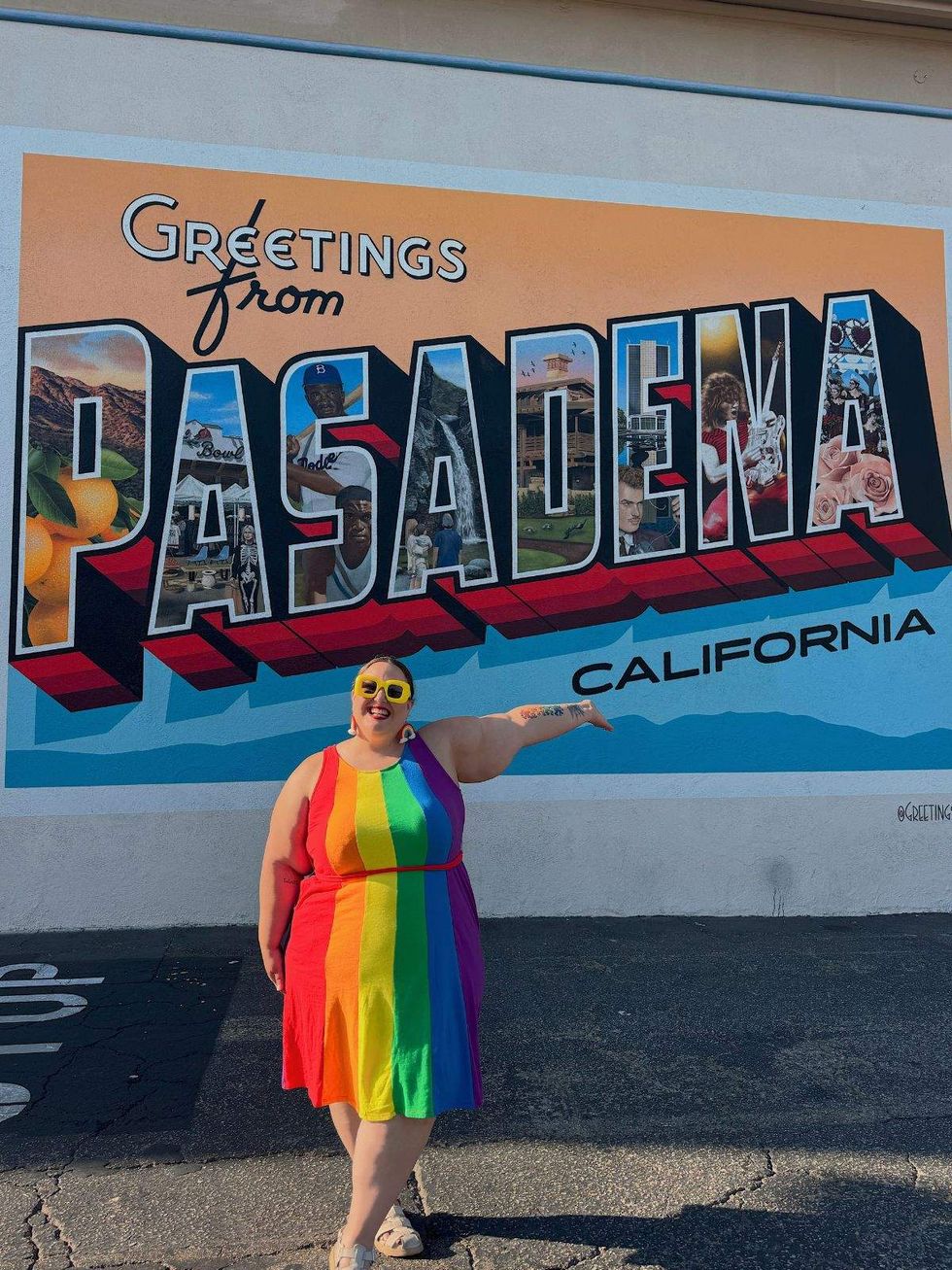 Alysse Dalessandro in Pasedina.Alysse Dalessandro for The Advocate
My wife’s arrival on my Route 66 road trip marked a respite. Maybe it was the joy of our reunion, but our time in Pasadena felt like bliss. We held hands without a second thought, and Visit Pasadena’s directory of LGBTQ+-owned businesses made it easy to spend our money within the community.
Before we settled into the Montrose at Beverly Hills hotel in West Hollywood, we stopped at the California African American Museum’s exhibit, Free and Queer: Black Californian Roots of Gay Liberation. There, I learned about Pauli Murray, who served as California’s first Black deputy attorney general in 1946. In Los Angeles, Murray’s work challenged discrimination in employment and housing. Learning about Murray reminded me that the sense of freedom I was experiencing in Southern California had been built through decades of activism.
Less than a block away from Santa Monica Boulevard, the June L. Mazer Lesbian Archives preserves more than 12,000 pieces of lesbian history. After spending a month searching for hidden LGBTQ+ history, it somehow felt perfectly on-brand that the lesbians had already started documenting it. Executive Director Kymn Goldstein showed us the early stages of a digital project mapping the businesses, gathering places and community spaces that shaped this stretch of the Mother Road, including the shuttered lesbian bars the Normandie Room and Palms. Erewhon, home of the $20 smoothie, now sits at the Palms’ former location. I yearned for the L Word-era West Hollywood the way Route 66 enthusiasts feel nostalgic for the 1950s.
I asked Goldstein why Route 66’s LGBTQ+ history had been overlooked for so long.
“When people think about Americana, they don’t think about us,” said Goldstein. “They think about the ’50s road trip, a family of four in a car, but we were in cars, traveling across the country.” And the fact that Route 66 comes through here, what really is, like, the gay mecca, there’s something to be said of that, you know?”
The power of being seen
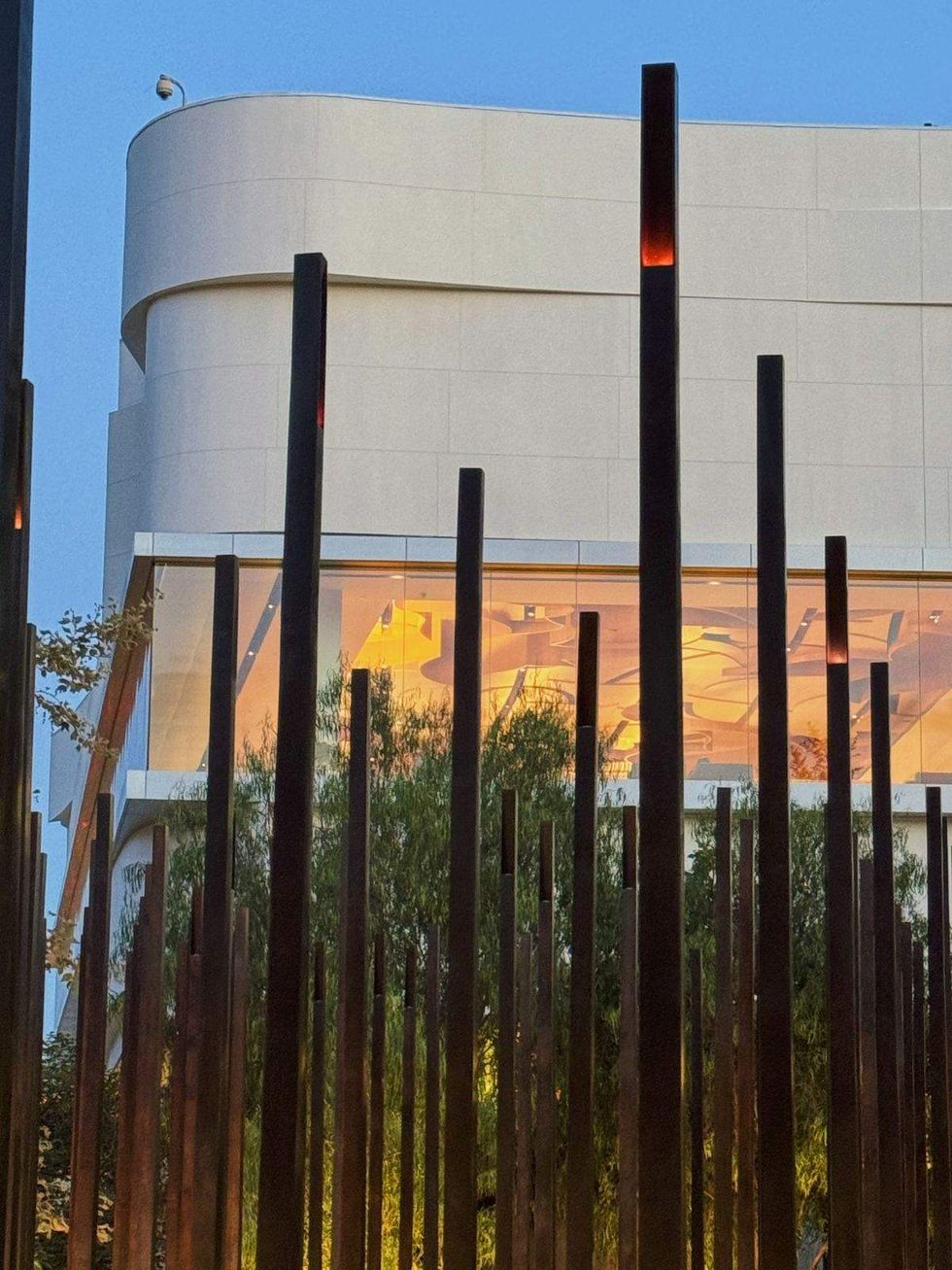 AIDS Monument i9n West Hollywood.Alysse Dalessandro for The Advocate
On the other side of the park from the Mazer, West Hollywood’s new AIDS Monument ensures another chapter of LGBTQ+ history is never forgotten. Tony Valenzuela, executive director of the ONE Institute, which stewards the monument, explained that its San Vicente Boulevard location, less than a quarter-mile from historic Route 66, was intentionally chosen for visibility.
“Visibility was a huge part of the protests,” explained Valenzuela. “There’s this sad irony that people living with HIV and AIDS were very visible. They were emaciated. They had KS lesions, sort of purple splotches on them. It was easy to tell. Also, you can’t change hearts and minds, and you can’t win a movement without being visible.”
On our last night in West Hollywood, we returned to watch the bronze pillars illuminate one by one, echoing the lighting of candles at a vigil. Watching the monument slowly come to life, I realized that remembrance, like hope, grows brighter when people refuse to carry it alone.
As my wife and I began the 36-hour journey home, my focus shifted from the hidden history I’d spent the past month uncovering to our own visibility. Traveling nearly 2,000 miles east on Route 66 as a visibly queer couple meant navigating the same patchwork of laws and attitudes LGBTQ+ travelers have encountered for generations.
The long road home
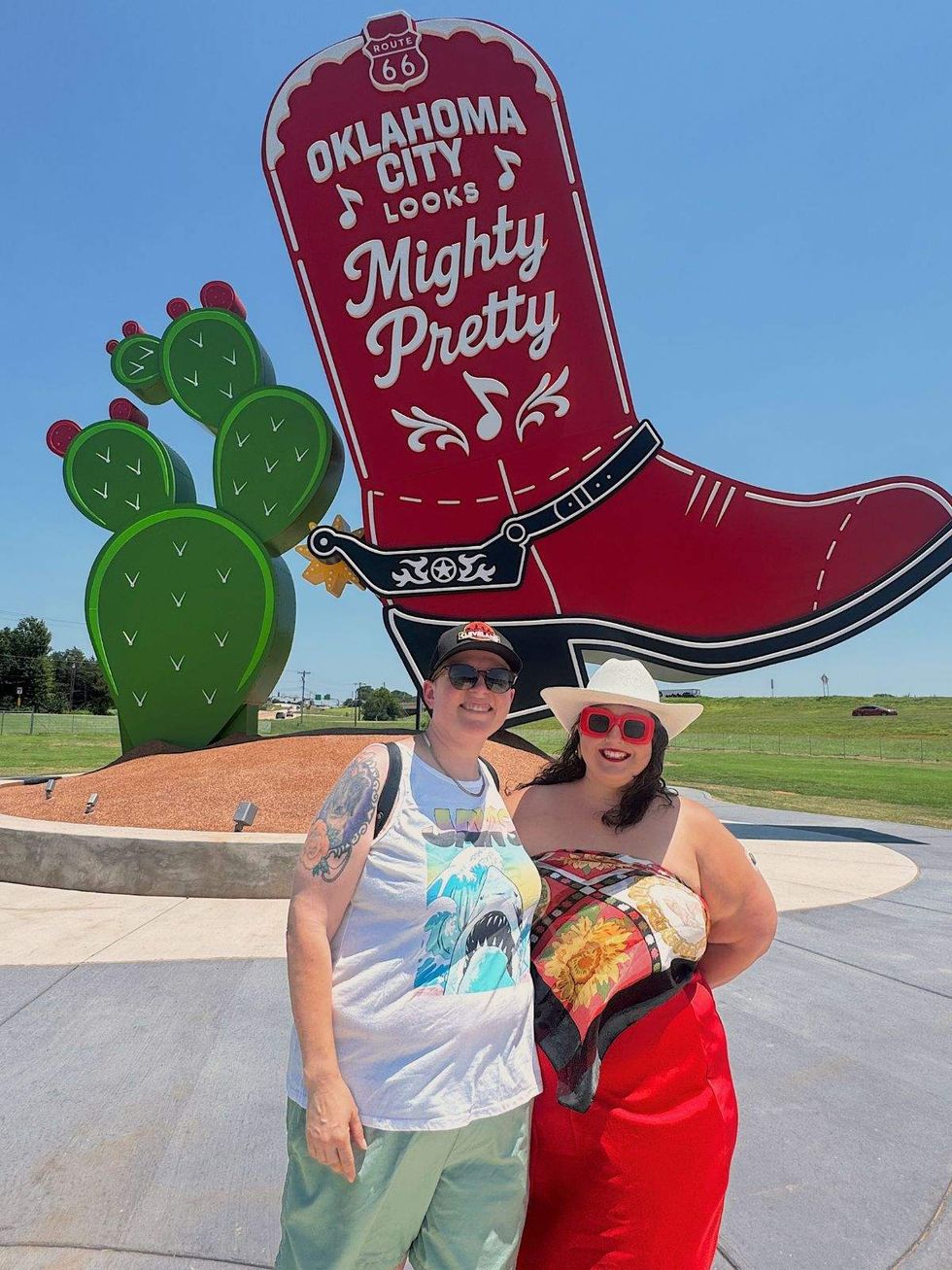 Oklahoma CityAlysse Dalessandro for The Advocate
Our trip home had its highs and lows. At Grand Canyon National Park, we took a Pink Jeep tour and admired the work of lesbian architect Mary Colter, whose designs — including Hopi House, Hermit’s Rest, Lookout Studio and Desert View Watchtower — all still stand in the park. We held hands without a second thought. Our visibility simply felt ordinary.
Texas challenged our comfort. In Amarillo, we stopped at the famed art installation Cadillac Ranch. As we got out of our car, I asked my wife, who uses she/they pronouns interchangeably, if they wanted to stop at the LGBTQ+-friendly café in town that I had scouted for its gender-neutral restroom. They said a gas station would be fine.
With spray paint in hand, we wandered toward one of the less crowded Cadillacs. As we turned to leave, I noticed my wife picking up the spray paint can again. Like so many LGBTQ+ people with religious trauma, they painted over a Bible verse. I added a rainbow. Moments later, a teenage boy painted the Bible verse back over our work as his family cheered from the sidelines.
My first instinct was to stay and keep painting. My wife’s was simpler: “Let’s just go.” As we drove away, they asked how far it was to the café with the gender-neutral restroom. On Amarillo’s stretch of Route 66, we found solace in the bathroom graffiti at 806: “Trust no gods.”
Leaving Amarillo, I felt the tension drain away mile by mile. I exhaled as we walked into Frankie’s, one of Oklahoma City’s lesbian bars. A neon sign reading “Welcome Home” greeted us, along with hugs from the bar’s regulars. We spent the night at the Skirvin, a historic hotel recognized by the National Trust for Historic Preservation. Its grand lobby and Art Deco architecture offered a glimpse into Route 66’s earliest years.
The contrast between Amarillo and Oklahoma City reminded me that you can’t paint Route 66 with broad strokes. Despite the nostalgic narrative that often defines it, the Mother Road has always contained multitudes. It can hold the unease of Cadillac Ranch and the comfort of Frankie’s, Bible verses and Pride flags, fear and belonging — all within a day’s drive of one another. After Amarillo, I realized my goal had never been to erase Route 66’s story. It was to expand it and make room for the people who had always been part of it.
Making room for the next generation
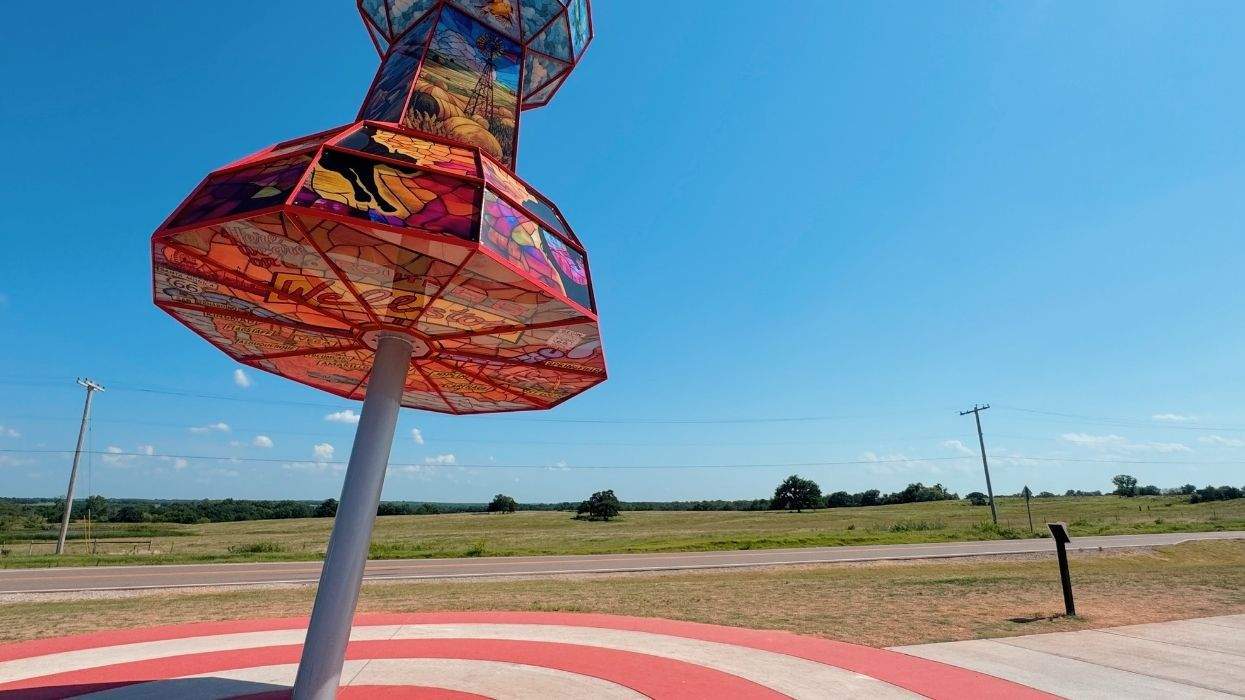
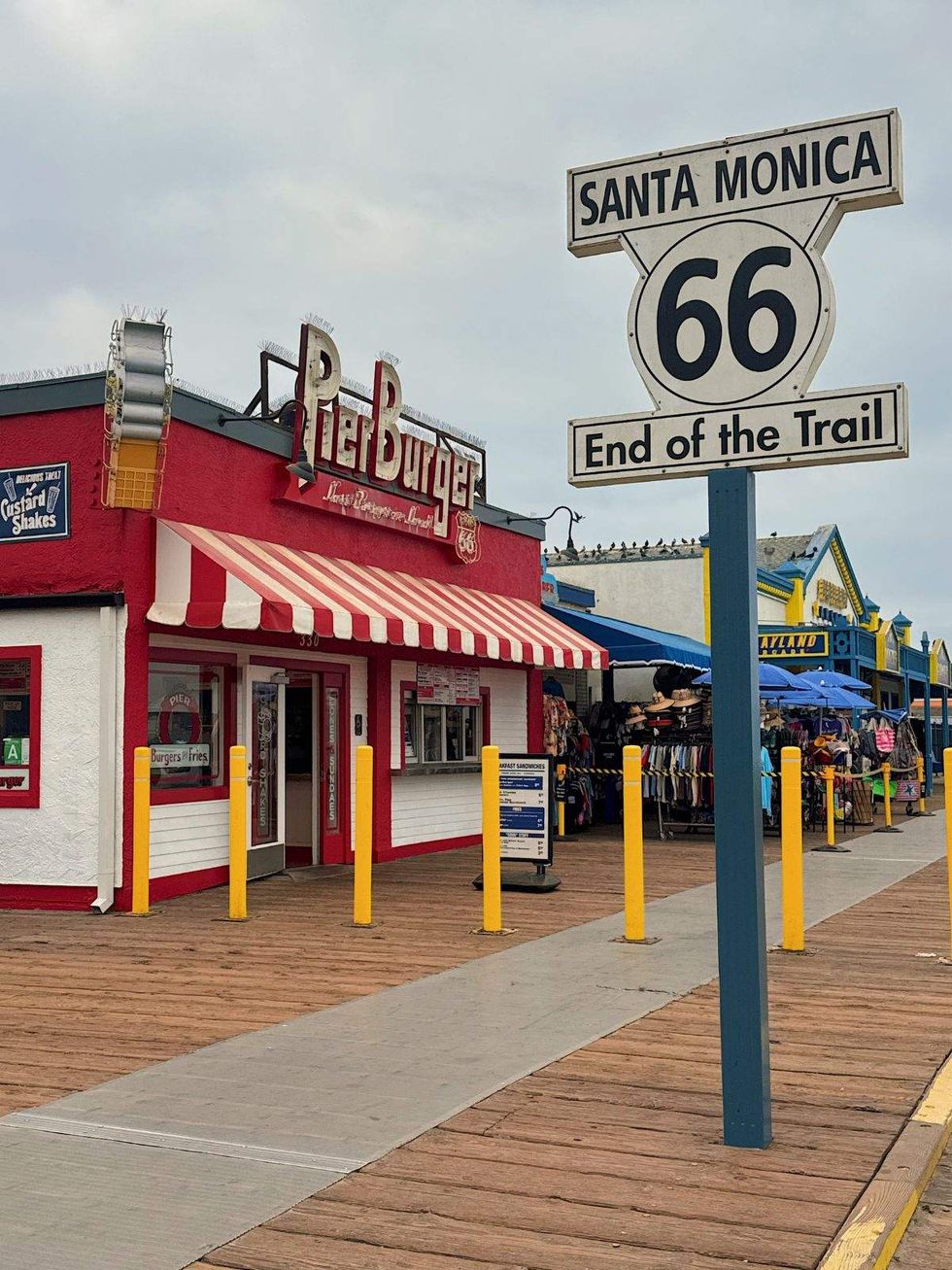 The end of Route 66 in CaliforniaAlysse Dalessandro for The Advocate
“You have a lot of people that might not feel like there’s space, and I’ve always said if you don’t feel like there’s space, make space,” Albuquerque drag queen Vanessa Patricks told me.
Interview after interview, I asked a version of the same question: What keeps you doing this work? The answer was queer youth.
In Albuquerque, I interviewed one of those emerging queer leaders: 18-year-old Ayzia Bridges. As her mother, makeup artist Danielle Bridges, applied gender-affirming makeup, I asked Ayzia what she wanted her queer elders to know.
“I think they fought a lot to set the base for us. And I think it puts a lot of weight on our shoulders to follow in their footsteps. But in the most respectful way, I don’t wanna follow in their footsteps. I want to see how far we can go.”
Ayzia’s answer reminded me that every person I’d met along Route 66 had done the same thing. They hadn’t accepted the story they inherited. They expanded it not just for themselves but for their communities, making the road a little wider for the people who followed. Much of Route 66’s LGBTQ+ history remains hidden in archives and memories across the Mother Road. But in every community I visited, I met people refusing to let their stories be erased. I left the Mother Road believing the next generation would inherit a fuller story than the one I set out to find.
Visit California, Hilton and Booking.com provided support for this trip. All views and opinions are the author’s.