'%3E%3Cpath d='M16.3574 35.6519H12.9537L15.0491 18.8873L16.3574 35.6519ZM30.4229 54.0093L22.309 0.994385H7.91795L0 54.0093H10.6634L11.5802 46.3855H17.4014L17.9914 54.0093H30.4229Z' fill='%23971B20'/%3E%3Cpath d='M48.2073 41.8813C48.2073 43.4049 47.4892 44.0011 46.1144 44.0011H43.7595V11.0687H46.1144C47.4892 11.0687 48.2073 11.6636 48.2073 13.1885V41.8813ZM59.5273 43.6695V11.3326C59.5273 3.71323 53.5729 0.994385 47.8157 0.994385H31.7213V54.0093H47.8157C53.5729 54.0093 59.5273 51.29 59.5273 43.6695Z' fill='%23971B20'/%3E%3Cpath d='M90.183 0.994385H78.6039L75.0711 30.6157L71.9955 0.994385H59.4346L69.2474 54.0093H80.373L90.183 0.994385Z' fill='%23971B20'/%3E%3Cpath d='M107.063 42.3448C107.063 43.7359 105.951 44.5974 104.643 44.5974C103.269 44.5974 102.157 43.7359 102.157 42.3448V12.658C102.157 11.2676 103.269 10.4058 104.643 10.4058C105.951 10.4058 107.063 11.2676 107.063 12.658V42.3448ZM119.233 43.2723V11.7312C119.233 6.36384 112.952 -3.8147e-06 104.643 -3.8147e-06C96.2667 -3.8147e-06 89.9867 6.36384 89.9867 11.7312V43.2723C89.9867 48.6393 96.2667 55 104.643 55C112.952 55 119.233 48.6393 119.233 43.2723Z' fill='%23971B20'/%3E%3Cpath d='M150.976 43.9349V33.7309H139.069V42.3448C139.069 43.7359 137.957 44.5974 136.582 44.5974C135.076 44.5974 133.964 43.7359 133.964 42.3448V12.658C133.964 11.2676 135.076 10.4058 136.582 10.4058C137.957 10.4058 139.069 11.2676 139.069 12.658V21.2723H150.976V11.0687C150.976 5.70107 145.283 -3.8147e-06 136.582 -3.8147e-06C127.75 -3.8147e-06 121.796 5.70107 121.796 11.0687V43.9349C121.796 49.3022 127.75 55 136.582 55C145.283 55 150.976 49.3022 150.976 43.9349Z' fill='%23971B20'/%3E%3Cpath d='M167.478 35.6519H164.076L166.17 18.8873L167.478 35.6519ZM181.544 54.0093L173.432 0.994385H159.037L151.123 54.0093H161.785L162.704 46.3855H168.523L169.114 54.0093H181.544Z' fill='%23971B20'/%3E%3Cpath d='M205.412 10.4058V0.994385H177.081V10.4058H185.392V54.0093H197.428V10.4058H205.412Z' fill='%23971B20'/%3E%3Cpath d='M230.002 54.0093V43.9349H218.914V31.8746H226.635V21.8028H218.914V10.4058H230.002V0.994385H206.875V54.0093H230.002Z' fill='%23971B20'/%3E%3C/g%3E%3Cdefs%3E%3CclipPath id='clip0_260_7080'%3E%3Crect width='230' height='55' fill='white'/%3E%3C/clipPath%3E%3C/defs%3E%3C/svg%3E)

Get your kicks on Route 66

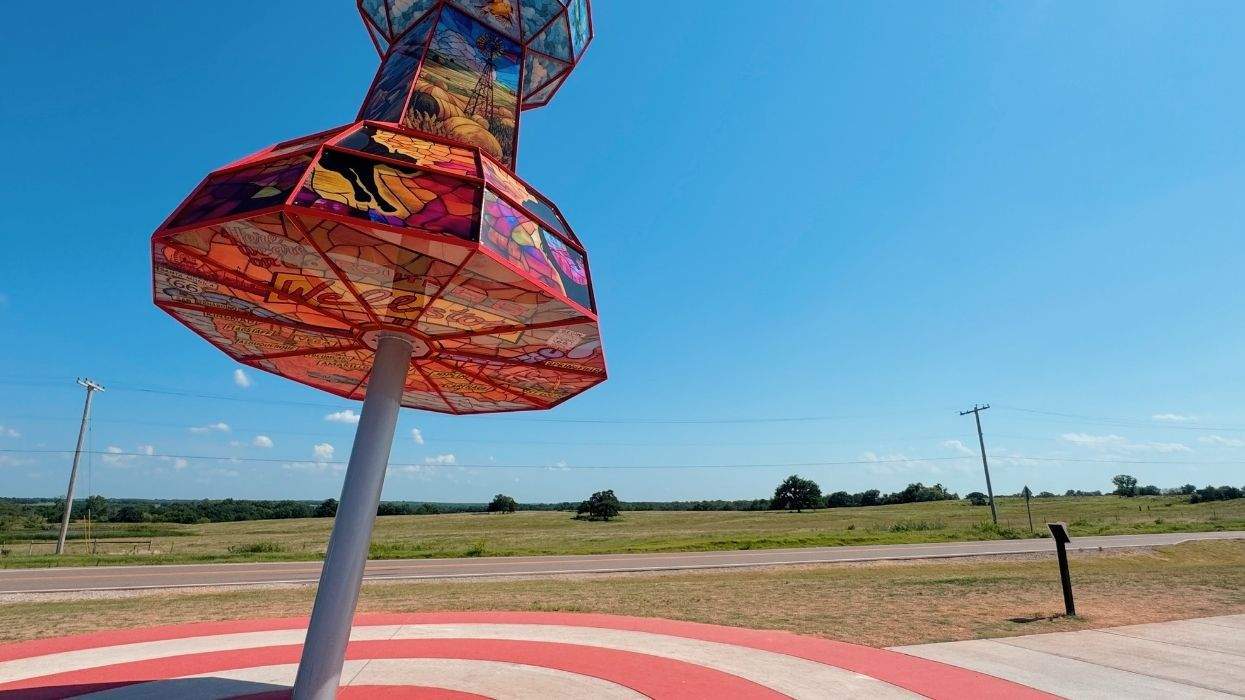
Oklahoma City's giant Route 66 cowboy boot sculpture.
Alysse Dalessandro for The Advocate
Sitting beneath a 40-foot-tall red neon cowboy boot sculpture of his own design, artist Cameron Eagle recounted his personal connection to Route 66.
“My grandparents had a farm, and the route cut their farm in half,” Eagle said. “They didn’t get upset about it because it was just the way it was.”
So what did Eagle’s grandparents do when cars began driving through the middle of their Oklahoma farm? They built an underpass to allow animals to move between the two sides. In the 1930s, when Oklahoma began paving Route 66, Eagle’s grandfather and his displaced mules helped build the road. By 1938, Route 66 had become the nation’s first fully paved highway.
During my second week on the Mother Road, Route 66’s nostalgia gave way to something more complicated. In Oklahoma and Texas, I found communities shaped by highways, policing, racism, economic change, and anti-LGBTQ+ hostility. Again and again, Black and queer people had responded by rebuilding, preserving history, and creating their own systems of safety.
Related: Dispatches from Route 66: Discover the queer stories hidden along the iconic road trip
Tulsa’s Route 66 is more than nostalgia

Route 66 souvenirs in Tulsa.
Alysse Dalessandro for The Advocate
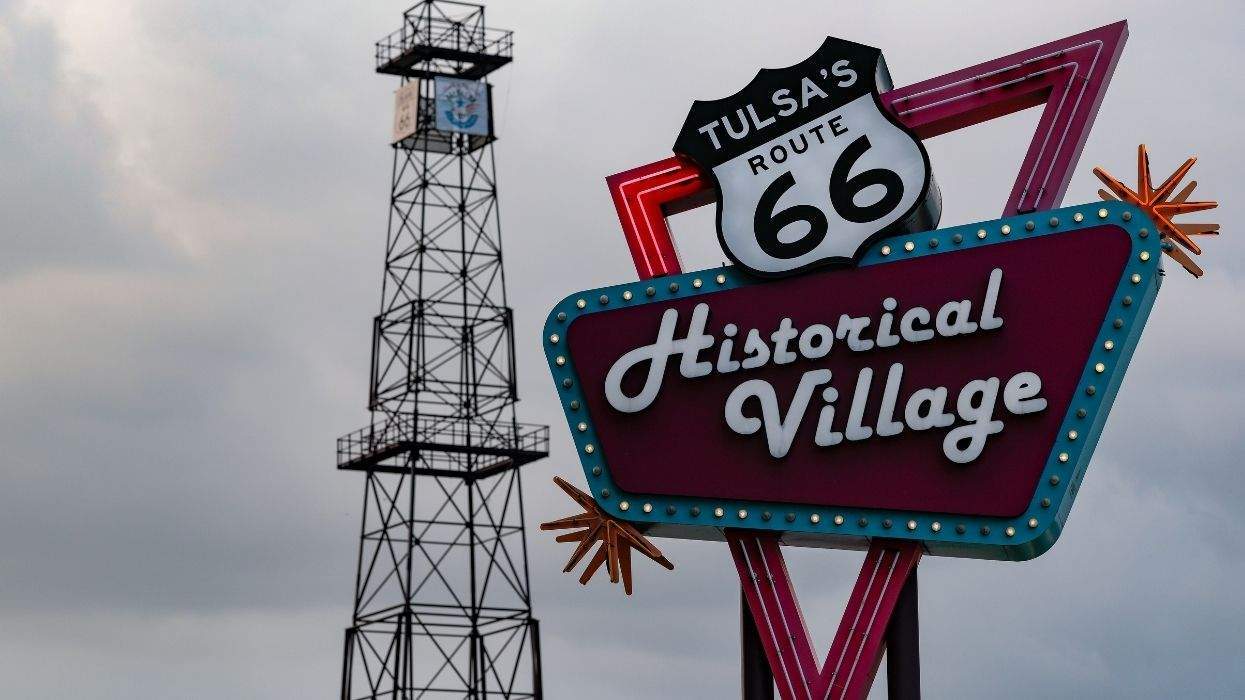
As the officially designated Capital of Route 66, Tulsa could easily be a city stuck in nostalgia. Instead, I found it refreshingly progressive. At Mother Road Market, I could choose between jollof rice, sushi, gumbo, and dozens of other cuisines reflecting the city’s diversity. I browsed books from Kinara Bookstore, a pop-up bookseller focused exclusively on marginalized authors.
By the time I reached Tulsa, I had made more than 20 stops along Route 66 to collect stamps in the Route 66 passport. I thought it would be a fun way to see places outside the cities where I planned to stay overnight. Some stops offered a look into Route 66 lore. Others, like the antique mall with a giant Trump statue out front, left me feeling completely unsafe.
When I entered Buck Atom’s Cosmic Curios to get my stamp, I expected more standard Route 66 merch. I almost cried when I saw a Progress Pride flag, a Route 66 sticker, and a Gilbert Baker Pride flag at the register. At the shop’s sister store, Meadow Gold Mack, I was immediately drawn to a 1980s-style painting of a gender-bending cowboy by Dan Rocky, an Indigenous artist who uses they/them pronouns.
Tulsa was the first place where I saw queerness fully woven into the Route 66 experience, and that visibility felt especially poignant given the city’s history. Just a few miles from Route 66 sits the former site of the 1921 Tulsa Race Massacre, one of the deadliest acts of racial violence in American history.
In Greenwood, rebuilding was resistance

A mural honors the history of Tulsa's Greenwood District.
Alysse Dalessandro for The Advocate
I met Chief Egunwale Amusan, author, historian, and founder of the Real Black Wall Street Tour, in Tulsa’s historic Greenwood District. He began by telling me it was important to tell this story through the lens of the people who experienced it, not those who tried to cover it up.
Fueled by Black land ownership, Greenwood grew into a thriving business district that Booker T. Washington famously dubbed “Negro Wall Street.” In a matter of 18 hours, Greenwood was burned to the ground by white residents. Though insurance companies denied their claims, Black survivors rebuilt Greenwood. Chief recalled asking survivors how they could rebuild after everything they had endured.
“We’re people that used to be property that now own it,” Chief said. “And one thing we wasn’t gonna do is go backwards.”
In 1967, the construction of Interstate 244 cut through Greenwood, disrupting the community that survivors had spent decades rebuilding after the massacre.
“The highways killed commercial districts in Black communities,” Chief said. “So when I was a kid, there were still 129 Black-owned businesses in Greenwood. By the time I graduated high school, zero.”
Before leaving town the next day, I visited Greenwood Rising, the Black Wall Street History Center. Even when communities fight to preserve their history, some people remain hidden within it.
The hidden histories still waiting to be found

Greenwood Rising explores the lives and legacies of Black Tulsans.
Alysse Dalessandro for The Advocate
While exploring Greenwood Rising, I became fascinated by the story of cafe owner Susie Bell. The museum displayed a photograph of Bell wearing a wide-brimmed fedora, suit, and tie, attire that would have challenged the era's gender expectations. Other historical sources note that no confirmed photograph of Bell has been found.
That uncertainty felt familiar. Throughout this journey, I repeatedly encountered people whose stories survive only in fragments.
A quote from Black queer writer James Baldwin is displayed on the side of the building: “Not everything that is faced can be changed, but nothing can be changed until it is faced.”
There was something fitting about ending my search for hidden histories beneath Baldwin’s words. The work is not just preserving history. It is continuing to look for the communities that have always been part of it.
Decades after Black Wall Street was rebuilt through the determination of Black entrepreneurs, a Black-owned bank helped preserve another marginalized community space: the only LGBTQ+ hotel on Route 66.
The only LGBTQ+ hotel on Route 66

The Habana Inn evolved into today's District Hotel.
Alysse Dalessandro for The Advocate
Steve Blundell was 18 years old when he first went to The District Hotel, then called the Habana Inn. Blundell found community and safety there that he did not experience anywhere else in Oklahoma City at the time.
“On any given night during that time, if you left this area about 2 o’clock in the morning, there’d probably be about 10 or 20 police cars sitting over there,” Blundell said. “You had about a 50 to 75 percent chance of one of their lights coming on as soon as you pulled out of the parking lot here, and you were gonna get pulled over and harassed.”
To avoid harassment, patrons of the gay clubs started staying overnight at the hotel. In 1983, the owners of Angles filed a civil lawsuit that barred police harassment of gay clubgoers and required gay awareness training. While the harassment stopped, the hotel remained a gay haven.
Originally built in 1965 along Route 66’s motel row, the property was not always a gay hotel. As Interstate 44 reshaped the area and the city’s economy changed, the owners embraced a growing LGBTQ+ clientele. Much of the original 1965 structure still stands, showing traces of where new Buick models once drove directly into the hotel for dealer showcases.
In the 1980s, the space that had once displayed Buicks became The Finishline, an iconic gay country-western bar. As Blundell scrolled through old photos and recalled friends lost to AIDS, I understood why he worked so hard to restore the space, antler chandelier and all.
As we walked the property, Blundell pointed out long-term residents, many of them LGBTQ+ seniors, and showed me spaces that reflect the hotel’s evolution. Jockstraps hang from chandeliers in The Eagle, former VIP sections have become puppy play areas, and patrons dancing poolside to EDM greeted him warmly as we walked by.
The District’s gender-nonconforming staff already signaled that inclusivity is more than a marketing slogan here. But as Blundell spoke about attacks on Oklahoma’s trans community, his voice cracked, and tears filled his eyes. At that moment, it became clear he was not interested in becoming another gay man operating a property that serves only the “G” in LGBTQ+.
Where queer community became infrastructure

Murals add color to Oklahoma City's Plaza District.
Alysse Dalessandro for The Advocate
The District is one of several thriving LGBTQ+-owned businesses in Oklahoma City. Another is Frankie’s, featured in the Lesbian Bar Project, where the city’s lesbian dart league welcomed me with open arms. I wondered why Tulsa, with its 18,000-square-foot dedicated Equality Center, does not seem to have the same queer business infrastructure as other cities. Rachael Crawford, executive director of the Plaza District, helped me understand.
“Adversity breeds community, so the less resources we have, the more we have to make a decision to come together on our own,” Crawford said. “That’s why our gay bars are thriving compared to other places.”
Crossing into Texas with caution

Route 66 landmarks in Amarillo during Juneteenth.
Alysse Dalessandro for The Advocate
Crawford’s words stayed with me as I prepared to travel to Amarillo. After witnessing a fight in Stroud, Oklahoma, and later learning it was a former sundown town, I found myself studying a digital copy of the 1947 Green Book at the Oklahoma History Center with new appreciation. That evening, I swapped a remote short-term rental for the Embassy Suites in downtown Amarillo, knowing that a familiar hotel brand and centralized location would help me feel more at ease. I filled my gas tank before dark and changed out of a rainbow-print dress before crossing into Texas.
I intentionally planned to be in Texas on Juneteenth. Rather than attend a celebration, I spent the day volunteering with the Amarillo Area Transgender Advocacy Group’s food pantry. When I arrived at the San Jacinto Community Center and immediately began unloading food donations from Public Relations Chair Teresa Burnett’s truck, it became obvious why no one had returned my emails. They were busy doing the work.
“The first week we had a guy call that said he filled all the paperwork out for one of the other places here in town,” AATAG President Sam Burnett said. “As soon as they got to list their spouse and they realized that he had a husband, they turned him away and wouldn’t give him anything.”
During a break from volunteering, I visited Amarillo’s Black Historical Cultural Center, where events manager Annie Wesley showed me an original 1940 Green Book, one of the artifacts she hopes to display in a future museum. Just a day after viewing a digital copy in Oklahoma City, the real thing was in front of me. If that is not a piece of Route 66 history, I do not know what is.
If there are major Route 66 funding grants in Amarillo, as I have seen in other Route 66 cities, they do not appear to be reaching places like the Black Historical Cultural Center and the San Jacinto Community Center.
I asked Teresa Burnett what it has been like being the spouse of a trans person in Texas, and I do not think I will ever forget her response.
“You know, we had to have the conversation of if he gets picked up, then me and my daughter are gonna leave the country,” she said. “And I’m like, ‘I’m not leaving without you.’ He’s like, ‘You’re leaving. If I get picked up and sent to a concentration camp, you have to get out of here.’”
Most of the food pantry’s volunteers did not initially know Sam Burnett was trans. But when attacks on the trans community intensified, he chose visibility over safety, running for mayor in 2023 as an out trans candidate.
“Minorities are all fighting the same fight,” Sam said. “If all of the different minority groups would join and band together, we could out-vote them.”
Is Route 66 safe for trans travelers?

Donated food is organized for distribution at the Amarillo Area Transgender Advocacy Group's food pantry.
Alysse Dalessandro for The Advocate
Feeding the greater Amarillo community has helped humanize the local trans community. But I wanted to know what that means for travelers. Booking.com reports that Amarillo is expected to see an 85.85 percent increase in tourism interest this year.
Is Route 66 in Texas safe for trans travelers?
The answer is complicated. Alone, probably not. With AATAG’s help, absolutely. Sam and AATAG’s board of directors keep a list of businesses that are safe and welcoming to trans travelers, along with a list of businesses to avoid. But Sam takes it further.
“We’re gonna go to dinner with you,” Sam said. “We’re gonna have coffee. Wednesday nights we have a support group.”
What resilience looks like on the road

Sam Burnett and Alysse Dalessandro at the Amarillo Area Transgender Advocacy Group's food pantry.
Alysse Dalessandro for The Advocate
As we unpacked boxes of barely expired baked goods, one volunteer told me, “I do this every week, and it feeds me.”
I do not know whether he meant the food pantry literally feeds him or whether the work feeds something deeper. After two weeks on Route 66, I was not sure it mattered. Everywhere I stopped, I found communities rebuilding, preserving history, and creating safety for one another. Amarillo was not an exception to that story. It was another chapter in it.
Visit Tulsa, Hilton, and Booking.com provided support for this trip. All views and opinions are the author’s.