'%3E%3Cpath d='M16.3574 35.6519H12.9537L15.0491 18.8873L16.3574 35.6519ZM30.4229 54.0093L22.309 0.994385H7.91795L0 54.0093H10.6634L11.5802 46.3855H17.4014L17.9914 54.0093H30.4229Z' fill='%23971B20'/%3E%3Cpath d='M48.2073 41.8813C48.2073 43.4049 47.4892 44.0011 46.1144 44.0011H43.7595V11.0687H46.1144C47.4892 11.0687 48.2073 11.6636 48.2073 13.1885V41.8813ZM59.5273 43.6695V11.3326C59.5273 3.71323 53.5729 0.994385 47.8157 0.994385H31.7213V54.0093H47.8157C53.5729 54.0093 59.5273 51.29 59.5273 43.6695Z' fill='%23971B20'/%3E%3Cpath d='M90.183 0.994385H78.6039L75.0711 30.6157L71.9955 0.994385H59.4346L69.2474 54.0093H80.373L90.183 0.994385Z' fill='%23971B20'/%3E%3Cpath d='M107.063 42.3448C107.063 43.7359 105.951 44.5974 104.643 44.5974C103.269 44.5974 102.157 43.7359 102.157 42.3448V12.658C102.157 11.2676 103.269 10.4058 104.643 10.4058C105.951 10.4058 107.063 11.2676 107.063 12.658V42.3448ZM119.233 43.2723V11.7312C119.233 6.36384 112.952 -3.8147e-06 104.643 -3.8147e-06C96.2667 -3.8147e-06 89.9867 6.36384 89.9867 11.7312V43.2723C89.9867 48.6393 96.2667 55 104.643 55C112.952 55 119.233 48.6393 119.233 43.2723Z' fill='%23971B20'/%3E%3Cpath d='M150.976 43.9349V33.7309H139.069V42.3448C139.069 43.7359 137.957 44.5974 136.582 44.5974C135.076 44.5974 133.964 43.7359 133.964 42.3448V12.658C133.964 11.2676 135.076 10.4058 136.582 10.4058C137.957 10.4058 139.069 11.2676 139.069 12.658V21.2723H150.976V11.0687C150.976 5.70107 145.283 -3.8147e-06 136.582 -3.8147e-06C127.75 -3.8147e-06 121.796 5.70107 121.796 11.0687V43.9349C121.796 49.3022 127.75 55 136.582 55C145.283 55 150.976 49.3022 150.976 43.9349Z' fill='%23971B20'/%3E%3Cpath d='M167.478 35.6519H164.076L166.17 18.8873L167.478 35.6519ZM181.544 54.0093L173.432 0.994385H159.037L151.123 54.0093H161.785L162.704 46.3855H168.523L169.114 54.0093H181.544Z' fill='%23971B20'/%3E%3Cpath d='M205.412 10.4058V0.994385H177.081V10.4058H185.392V54.0093H197.428V10.4058H205.412Z' fill='%23971B20'/%3E%3Cpath d='M230.002 54.0093V43.9349H218.914V31.8746H226.635V21.8028H218.914V10.4058H230.002V0.994385H206.875V54.0093H230.002Z' fill='%23971B20'/%3E%3C/g%3E%3Cdefs%3E%3CclipPath id='clip0_260_7080'%3E%3Crect width='230' height='55' fill='white'/%3E%3C/clipPath%3E%3C/defs%3E%3C/svg%3E)

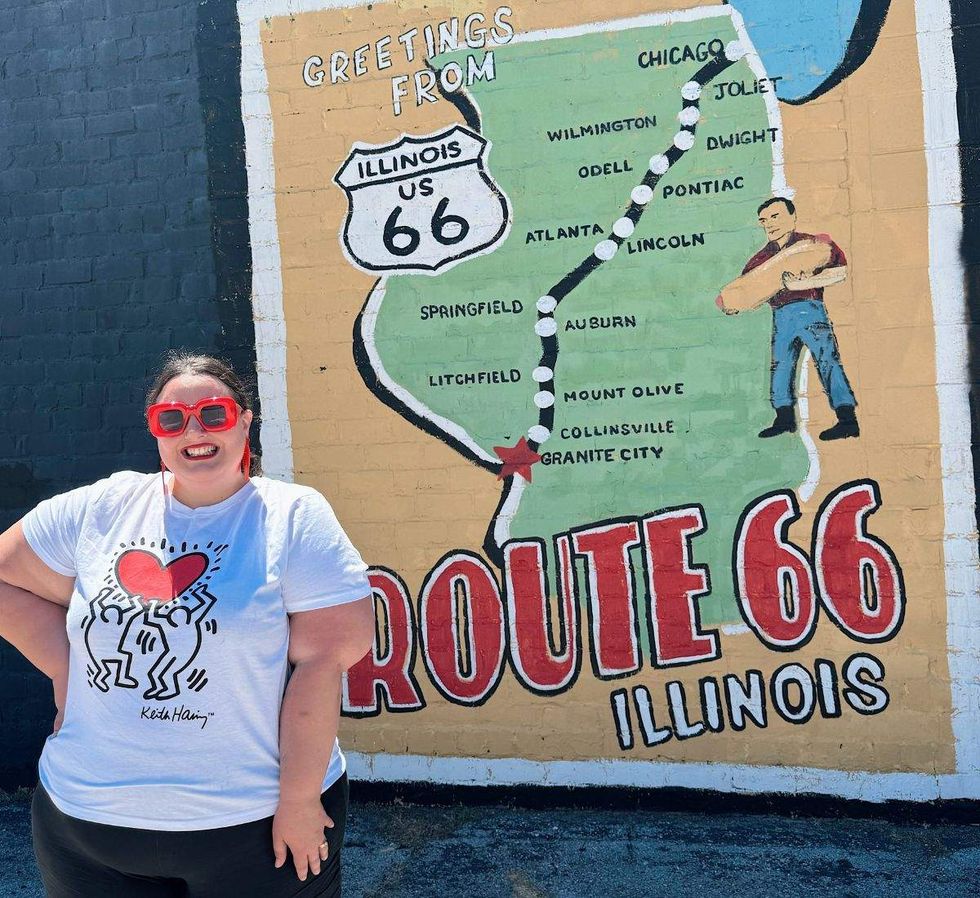
Driving along historic Route 66 in Edwardsville, Illinois, I heard the honking before I saw the crowd.
At first, all I could make out were American flags waving in the town square. As a solo queer female traveler passing through a city of about 26,000 people, I kept my guard up.
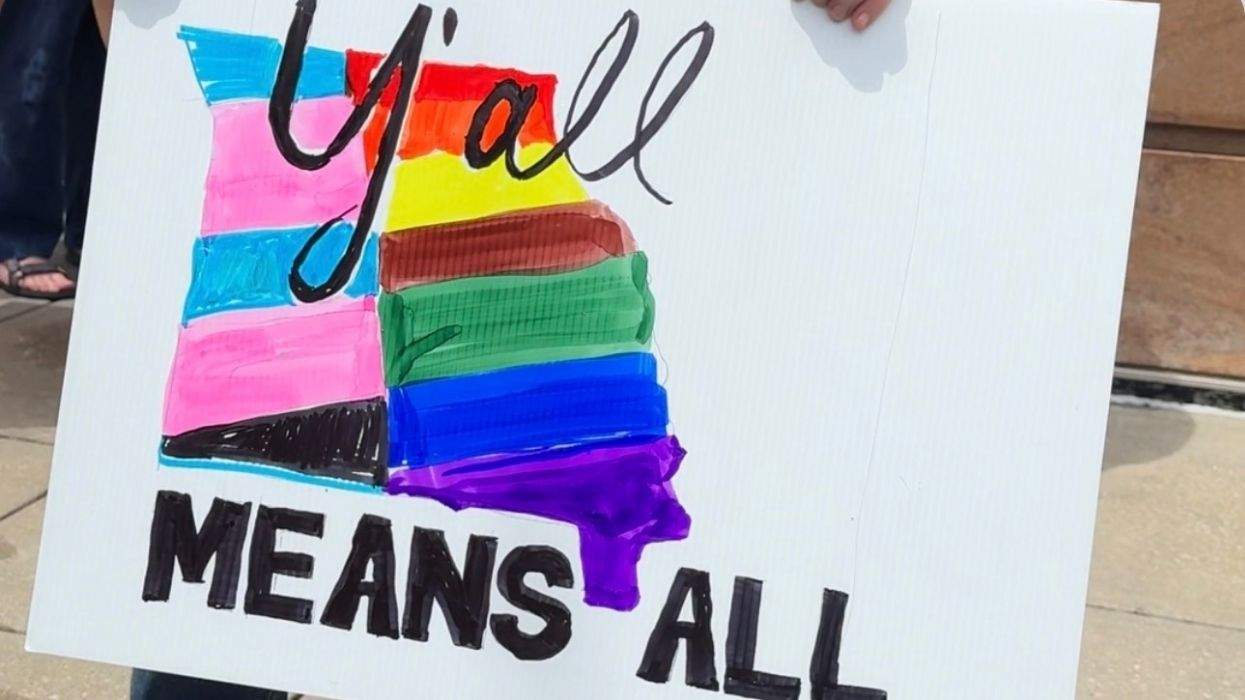
Then I spotted a sign. "Proud LGBTQ Mom, Proud Ally." Other signs called for protecting democracy and fighting fascism.
I had reached Edwardsville roughly 275 miles into a monthlong journey along Route 66. From June 7 through July 1, I’m exploring the LGBTQ+ experience along America's most famous highway — its past, present, and future.
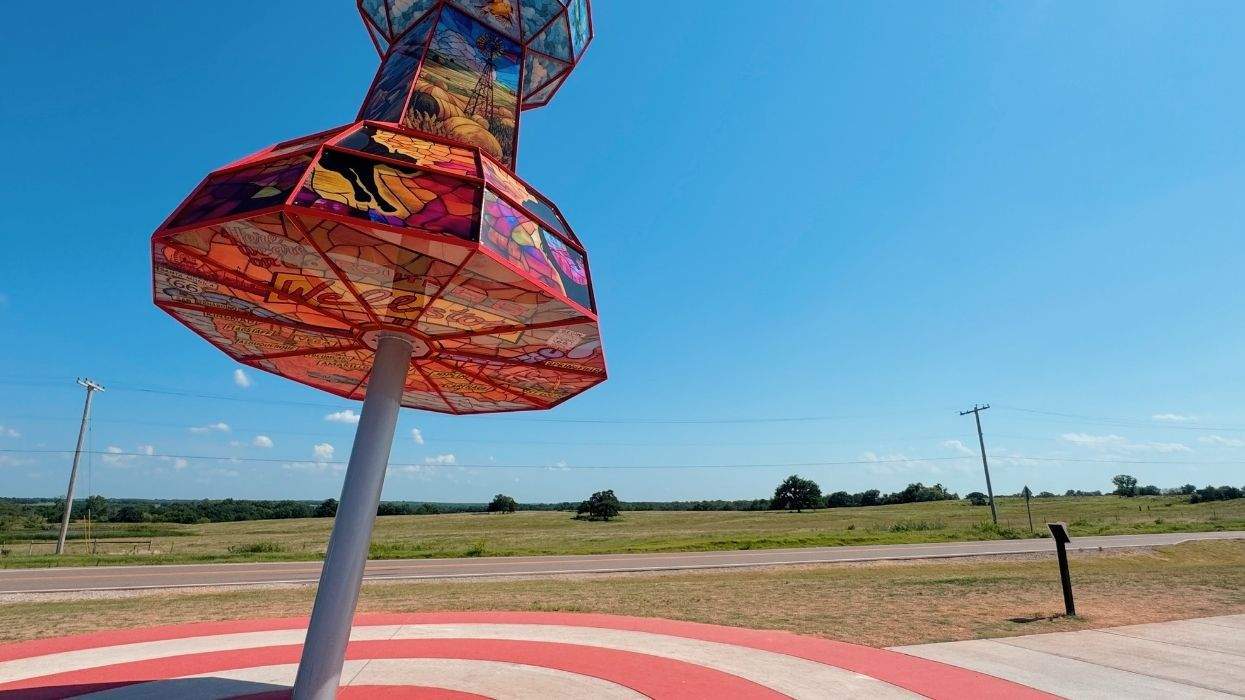
As Route 66 celebrates its centennial this year, communities across its more than 2,400 miles are marking the occasion with festivals, museum exhibits, and tributes to the roadway's place in American history. But after visiting Route 66 landmarks and museums, I kept noticing who was missing from the story.
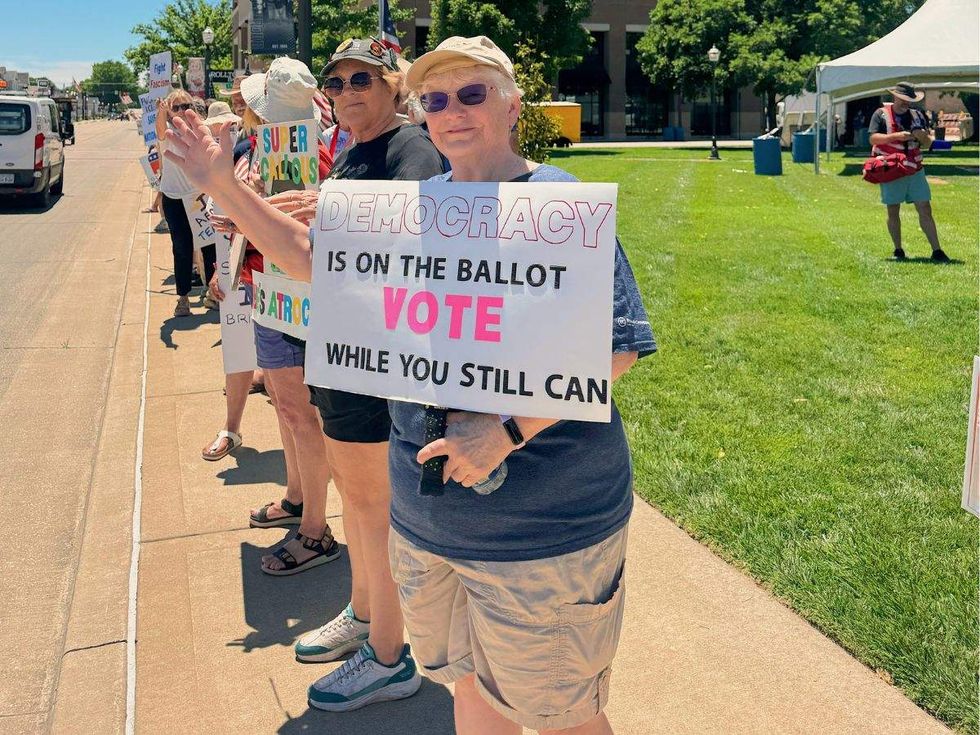 Protesters in Edwardsville, Illinois.Alysse Dalessandro for The Advocate
Some sites acknowledge the barriers Black travelers faced and the safe havens that emerged in response, including places such as the Alberta Hotel in Springfield, Missouri. LGBTQ+ travelers, however, are largely absent from the official narrative.
Yet their stories are everywhere once you start looking.
The horns continued to sound as I met Andi Smith, who explained that the American flags were part of preparations for Edwardsville's upcoming Route 66 centennial celebration. Smith knows the town square well. She has been standing there every Friday at noon since Feb. 4, 2025.
What started as one woman's frustration with the current administration has grown into a community catalyst. Smith said anywhere from 100 to 300 people now attend the weekly demonstrations, while as many as 1,600 joined the community's recent No Kings protest.
"The first day I stood here by myself, and someone joined me wearing a rainbow sweatshirt," Smith said. "And the next day we had five. By Friday we had a dozen, and it's just kept steamrolling every single week since then."
In an April 2025 speech, Illinois Gov. J.B. Pritzker applauded Smith's efforts and the stand she has taken in her community.
I had never heard of Edwardsville before planning this trip.
Yet just a few hours after meeting Smith in the town square, I found myself examining archival documents of LGBTQ+ history when Edwardsville unexpectedly appeared again.
An arrest record in the archives
Along a stretch of roadway designated Historic Route 66 in St. Louis, the Missouri Historical Society is home to the Gateway to Pride collection, one of the Midwest's largest repositories of LGBTQ+ history.
The collection preserves everything from personal letters and photographs to police records and organizational documents. Sitting in the archives and paging through materials spanning decades of queer life, I came across a document from the St. Louis Department of Police dated August 27, 1954.
 Alysse Dalessandro for The Advocate
The complaint alleged, "homosexuals frequenting the above mentioned taverns."
While the names and addresses of those arrested had been redacted, their hometowns remained. Among them was a 28-year-old shipping clerk from Edwardsville.
We don't know how he arrived at that St. Louis gay bar. But given the geography and the era, it's entirely possible he traveled there on Route 66.
That possibility lingered with me.
Because while Route 66 is often remembered as a symbol of freedom, reinvention, and opportunity, it may also have served another purpose: helping LGBTQ+ people find one another.
Route 66 wasn't America's first cross-country highway. According to the National Park Service, the Lincoln Highway connected New York and San Francisco a decade earlier. But the increasing affordability of automobiles and Route 66’s Midwestern starting point in Chicago helped transform who could travel and where they could go.
Popular culture soon turned the highway into a symbol of opportunity and self-discovery. John Steinbeck's 1939 novel The Grapes of Wrath followed the Joad family westward in search of a better life along the Mother Road, while Nat King Cole's 1946 hit "(Get Your Kicks on) Route 66," later recorded by Chuck Berry and the Rolling Stones, cemented the roadway's place in the American imagination.
The road to Chicago
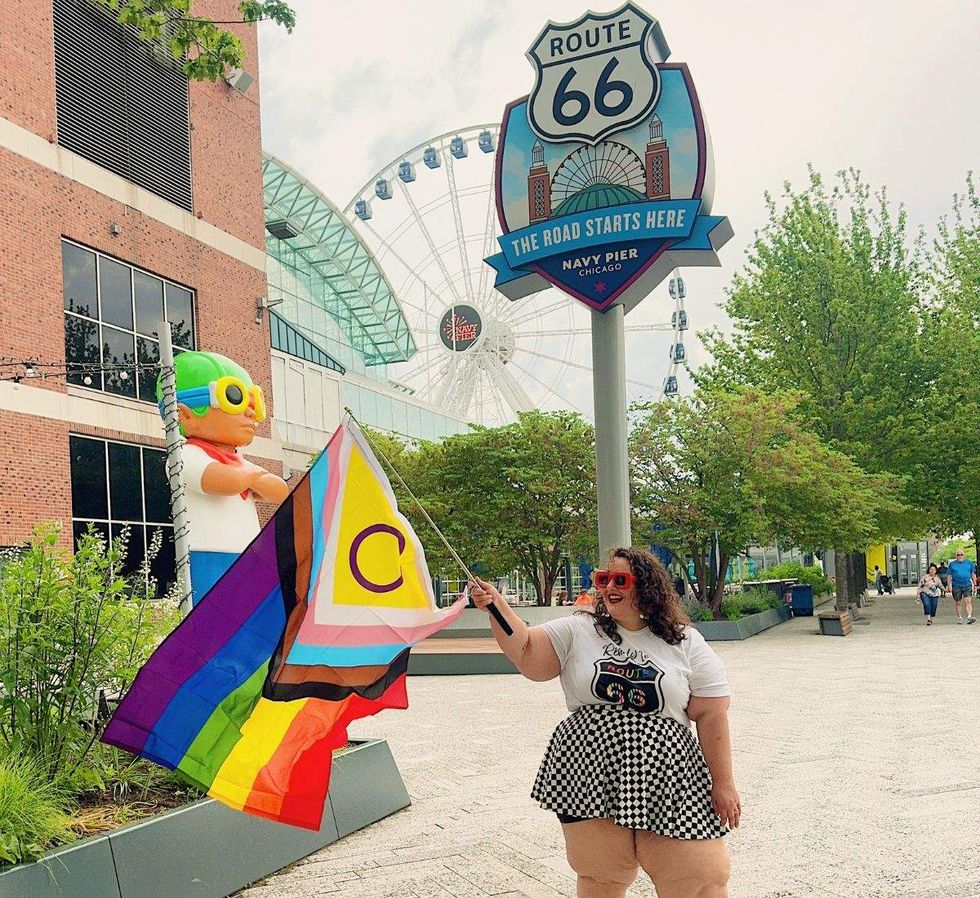
On the first day of my Route 66 trip, I stood at the Sable at Navy Pier looking out through floor-to-ceiling windows at the Chicago skyline. Twenty years ago, I moved to Chicago because I needed out of a small town where I felt suffocated by everyone's sameness. I longed for community and found it there.
Chicago is where I attended my first Pride celebration, visited my first gay bar, discovered that sexuality could be fluid, and realized that "queer" was the word that best fit my identity.
Looking out over the city, I wondered whether LGBTQ+ travelers arriving generations earlier had experienced something similar.
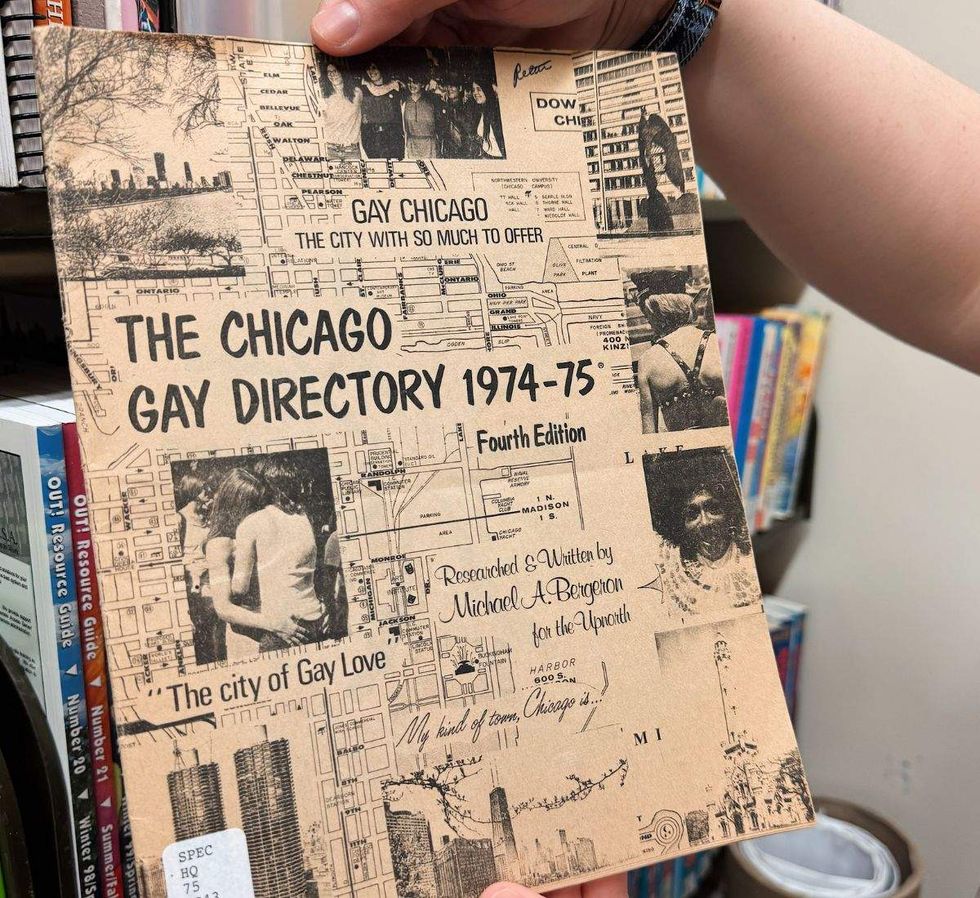
To find out, I visited Chicago's Gerber/Hart Library and Archives.
Operations Director Erin Bell helped paint a picture of the city LGBTQ+ people would have encountered in the 1920s.
 Alysse Dalessandro for The Advocate
"In 1924, Henry Gerber and a group of other gay men founded the first gay rights organization in the United States called the Society for Human Rights," Bell said. "They had to kind of keep their activities quiet, but it became a way for this group of gay men to meet, to be in community with each other."
The organization was short-lived. But Chicago would soon become even more attractive to LGBTQ+ people.
"In 1962, Illinois became the first state in the entire country to decriminalize sodomy," said tour guide and local historian Mike McMains of Tours with Mike. "It was the first state in the entire country where it was no longer illegal for a man to have sex with another man. So we probably also had an inflow of LGBTQ people coming into Chicago, likely along Route 66."
Before Boystown
Today, visitors often associate Chicago's LGBTQ+ history with Boystown and Andersonville.
But before either neighborhood emerged as a queer destination, there was Towertown.
Home to artists, bohemians, and self-described intellectuals, Towertown became one of Chicago's earliest documented gathering places for gay men and lesbians. Situated just over two miles from Route 66's original starting point at Jackson Boulevard and Michigan Avenue, the neighborhood offered newcomers an early foothold in the city.
According to Tracy Baim's Out and Proud in Chicago, there were roughly 35 venues — including tea rooms, cafes, and speakeasies — where gay men and lesbians gathered by 1930.
Most have long since disappeared. One exception remains.
The gay-friendly haunts of Towertown may be gone, but a relic of Michigan Avenue's hidden queer past survives in Second Story Bar, tucked just off Michigan Avenue on Ohio Street.
I lived in Chicago for seven years. I attended Loyola University Chicago's Water Tower campus just a few blocks away, yet I had never heard of Second Story Bar until this trip.
Like the speakeasies that once defined Towertown, its secrecy feels intentional.
There is no sign on the door. Only a small neon rainbow light glowing from a second-story window lets visitors know they're in the right place.
Inside, regulars line the bar while reruns of RuPaul's Drag Race play on a television in the corner. A stuffed toy rat spins overhead from a disco ball.
It's a far cry from the flash of Boystown's nightlife district, which helps explain why the Chicago Reader once called it the city's "best gay time machine."
It also sits as the closest surviving gay bar to Route 66.
The places that survive
As I joined Tours with Mike's Route 66 Neighborhoods by Trolley Tour, I encountered another piece of hidden LGBTQ+ history. Passing a three-story brick building that many visitors would never notice, guide Mike McMains pointed to what was once home to The Warehouse.
"Frankie Knuckles was the resident DJ, and it's seen as the most important landmark associated with house music in Chicago," McMains said.
Black LGBTQ+ Chicagoans flocked to The Warehouse, helping create a musical movement that would eventually transform dance floors around the world.
Its influence can still be felt today in spaces like Party Noire and Nobody's Darling, a Black-owned queer cocktail lounge that has become one of Chicago's most celebrated LGBTQ+ gathering places.
Although Nobody's Darling was closed during my visit, I walked by just to take it in.
I learned about the bar from my friend Chase Vondran of Explore with Chase.
Chase is also the reason I found myself on a Monday night at Fathom, a nautical-themed queer dive bar, sipping a dirty martini and singing along to Panic! At the Disco's "I Write Sins Not Tragedies" during the venue's first karaoke night.
The scene felt worlds away from the archives and historical markers I'd spent much of the week exploring.
Yet it was part of the same story.
The bars may be different. The generations may be different. But LGBTQ+ people are still gathering, building community, and creating spaces of their own along Route 66.
How travelers found one another
Before social media, before Google Maps, and before travelers could search Instagram or TikTok for recommendations, finding the LGBTQ+ community on the road required a different set of tools.
In addition to asking Chase for recommendations, I searched Facebook groups, social media, and Choose Chicago's LGBTQ+ travel resources while planning my trip.
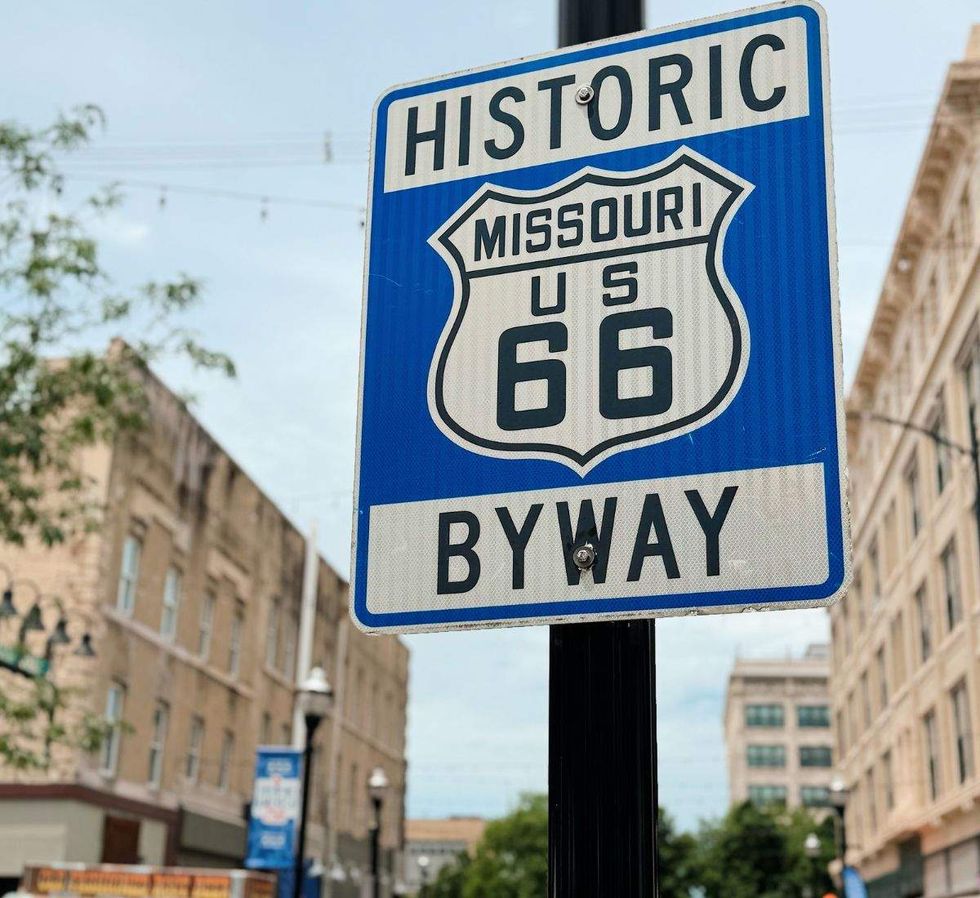
But in the era of TripTiks, travelers couldn't simply walk into AAA and ask for directions to the nearest gay bar. So how did LGBTQ+ people find one another? Part of the answer sits inside the archives of both Chicago's Gerber/Hart Library and Archives and St. Louis' Gateway to Pride collection.
 Alysse Dalessandro for The Advocate
In 1965, San Francisco bar owner Bob Damron published the first edition of what became Bob Damron's Address Book.
The pocket-sized guide listed more than 1,800 gay-friendly bars, hotels, beaches, restaurants, and gathering places across the United States, Canada, Mexico, and Puerto Rico. For countless LGBTQ+ travelers, it served as a roadmap to community. The guides reveal just how much effort was once required to locate safe spaces and welcoming faces in unfamiliar places.
That reality became even clearer while paging through a 1980s photo album documenting a gathering of the Society for the Second Self, a support organization for transgender women.
At the Missouri Historical Society, Associate Curator of Community History Ian Darnell helped put the photographs into context.
"They would just book some hotel rooms, and they would come and change into clothes that felt more comfortable," Darnell said. "They could socialize as women for at least a little while."
The photographs capture moments of joy and connection. They also reveal the lengths LGBTQ+ people often went to simply find community. And in many ways, they provide a bridge between the hidden histories preserved in archives and the communities that continue to thrive along Route 66 today.
The journey isn't over
The secrecy that shaped so much of LGBTQ+ history may feel distant. But in many ways, it isn't.
Recent years have brought a wave of anti-LGBTQ+ legislation and policies that have complicated daily life — and travel — for many people, particularly transgender Americans. In Kansas, for example, the Department of Revenue began sending letters earlier this year invalidating driver's licenses that reflected transgender residents' gender identities.
The policy became one more reminder that where a person lives — or travels — can still shape how safely they move through the world. Along Route 66, however, I kept finding communities working to fill those gaps. Illinois' reputation as an LGBTQ+-affirming state has made places like Edwardsville and Springfield destinations for people seeking safety, support, and stability.
"Our governor has really done a good job of making sure the entire country knows that we are an open and affirming state," said Teresa Silva, executive director of the Phoenix Center in Springfield, Illinois.
As a result, she said, people are relocating.
"People are flooding to this area from states all around us," Silva said. "We have several transplants that are part of the Phoenix Center community from outside that have come to this area because they can't receive gender affirming care or because they're scared to lose their kids or their marriage."
I never expected to find a thriving LGBTQ+ community center providing housing support, HIV testing, harm reduction services, and other resources in Springfield.
But Springfield wasn't the only place where I found organizations filling critical gaps.
 Alysse Dalessandro for The Advocate
Just blocks from the future Obama Presidential Center, I walked through an alley on East 52nd Place toward the third-floor offices of Brave Space Alliance, one of the nation's first Black trans-led LGBTQ+ organizations.
Inside, Community Health Program Manager Chrissy Huerta showed me where the organization provides HIV testing, operates a food pantry, and maintains a dignity closet stocked with gender-affirming clothing and beauty products.
Huerta and Senior Outreach Coordinator Courtney McKinney also host Transformation Tuesday, where they provide free hair and makeup services for transfeminine community members.
When I asked Huerta what advice they would give transgender people considering travel right now, their answer reflected both resilience and caution. "Preparing yourself and your gender identity is the toughest thing right now because of what is happening," Huerta said. Chicago's LGBTQ+ community, they noted, has spent decades building visibility and support systems.
"We've been so open to people being so gender diverse and not fitting into this binary," Huerta said. "Our city has been a lot more inclusive with their queer community because we've been so at their face and at the forefront for so long that we've kind of never gave them a choice whether to like us or not or accept us or not."
But not every city is Chicago. And Huerta, who identifies as non-conforming, said safety remains the top priority.
"If that means that you might have to take your earrings out just to go use the restroom and then come back out — do what you have to do until you get to that safe space, and then you can feel and become yourself again," Huerta said. "It's just about being safe and what resources that we used to use back in the day."
Three days later, sitting in the Missouri Historical Society's archives, I found myself thinking about Huerta’s words.
Hidden in plain sight
I was reading a handwritten letter penned in 1982 by Black transgender activist Sharon Love.
Love signed the letter as Sharon. But she asked her friend to address any reply simply to "S. The letter offered a glimpse into a world where visibility carried risks and where LGBTQ+ people often relied on discretion, trusted networks, and carefully created spaces to live authentically.
People travel Route 66 to connect with the past. I understand the appeal. While browsing online, I came across a room at the Best Western Rail Haven in Springfield, Missouri, featuring a pink Cadillac bed once used by Elvis Presley. I booked it immediately.
But it wasn’t sleeping in Elvis’ bed that made me feel connected to Route 66.
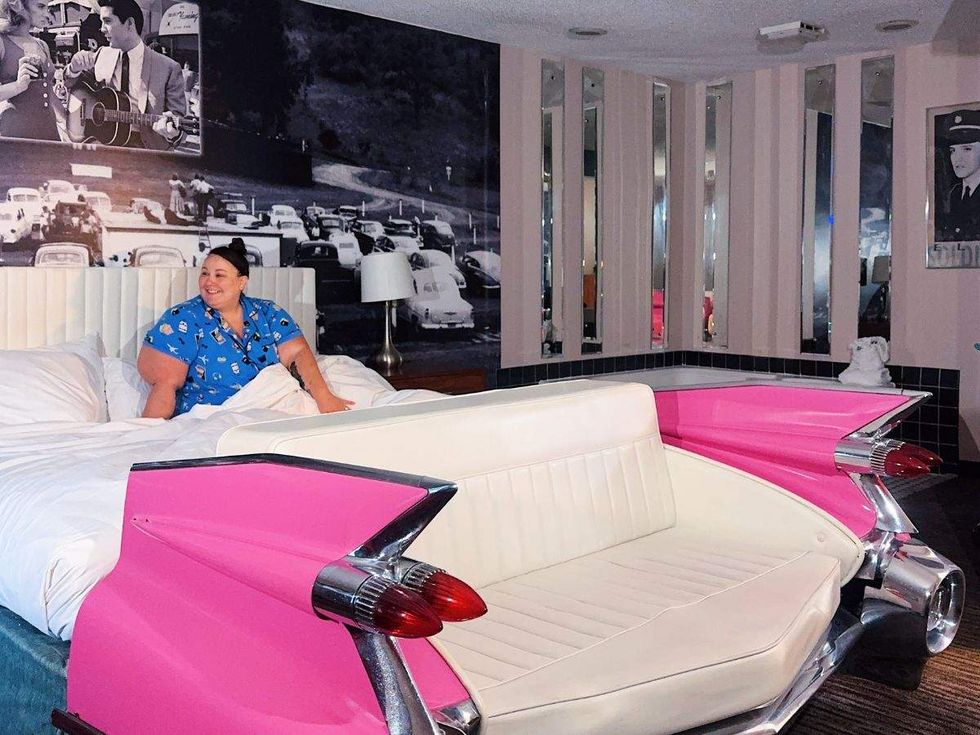 The Pink Cadillac bed.Alysse Dalessandro for The Advocate
It was Sharon Love’s letter tucked inside an archive box. It was the unmarked entrance to Second Story Bar. It was the transgender women who rented hotel rooms so they could spend a weekend as themselves. It was the shipping clerk from Edwardsville whose name disappeared from a police report but whose hometown remained.
A century after Route 66 first opened, those stories are still waiting to be found. And after one week and roughly 600 miles on the road, I’m just getting started.
Illinois Office of Tourism and Booking.com provided support for this trip. All views and opinions are the author's.