'%3E%3Cpath d='M16.3574 35.6519H12.9537L15.0491 18.8873L16.3574 35.6519ZM30.4229 54.0093L22.309 0.994385H7.91795L0 54.0093H10.6634L11.5802 46.3855H17.4014L17.9914 54.0093H30.4229Z' fill='%23971B20'/%3E%3Cpath d='M48.2073 41.8813C48.2073 43.4049 47.4892 44.0011 46.1144 44.0011H43.7595V11.0687H46.1144C47.4892 11.0687 48.2073 11.6636 48.2073 13.1885V41.8813ZM59.5273 43.6695V11.3326C59.5273 3.71323 53.5729 0.994385 47.8157 0.994385H31.7213V54.0093H47.8157C53.5729 54.0093 59.5273 51.29 59.5273 43.6695Z' fill='%23971B20'/%3E%3Cpath d='M90.183 0.994385H78.6039L75.0711 30.6157L71.9955 0.994385H59.4346L69.2474 54.0093H80.373L90.183 0.994385Z' fill='%23971B20'/%3E%3Cpath d='M107.063 42.3448C107.063 43.7359 105.951 44.5974 104.643 44.5974C103.269 44.5974 102.157 43.7359 102.157 42.3448V12.658C102.157 11.2676 103.269 10.4058 104.643 10.4058C105.951 10.4058 107.063 11.2676 107.063 12.658V42.3448ZM119.233 43.2723V11.7312C119.233 6.36384 112.952 -3.8147e-06 104.643 -3.8147e-06C96.2667 -3.8147e-06 89.9867 6.36384 89.9867 11.7312V43.2723C89.9867 48.6393 96.2667 55 104.643 55C112.952 55 119.233 48.6393 119.233 43.2723Z' fill='%23971B20'/%3E%3Cpath d='M150.976 43.9349V33.7309H139.069V42.3448C139.069 43.7359 137.957 44.5974 136.582 44.5974C135.076 44.5974 133.964 43.7359 133.964 42.3448V12.658C133.964 11.2676 135.076 10.4058 136.582 10.4058C137.957 10.4058 139.069 11.2676 139.069 12.658V21.2723H150.976V11.0687C150.976 5.70107 145.283 -3.8147e-06 136.582 -3.8147e-06C127.75 -3.8147e-06 121.796 5.70107 121.796 11.0687V43.9349C121.796 49.3022 127.75 55 136.582 55C145.283 55 150.976 49.3022 150.976 43.9349Z' fill='%23971B20'/%3E%3Cpath d='M167.478 35.6519H164.076L166.17 18.8873L167.478 35.6519ZM181.544 54.0093L173.432 0.994385H159.037L151.123 54.0093H161.785L162.704 46.3855H168.523L169.114 54.0093H181.544Z' fill='%23971B20'/%3E%3Cpath d='M205.412 10.4058V0.994385H177.081V10.4058H185.392V54.0093H197.428V10.4058H205.412Z' fill='%23971B20'/%3E%3Cpath d='M230.002 54.0093V43.9349H218.914V31.8746H226.635V21.8028H218.914V10.4058H230.002V0.994385H206.875V54.0093H230.002Z' fill='%23971B20'/%3E%3C/g%3E%3Cdefs%3E%3CclipPath id='clip0_260_7080'%3E%3Crect width='230' height='55' fill='white'/%3E%3C/clipPath%3E%3C/defs%3E%3C/svg%3E)


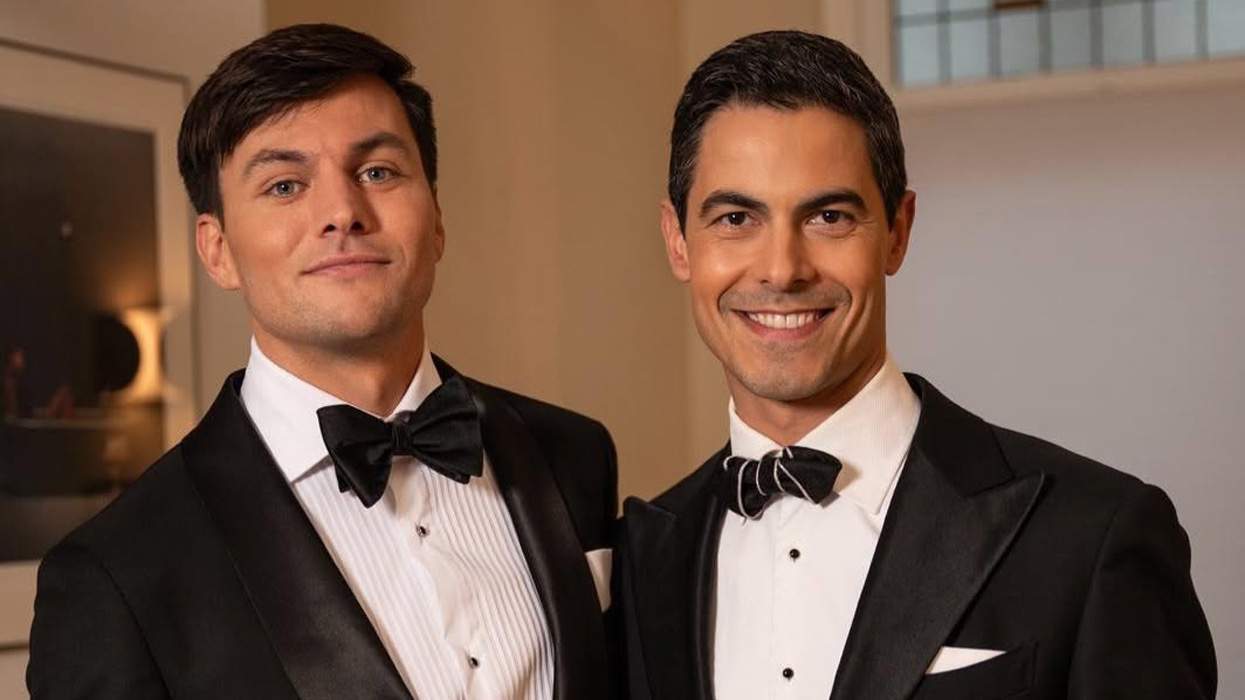
Two gay Iranian men who fled their home country after being arrested for “homosexual conduct” and facing possible execution are at risk of being deported by the United States as early as Sunday, according to their attorney, even as one federal court has intervened to temporarily block one of the removals. Advocates warn that the case exposes a deeper collapse of asylum protections.
Keep up with the latest in LGBTQ+ news and politics. Sign up for The Advocate's email newsletter.
The men, romantic partners in their late 30s and early 40s, were arrested in Iran in 2021 by the country’s morality police for what authorities described as homosexual activity — a charge that can carry punishments ranging from flogging to death. They were released from jail while awaiting sentencing and fled before punishment was imposed, eventually making their way to the United States to seek asylum, said Rebekah Wolf, a staff attorney with the American Immigration Council who represents them. Now the Trump administration is trying to send them back to Iran, she said.
Related: Inside the movement that freed gay makeup artist Andry Hernández Romero from a hellhole
Related: Andry Hernández Romero on surviving CECOT: 'They told us we would die there'
“They are textbook asylum cases,” Wolf said in an interview with The Advocate on Saturday afternoon. “People from a country where who they are is criminalized and punishable by torture or death — that is literally the definition of an asylum seeker.”
In Iran, homosexuality carries some of the harshest penalties in the world, from flogging and torture to death. In 2022, human rights groups reported that two gay men convicted on sodomy charges after years on death row were executed, illustrating the real threat LGBTQ+ people face.
After fleeing Iran, the men traveled through Türkiye, Wolf explained, where they were also unsafe, before crossing into the United States at the southern border in January 2025 to apply for asylum. They arrived with a third LGBTQ+ person, a woman, who was also detained by U.S. Immigration and Customs Enforcement. The two men have remained in detention for more than a year.
The woman, whom Wolf represented during her immigration proceedings, was granted asylum after a brief 45-minute hearing, she said. The government waived its right to appeal, and the woman was released from detention. The men’s cases took a drastically different turn.
According to Wolf, the two men did not have legal representation during their asylum hearings in late April and early May. Those hearings, she said, were marred by bias and basic violations of due process, including dismissive and inappropriate language about what kind of evidence LGBTQ+ asylum seekers should be able to provide.
“These are incredibly straightforward cases,” Wolf said. “But our immigration courts, when there aren’t other eyes — attorneys or otherwise — can be really fraught with bias.”
The contrast between the outcomes, she said, underscores the life-or-death consequences of navigating immigration court without counsel. “If only we had caught these cases five months earlier,” Wolf said, “we would have been in a very different situation.”
At the time the men’s asylum claims were denied, deportations to Iran were not taking place because the United States lacks diplomatic relations with Tehran. According to Wolf, that changed in late summer, when the government quietly resumed removal flights to Iran. This would be the third such flight since the fall, Wolf said.
The men were previously scheduled for deportation in September and again in December, but removals were halted after negotiations with ICE. This time, both were transferred from the Fort Bliss detention center in El Paso, Texas, to southern Arizona, where a group of about three dozen Iranian nationals has been assembled for a planned deportation flight on Sunday.
ICE’s position, Wolf said, is that once an immigration judge issues a final order of removal, the agency is free to execute deportation, even while appeals are pending. One of the men received a last-minute stay of removal late Friday from the 10th U.S. Circuit Court of Appeals in Colorado, temporarily blocking his deportation, Wolf said. The other man does not yet have such protection.
Related: Gay asylum-seeker's lawyer worries for the makeup artist's safety in Salvadoran ‘hellhole’ prison
Related: CECOT survivor Andry Hernández Romero, gay Venezuelan makeup artist, and his lawyer named to Out100
“That’s all ICE cares about — that there’s an order,” Wolf said. While such removals were technically possible under prior administrations, she said, they were rarely pursued while federal appeals were underway. “It certainly was not the norm in the way that it is now.”
Human rights groups warn that deporting the men would almost certainly place them in immediate danger. Iran is one of a dozen countries that still execute people for same-sex relationships, according to international watchdogs, and LGBTQ+ people there face pervasive surveillance, arbitrary detention, and violence.
Advocates also point to recent U.S. immigration cases involving LGBTQ+ asylum seekers as evidence that the government has shown a willingness to send queer people into harm’s way. In 2025, The Advocate reported extensively on the case of Andry Hernández Romero, a Venezuelan makeup artist and out gay asylum seeker who was deported under the Trump administration to El Salvador’s notorious “Terrorism Confinement Center” or CECOT despite having no criminal record and without receiving a full asylum hearing. Hernández Romero spent more than four months in brutal detention conditions before a prisoner exchange ultimately secured his release. His case became a rallying point for critics who said the administration was willing to disregard basic procedural protections even when LGBTQ+ lives were at risk.
Kelley Robinson, president of the Human Rights Campaign, told The Advocate through a spokesperson that returning the men to Iran would knowingly place their lives at risk.
“Iran is one of 12 nations that still execute queer people. Sending these men back there would put them in immediate danger,” Robinson said. “But that’s par for the course for a Trump administration that deploys ICE to endanger our community’s lives every day. That same terror and cruelty murdered Renee Nicole Good, imprisoned Andry Hernandez Romero, and continues to force communities to live in fear. We join the American Immigration Council in demanding these men be kept safe — and call on Congress to rein in this out-of-control administration.”
Related: Andry Hernández Romero explains how he survived CECOT after the U.S. government disappeared him
The Department of Homeland Security did not respond to a request for comment. DHS spokesperson Tricia McLaughlin did not reply to The Advocate's emailed questions seeking clarification on how the department is weighing the risk of persecution or execution in these cases.
Wolf said political intervention remains one of the few remaining avenues if courts do not act, though she cautioned that even those informal safeguards are eroding. Congressional offices have expressed alarm, she said, but ICE retains discretion to proceed.
“At the end of the day, ICE can just decide to take him off the flight,” Wolf said of the man who does not yet have a court-ordered stay. “If the courts don’t order them to, our hope is that they will be persuaded not to put my other client on that plane.”
The men, she said, are terrified. One speaks English and has repeatedly called her as removal looms. “He’s saying, ‘Please, Ms. Wolf, save my life,’” she said. The situation has grown even more anguishing because one man now has a stay while the other does not, raising the possibility that the couple could be separated — one deported to Iran, the other left behind.
Beyond the immediate danger, Wolf said the case illustrates how unprepared even experienced immigration lawyers have been for the scale and intensity of the current moment. Wolf has worked in immigration policy for more than 20 years and has spent over a decade as an asylum and detention attorney. She practiced during the first Trump administration, she said, but what is happening now is different in kind.
“We knew it was going to be bad,” she said. “But we had no idea how bad it was going to be.” She described an administration that has tested the boundaries of law and norms, identified where the cracks are, and “just bulldozed over them,” leaving lawyers with fewer tools to stop deportations even when the risk of death is clear.
Related: Andry Hernández Romero, gay asylum seeker disappeared by Trump, part of prisoner swap
What remains on the books, she said, often no longer exists in practice. Asylum is still the law of the land — only Congress can change that — but it can be rendered effectively unreachable through detention, speed, and procedural barriers.
“You can make it so unbearable and so impossible to access that, for all intents and purposes, it no longer exists,” Wolf said.
If the deportations proceed, she warned, the implications will extend far beyond this case. “The fact that this can happen to them means it could happen to anyone,” she said. The men, she added, repeatedly told her they came to the United States believing it was free and safe. “They’re asking, ‘Why can’t you stop this?’”
For now, at least one federal court has answered that question by stepping in. Whether the system will do the same for the other man, and whether the United States will choose to send a gay couple back to a country where they could be executed for who they are, remains an open and urgent question.
As of publication, ICE had not announced whether the deportation flight would proceed as planned.