'%3E%3Cpath d='M16.3574 35.6519H12.9537L15.0491 18.8873L16.3574 35.6519ZM30.4229 54.0093L22.309 0.994385H7.91795L0 54.0093H10.6634L11.5802 46.3855H17.4014L17.9914 54.0093H30.4229Z' fill='%23971B20'/%3E%3Cpath d='M48.2073 41.8813C48.2073 43.4049 47.4892 44.0011 46.1144 44.0011H43.7595V11.0687H46.1144C47.4892 11.0687 48.2073 11.6636 48.2073 13.1885V41.8813ZM59.5273 43.6695V11.3326C59.5273 3.71323 53.5729 0.994385 47.8157 0.994385H31.7213V54.0093H47.8157C53.5729 54.0093 59.5273 51.29 59.5273 43.6695Z' fill='%23971B20'/%3E%3Cpath d='M90.183 0.994385H78.6039L75.0711 30.6157L71.9955 0.994385H59.4346L69.2474 54.0093H80.373L90.183 0.994385Z' fill='%23971B20'/%3E%3Cpath d='M107.063 42.3448C107.063 43.7359 105.951 44.5974 104.643 44.5974C103.269 44.5974 102.157 43.7359 102.157 42.3448V12.658C102.157 11.2676 103.269 10.4058 104.643 10.4058C105.951 10.4058 107.063 11.2676 107.063 12.658V42.3448ZM119.233 43.2723V11.7312C119.233 6.36384 112.952 -3.8147e-06 104.643 -3.8147e-06C96.2667 -3.8147e-06 89.9867 6.36384 89.9867 11.7312V43.2723C89.9867 48.6393 96.2667 55 104.643 55C112.952 55 119.233 48.6393 119.233 43.2723Z' fill='%23971B20'/%3E%3Cpath d='M150.976 43.9349V33.7309H139.069V42.3448C139.069 43.7359 137.957 44.5974 136.582 44.5974C135.076 44.5974 133.964 43.7359 133.964 42.3448V12.658C133.964 11.2676 135.076 10.4058 136.582 10.4058C137.957 10.4058 139.069 11.2676 139.069 12.658V21.2723H150.976V11.0687C150.976 5.70107 145.283 -3.8147e-06 136.582 -3.8147e-06C127.75 -3.8147e-06 121.796 5.70107 121.796 11.0687V43.9349C121.796 49.3022 127.75 55 136.582 55C145.283 55 150.976 49.3022 150.976 43.9349Z' fill='%23971B20'/%3E%3Cpath d='M167.478 35.6519H164.076L166.17 18.8873L167.478 35.6519ZM181.544 54.0093L173.432 0.994385H159.037L151.123 54.0093H161.785L162.704 46.3855H168.523L169.114 54.0093H181.544Z' fill='%23971B20'/%3E%3Cpath d='M205.412 10.4058V0.994385H177.081V10.4058H185.392V54.0093H197.428V10.4058H205.412Z' fill='%23971B20'/%3E%3Cpath d='M230.002 54.0093V43.9349H218.914V31.8746H226.635V21.8028H218.914V10.4058H230.002V0.994385H206.875V54.0093H230.002Z' fill='%23971B20'/%3E%3C/g%3E%3Cdefs%3E%3CclipPath id='clip0_260_7080'%3E%3Crect width='230' height='55' fill='white'/%3E%3C/clipPath%3E%3C/defs%3E%3C/svg%3E)
A retired U.S. Space Force colonel who was forced out of the military under the Trump administration’s ban on transgender service members announced Tuesday that she is running for Congress in Virginia, turning a sudden end to her 23-year military career into a bid for elected office.
Keep up with the latest in LGBTQ+ news and politics. Sign up for The Advocate's email newsletter.
Space Force Col. Bree Fram, an Out 100 honoree, never planned to leave the military the way she did.
For more than two decades, she served in uniform — through war, technological transformation, and the creation of the U.S. Space Force itself. She rose to the rank of colonel, led billion-dollar national security programs, deployed overseas, and helped build the nation’s newest armed service with an eye toward the future rather than nostalgia for the past.
Then, in December, her career ended abruptly. Not because of failure or misconduct. Not because she could no longer do the job. But because the Trump administration decided that transgender people no longer belonged in the ranks.
Weeks later, Fram, 46, stood at a retirement ceremony unlike any other at the Human Rights Campaign headquarters in Washington, D.C., presided over by retired four-star general Stanley McChrystal — one held not in triumph but in defiance, honoring transgender service members forced out under a sweeping ban. The moment was both an ending and a reckoning.
Now, she is stepping into another arena altogether.
Related: Meet the transgender Space Force rocket scientist who’s unimpressed by Libs of TikTok’s attacks
On Tuesday, Fram announced that she is entering electoral politics with a message shaped by loss, conviction, and a stubborn belief that the country is still capable of becoming something better than it is right now.
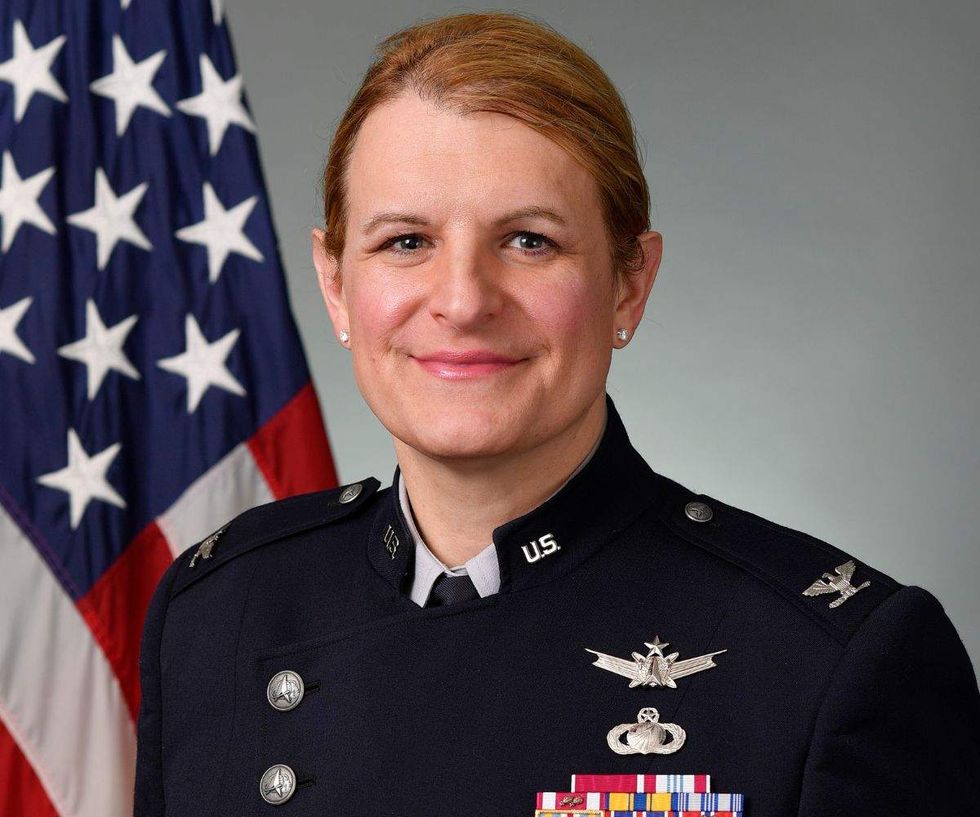 Col. Bree FramCourtesty Bree Fram
“Too many Americans are afraid of what their own government is doing to them, instead of confident it’s working for them,” Fram said in a statement launching her campaign. “That’s why I’m running for Congress.”
A Democrat who lives in Northern Virginia, Fram is entering the race as Virginia is poised for redistricting, leaving the contours of the 2026 congressional map unsettled. She has said she plans to run in whichever district she resides once new lines are finalized, even if that means challenging an incumbent or navigating a crowded primary.
It is, she acknowledges, a risk. But risk, she says, is something she understands.
A career cut short — and a grief still unfolding
In an interview with The Advocate days after the January retirement ceremony and before her announcement, Fram described the emotional aftermath of being forced out of service — a process she said still arrives in waves.
“There are still these moments where something will hit,” she said. “Sometimes the tears will come — not only for what was lost, but the lost potential as well.”
The ceremony briefly restored something the policy had taken from her and from others: the sense of belonging that defines military life.
 Bree Fram speaks at the Smithsonian Air and Space Museaum.Courtesty Bree Fram
“That camaraderie, that love, that feeling that we’re in this together, that’s part of what’s been lost,” Fram said. “And the message coming from the administration is, ‘No, you aren’t. You are the problem,’ pulls you away from that.”
Her departure from the military did not come quietly. Fram had become one of the most visible transgender officers in the country, not by seeking attention but by excelling in her work — and by surviving it. When conservative media trained its spotlight on her, she endured it. When policy turned against her, she refused to disappear.
Instead, she began speaking more openly — about readiness, about leadership, about what happens when ideology supplants competence.
The Space Force — and a future worth imagining
Fram’s résumé is formidable. Commissioned after September 11, she served more than 23 years across the Air Force and Space Force, deploying to Iraq and Qatar, working at the Pentagon and on Capitol Hill, and overseeing advanced acquisition and technology programs. She was part of the effort to stand up the Space Force itself — an experience she describes as rare and exhilarating.
“Just like [my favorite TV show] Star Trek, our tech was amazing,” she said. “But it was the people. It was the culture — building something we could be proud of that allowed us to do far more together than any of us could alone.”
Her favorite is the Deep Space Nine world.
That reference to Star Trek, half metaphor, half confession, opened a door during her interview that led somewhere deeper than nostalgia.
Asked jokingly whether transporters or replicators might be real, Fram laughed and began talking about quantum entanglement and scientific possibility. Then she gestured to the screen and an iPhone.
“Talking to you right now, we’ve got your tricorder,” she said. “And it’s better.”
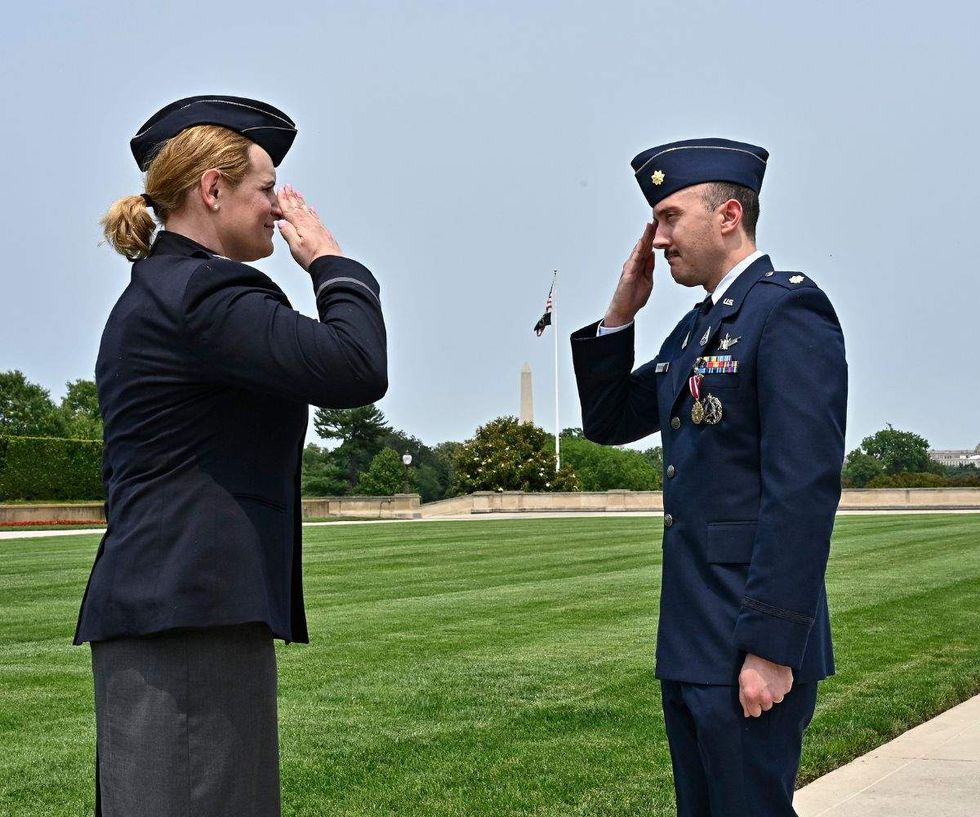 Col. Bree Fram on her last day in the military.Courtesty Bree Fram
But when the conversation turned to favorite episodes of Star Trek: The Next Generation, Fram paused, and her voice caught.
“I’m getting emotional even thinking about this,” she said, as she recalled the episode “Yesterday’s Enterprise,” which centers on sacrifice and alternate futures. “Because these are the things that always drove me, when you are willing to give up everything to protect the people you love.”
She quoted a line spoken by Capt. Jean-Luc Picard as the Enterprise faces destruction: “Let’s make sure history never forgets the name Enterprise.”
After she was forced out of the military, Fram said, she brought her wooden model starships home. Photos of them circulated online, and then something unexpected happened.
Days later, Star Trek writer David Gerrold wrote on social media: “Colonel Fram is the kind of person we imagined going to the stars when we wrote Star Trek.”
The moment stayed with her. “It matters deeply, because I believe in who we can be,” she said. “That vision is so important, having a positive future to look toward, not this fear and hatred that’s so pervasive right now.”
What she says she would do in Congress
That future-oriented vision now animates Fram’s campaign.
She has been unsparing in her critique of the administration’s approach to the military, particularly under Defense Secretary Pete Hegseth.
“Performative military is not strength,” Fram said. “A real leader understands that strength is knowing when to do something, not just that we can do the thing.”
She has warned that the purging of transgender service members and senior women leaders will accelerate a retention crisis and weaken national security.
“We are absolutely going to lose some of our most dedicated, most capable members of the military,” she said. “People look at that and say, ‘There’s no future here for me. Why would I stay?’”
Fram says her run is not a single-issue campaign, even as her forced removal from the military has made her a national figure. She frames her legislative priorities around two ideas she returns to repeatedly: restoring democratic guardrails and making government function for people rather than frightening them.
On oversight, she argues Congress must fully use its investigative powers. “No matter what rock we might look under, you can find something this administration has [done] that is worthy of not only an investigation but being held accountable,” she said — a category she said “can absolutely include impeaching senior officials or the president for the failure to faithfully execute the laws of the United States and to fulfill his oath to support and defend the Constitution.”
But Fram said oversight alone is insufficient. She stressed the need to “show the vision of what can be down the road,” by advancing and voting on policies so Americans can see what Democrats intend to do “when we have the Senate, when we have the presidency,” and can “actually think about putting Americans first in a way that matters.”
She described a basic expectation of government competence, from “the simple things like going to a social security appointment” to knowing that government is “there protecting them from disease, from war, from foodborne illnesses.” She contrasted that with what she described as the administration “forcing out all the people, the dedicated public servants that are there keeping us safe.”
Civil liberties, she said, must be non-negotiable. “Their First Amendment rights are sacrosanct,” Fram said. “They do not have to hide who they are or who they love for fear of this government.”
Asked what she hears most from people in Northern Virginia, Fram pointed to the region’s reliance on the federal government. In the 11th District, “as it stands today,” she said, there are “the second most federal workers in the nation.” The district is currently represented by Democratic U.S. Rep. James Walkinshaw, though redistricting efforts could redraw the electoral maps. Fram said a “dysfunctional federal government” that “constantly lays off the best and the brightest and causes chaos” creates fear that goes beyond jobs: “Not just, will I have a paycheck, but am I safe? Am I going to have to show an agent on the street my identity documentation?”
She also tied those concerns to schools and local stability, noting that the region’s “greatest schools in the country” have been supported by a “well-paid federal workforce,” and warning that mass firings threaten that foundation.
Fram emphasized long-term investment in a district she described as “high tech, high science, high health care,” arguing that when government “takes away investment,” it undermines what the country will need “to thrive five, 10, 50 years in the future.”
At its broadest, Fram describes this moment as a chance for what she called a “fundamental rebirth of democracy.” She spoke of reining in presidential power, including on pardons, reaffirming that a president “is not above the law,” reducing foreign influence through the Emoluments Clause, completing the Equal Rights Amendment, and embedding voting rights in the Constitution so “every American knows that they count, that they matter, and they have a future here.”
A reason to stay
Away from Washington and the campaign trail, Fram’s life is rooted in family and the ordinary rhythms she says make public service worth fighting for.
She has been married to her wife for more than 20 years, and the couple have been together for more than 25, meeting as college students in Minnesota. Over the course of Fram’s military career, they navigated nine moves, multiple deployments, and the pressures that come with life in uniform — including Fram’s transition.
“She’s been with me through everything,” Fram said. “Through my transition, through every assignment, through all of it.”
They are raising two children in Fairfax County, both of whom attend public schools and are on the autism spectrum. Her oldest child is also transgender, a reality Fram says sharpens the stakes of the political moment.
“My kids animate my fight,” she said. “This is about what kind of world they’re going to get to live in — where they get to choose who they are, who they love, and do that safely.”
That sense of responsibility extends beyond her own household. Fram has said she worries about children who feel unsafe at school, families strained by instability, and communities unsettled by a federal government she believes has become unpredictable and punitive.
“I don’t want kids afraid to get on the bus or go to school,” she said. “I want them to know they’re safe, seen, and celebrated.”
When she is not immersed in policy or campaigning, Fram gravitates outdoors. She is an avid hiker and skier, drawn especially to the mountains of Colorado, where she has climbed multiple 14,000-foot peaks. In the summer, she hikes; in the winter, she skis — two expressions, she said, of the same love of challenge and perspective.
“Getting to the top and taking that breath — that’s when it hits you,” she said. “This is our planet. How amazing is this?”
She also plays disc golf — a hobby she has kept up for more than three decades — and treasures time spent with a close-knit group of friends she has known since childhood. Being outside, she said, is how she recharges.
“I think about Spaceship Earth a lot,” Fram said. “Exploring it, wondering at it. That’s what grounds me.”
Running for Congress, she said, was not the quiet next chapter her family envisioned. But it echoes a conversation with her mother, who once asked whether she had an escape plan.
“Mom, I have to stay here and fight,” Fram said. “There is too much at stake. This America that I believe in is not lost. It is worth fighting for.”
For Fram, the transition from uniformed service to Congress is not a departure from duty, but a continuation of it — a refusal to accept fear as the organizing principle of public life.
“This is the calling,” she said. “If we don’t stand up now, we might not have anything to stand up for in the future.”