'%3E%3Cpath d='M16.3574 35.6519H12.9537L15.0491 18.8873L16.3574 35.6519ZM30.4229 54.0093L22.309 0.994385H7.91795L0 54.0093H10.6634L11.5802 46.3855H17.4014L17.9914 54.0093H30.4229Z' fill='%23971B20'/%3E%3Cpath d='M48.2073 41.8813C48.2073 43.4049 47.4892 44.0011 46.1144 44.0011H43.7595V11.0687H46.1144C47.4892 11.0687 48.2073 11.6636 48.2073 13.1885V41.8813ZM59.5273 43.6695V11.3326C59.5273 3.71323 53.5729 0.994385 47.8157 0.994385H31.7213V54.0093H47.8157C53.5729 54.0093 59.5273 51.29 59.5273 43.6695Z' fill='%23971B20'/%3E%3Cpath d='M90.183 0.994385H78.6039L75.0711 30.6157L71.9955 0.994385H59.4346L69.2474 54.0093H80.373L90.183 0.994385Z' fill='%23971B20'/%3E%3Cpath d='M107.063 42.3448C107.063 43.7359 105.951 44.5974 104.643 44.5974C103.269 44.5974 102.157 43.7359 102.157 42.3448V12.658C102.157 11.2676 103.269 10.4058 104.643 10.4058C105.951 10.4058 107.063 11.2676 107.063 12.658V42.3448ZM119.233 43.2723V11.7312C119.233 6.36384 112.952 -3.8147e-06 104.643 -3.8147e-06C96.2667 -3.8147e-06 89.9867 6.36384 89.9867 11.7312V43.2723C89.9867 48.6393 96.2667 55 104.643 55C112.952 55 119.233 48.6393 119.233 43.2723Z' fill='%23971B20'/%3E%3Cpath d='M150.976 43.9349V33.7309H139.069V42.3448C139.069 43.7359 137.957 44.5974 136.582 44.5974C135.076 44.5974 133.964 43.7359 133.964 42.3448V12.658C133.964 11.2676 135.076 10.4058 136.582 10.4058C137.957 10.4058 139.069 11.2676 139.069 12.658V21.2723H150.976V11.0687C150.976 5.70107 145.283 -3.8147e-06 136.582 -3.8147e-06C127.75 -3.8147e-06 121.796 5.70107 121.796 11.0687V43.9349C121.796 49.3022 127.75 55 136.582 55C145.283 55 150.976 49.3022 150.976 43.9349Z' fill='%23971B20'/%3E%3Cpath d='M167.478 35.6519H164.076L166.17 18.8873L167.478 35.6519ZM181.544 54.0093L173.432 0.994385H159.037L151.123 54.0093H161.785L162.704 46.3855H168.523L169.114 54.0093H181.544Z' fill='%23971B20'/%3E%3Cpath d='M205.412 10.4058V0.994385H177.081V10.4058H185.392V54.0093H197.428V10.4058H205.412Z' fill='%23971B20'/%3E%3Cpath d='M230.002 54.0093V43.9349H218.914V31.8746H226.635V21.8028H218.914V10.4058H230.002V0.994385H206.875V54.0093H230.002Z' fill='%23971B20'/%3E%3C/g%3E%3Cdefs%3E%3CclipPath id='clip0_260_7080'%3E%3Crect width='230' height='55' fill='white'/%3E%3C/clipPath%3E%3C/defs%3E%3C/svg%3E)

A cheap antibiotic that has been sitting in medicine cabinets for decades is suddenly doing something remarkable: helping reverse one of America’s fastest-growing sexually transmitted infections, and offering one of the clearest measurable successes of a Joe Biden-era LGBTQ+ public health initiative just as President Donald Trump’s administration dismantles many of the federal systems that made it possible.
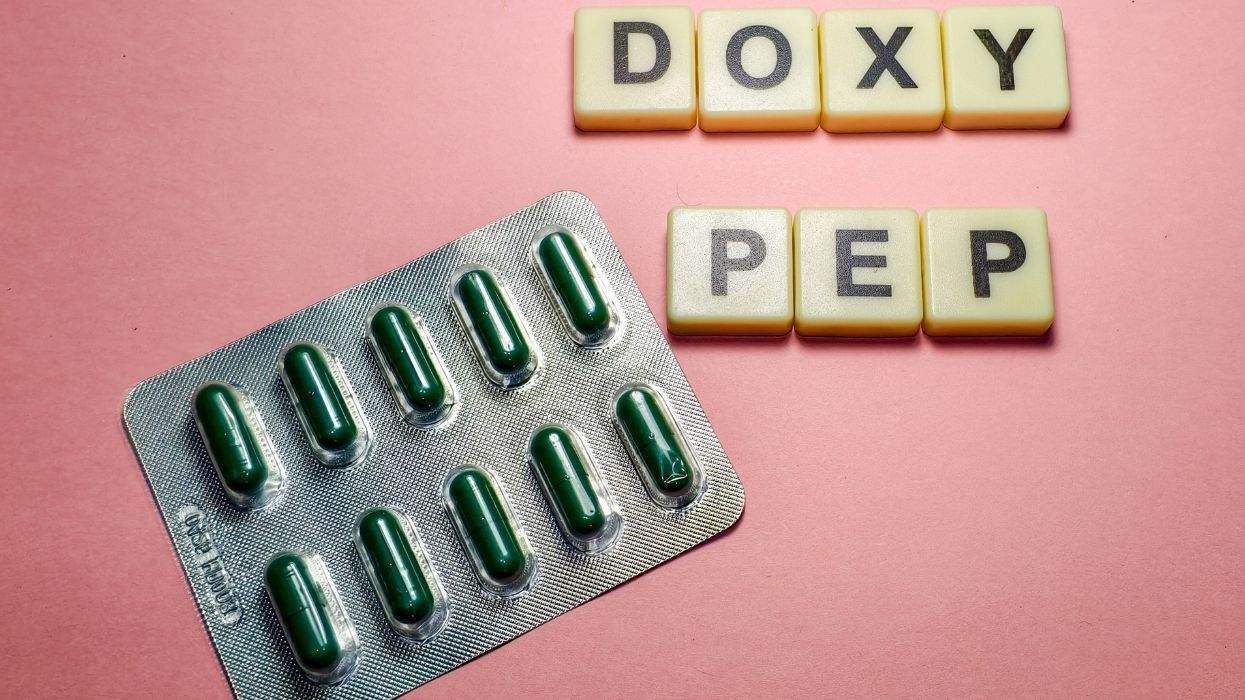
A new University of Washington study published in Clinical Infectious Diseases and highlighted recently by the Center for Infectious Disease Research and Policy found that doxyPEP, short for doxycycline post-exposure prophylaxis, is sharply reducing syphilis infections after federal health officials issued prescribing guidelines in 2023.
The scale of the decline is striking. In King County, Washington, researchers estimate that doxyPEP prevented 3,031 syphilis cases, amounting to a 52.3 percent relative reduction after the strategy was introduced. That is among the clearest real-world signs yet that the federal strategy is associated with large declines in syphilis where doxyPEP uptake is high.
That means that if someone at elevated risk for bacterial sexually transmitted infections takes one dose of doxycycline soon after sex, it can stop infections like syphilis and chlamydia before they start.
Related: A Pill After Sex Could Help Slow STIs Among Gay Men
Related: CDC Proposes Gay Men and Trans Women Take ‘Morning After’ Pill for STI Prevention
And now there is strong population-level evidence that where doxyPEP is widely used, syphilis infections can fall dramatically.
For the scientists and officials who helped build the policy during the Biden administration, the findings are a satisfying thing in public health: confirmation that the plan is producing measurable results.
“This is an example of successful public health,” Dr. Jonathan Mermin, who led the CDC’s National Center for HIV, Viral Hepatitis, STD, and TB Prevention during the Biden administration and is now dean of Columbia University’s Mailman School of Public Health, told The Advocate.
“We saw that just issuing doxyPEP guidelines for the populations at highest risk resulted in large decreases in STI incidence among them and overall,” he said. “A public health approach focused on efficiency and equity benefited everyone.”
How doxyPEP works
Think of doxyPEP as the STI equivalent of grabbing an umbrella before the storm hits. A person takes 200 milligrams of doxycycline — ideally within 24 hours after sex, and no later than 72 hours — to prevent bacterial infections from taking hold.
Doxycycline itself is not new. It has long been used for acne, Lyme disease, malaria, and other bacterial illnesses. What changed was the science.
Before CDC guidelines existed, many doctors hesitated to prescribe doxyPEP because there was no national standard explaining when and how to use it.
Related: Trump admin moves to end federal HIV prevention programs. ‘Catastrophic’ consequences, experts say
That is where the Department of Health and Human Services came in.
Adrian Shanker, who led LGBTQI+ health equity policy at HHS as deputy assistant secretary for health policy and senior adviser on LGBTQI+ health equity, helped finalize the doxyPEP guidance and frame it as a major LGBTQ+ health initiative.
“This was an LGBTQ health priority for the Biden administration,” Shanker told The Advocate.
He said the lack of formal guidance had created uneven access across the country.
“Outside of the large metropolitan areas, it was pretty difficult, if not impossible, to access doxyPEP for gay and bisexual men for STI prevention,” he said. “There needed to be clinical guidelines because without that, too many providers were uncertain about how to prescribe it.”
Once those guidelines arrived, prescribing expanded quickly.
A coordinated Biden-era science effort
The doxyPEP rollout was part of a deliberate federal campaign to reverse a worsening syphilis crisis.
Dr. Rachel Levine, then assistant secretary for health, chaired the Biden administration’s National Syphilis and Congenital Syphilis Task Force, a government-wide initiative launched to combat a surge that had become deeply alarming to federal health officials.
“We decided to really address this in a comprehensive way,” Levine told The Advocate, describing a task force that brought together HHS, CDC, the Department of Veterans Affairs, the Defense Department, and the Indian Health Service. “The right research, at the right treatment at the right time, is having an impact.”
Related: Out CDC vaccine chief resigns, saying ‘enough is enough’ with Trump and RFK Jr.
Related: Dr. Demetre Daskalakis on leaving the CDC and calling out RFK Jr.
The task force focused on the communities most affected: LGBTQ+ Americans, Black Americans, Native communities, and pregnant patients facing rising congenital syphilis risk.
That targeted approach is central to understanding the significance of this study. The success of doxyPEP is not simply in reducing infections. It reduced them because federal officials deliberately focused resources on areas where the epidemic was hitting hardest.
Why did LGBTQ+ communities adopt it quickly?
For many LGBTQ+ Americans, doxyPEP felt familiar from the start.
After decades of HIV prevention campaigns involving PrEP and PEP, many patients and providers in LGBTQ+ communities were already comfortable using medication to prevent infection before illness develops.
Dr. Demetre Daskalakis, now chief medical officer at Callen-Lorde Community Health Center in New York, said that cultural familiarity mattered. He is one of the most trusted public health experts in the LGBTQ+ community.
“We’re used to science because science has been important in so many aspects of our lives,” Daskalakis told The Advocate. “There is muscle memory about HIV.”
Related: Homophobe Rand Paul says gay CDC official's 'lifestyle' made him unfit to be in government
Daskalakis, who also served in the Biden administration as White House National Mpox Response deputy coordinator and later held senior CDC leadership roles, said the study confirms what frontline clinicians had already seen in practice.
“We’ve got studies and guidelines that indicate to do it,” he said. “And when you do it and launch it, you see a difference.”
The Advocate previously reported on Daskalakis’s 2025 departure from CDC, during which he warned that political interference under the Trump administration was undermining scientific independence within federal health agencies.
What the study does and does not solve
The results are dramatic, but not universal.
CIDRAP notes that congenital syphilis continues to rise, and cases among pregnant people remain deeply concerning. That is partly because doxyPEP is not routinely used in pregnancy because of dangers to the fetus, and is not broadly recommended for cisgender women under current guidelines.
So while doxyPEP is helping bring down syphilis overall, it is not yet fixing every part of the epidemic.
The big scientific concern: antibiotic resistance
Antibiotic resistance has been the biggest scientific question around doxyPEP from the start:m. If more people take antibiotics preventively, could bacteria adapt and become harder to treat?
Mermin said CDC scientists treated that concern seriously when writing the guidelines.
“Antibiotic resistance is always a concern,” he said. But he noted that syphilis and chlamydia — the infections doxyPEP works best against — are unlikely to become resistant to doxycycline in the way some other bacteria can. The larger unknown is whether increased doxycycline use could affect unrelated bacteria elsewhere in the body, something researchers are still monitoring.
What makes doxyPEP different is how it is taken. Doxycycline has been prescribed safely for decades, including for acne patients who may take it daily for months at a time. DoxyPEP, by contrast, is intermittent: one 200-milligram dose after sex, not continuous daily use.
Daskalakis said that contrast is often overlooked.
“There is sort of an alternate discourse around the fact that doxyPEP could potentially increase resistance for other organisms,” he said. “But where’s the other place that people use minocycline or doxycycline? And it’s for acne. And they’re getting acne meds for months and months and months continuously, but no one seems so concerned about that.”
For him, the immediate danger is untreated infection.
“On the flip side, we have infections that can kill people or can cause long-term neurological complications or can transmit to newborns and cause a catastrophe,” he said.
Mermin added that if doxyPEP prevents thousands of infections, it could actually reduce overall antibiotic use by reducing the need for later treatment. Shanker said that the trade-off was debated before approval.
“The question was asked, and it was clear that the benefit would outweigh the risk,” he said.
For now, scientists are still watching resistance closely, but the evidence so far suggests that doxyPEP’s benefits outweigh the risk.
Why this matters politically now
The study lands at a moment when many of the federal LGBTQ+ health frameworks that helped make this success possible are being dismantled.
According to KFF, the Trump administration’s executive actions have laid the groundwork to roll back explicit LGBTQ+ health protections, including by narrowing how federal agencies interpret sex discrimination in health care and by scaling back sexual orientation and gender identity data collection used to measure disparities and target care.
Early in Trump’s second term, federal health agencies began scrubbing webpages and datasets tied to transgender people, LGBTQ youth, HIV, and health disparities in response to orders targeting what the administration called “gender ideology. CDC and other agency pages were removed or altered, and a federal judge later ordered the restoration of some health information after doctors argued the deletions had cut off access to critical medical guidance.
Ironically, one of the clearest surviving federal explanations of doxyPEP remains on the CDC’s website because of a court order requiring the administration to restore health pages that had been altered or removed. The CDC’s doxyPEP guidance page now carries a Trump-era disclaimer stating that, “Per a court order, HHS is required to restore this website,” even as the administration denounces references to what it calls “gender ideology” on restored LGBTQ-inclusive health pages. It’s a striking contradiction on a site explaining a prevention strategy built largely for gay, bisexual men, and transgender women.
Under Health and Human Services Secretary Robert F. Kennedy Jr., the administration has also pushed additional restrictions affecting LGBTQ+ health, including moves aimed at cutting access to gender-affirming care for minors.
To the Biden administration officials, the study results confirm that targeted LGBTQ+ health policy works and that deleting LGBTQ+ people from the science does not make disparities disappear. It just makes them harder to measure and harder to fight.
“You’re missing important epidemiological data,” Levine told The Advocate. “Thus, infectious illnesses can spread because we’re not targeting where we need to go.”
That warning echoes what Shanker called “precision public health” in his interview: the idea that public health works best when it actually looks at who is getting sick, where, and why. In the case of doxyPEP, that meant focusing on communities with the highest syphilis burden, including gay and bisexual men and transgender women.
In the current political climate, former officials argue, that kind of targeted work is becoming harder precisely because the Trump administration is stripping away the language, data, and infrastructure that made it possible in the first place.