'%3E%3Cpath d='M16.3574 35.6519H12.9537L15.0491 18.8873L16.3574 35.6519ZM30.4229 54.0093L22.309 0.994385H7.91795L0 54.0093H10.6634L11.5802 46.3855H17.4014L17.9914 54.0093H30.4229Z' fill='%23971B20'/%3E%3Cpath d='M48.2073 41.8813C48.2073 43.4049 47.4892 44.0011 46.1144 44.0011H43.7595V11.0687H46.1144C47.4892 11.0687 48.2073 11.6636 48.2073 13.1885V41.8813ZM59.5273 43.6695V11.3326C59.5273 3.71323 53.5729 0.994385 47.8157 0.994385H31.7213V54.0093H47.8157C53.5729 54.0093 59.5273 51.29 59.5273 43.6695Z' fill='%23971B20'/%3E%3Cpath d='M90.183 0.994385H78.6039L75.0711 30.6157L71.9955 0.994385H59.4346L69.2474 54.0093H80.373L90.183 0.994385Z' fill='%23971B20'/%3E%3Cpath d='M107.063 42.3448C107.063 43.7359 105.951 44.5974 104.643 44.5974C103.269 44.5974 102.157 43.7359 102.157 42.3448V12.658C102.157 11.2676 103.269 10.4058 104.643 10.4058C105.951 10.4058 107.063 11.2676 107.063 12.658V42.3448ZM119.233 43.2723V11.7312C119.233 6.36384 112.952 -3.8147e-06 104.643 -3.8147e-06C96.2667 -3.8147e-06 89.9867 6.36384 89.9867 11.7312V43.2723C89.9867 48.6393 96.2667 55 104.643 55C112.952 55 119.233 48.6393 119.233 43.2723Z' fill='%23971B20'/%3E%3Cpath d='M150.976 43.9349V33.7309H139.069V42.3448C139.069 43.7359 137.957 44.5974 136.582 44.5974C135.076 44.5974 133.964 43.7359 133.964 42.3448V12.658C133.964 11.2676 135.076 10.4058 136.582 10.4058C137.957 10.4058 139.069 11.2676 139.069 12.658V21.2723H150.976V11.0687C150.976 5.70107 145.283 -3.8147e-06 136.582 -3.8147e-06C127.75 -3.8147e-06 121.796 5.70107 121.796 11.0687V43.9349C121.796 49.3022 127.75 55 136.582 55C145.283 55 150.976 49.3022 150.976 43.9349Z' fill='%23971B20'/%3E%3Cpath d='M167.478 35.6519H164.076L166.17 18.8873L167.478 35.6519ZM181.544 54.0093L173.432 0.994385H159.037L151.123 54.0093H161.785L162.704 46.3855H168.523L169.114 54.0093H181.544Z' fill='%23971B20'/%3E%3Cpath d='M205.412 10.4058V0.994385H177.081V10.4058H185.392V54.0093H197.428V10.4058H205.412Z' fill='%23971B20'/%3E%3Cpath d='M230.002 54.0093V43.9349H218.914V31.8746H226.635V21.8028H218.914V10.4058H230.002V0.994385H206.875V54.0093H230.002Z' fill='%23971B20'/%3E%3C/g%3E%3Cdefs%3E%3CclipPath id='clip0_260_7080'%3E%3Crect width='230' height='55' fill='white'/%3E%3C/clipPath%3E%3C/defs%3E%3C/svg%3E)
On the deck of the USS Missouri in Hawaii, where one war formally ended 80 years ago, Air Force Master Sgt. Logan Ireland stood before more than 100 people in late May and tried to end another chapter of his life with grace.
The guests had come from across the Pacific and the Atlantic, from around the world, some in person and some through screens — friends, family, colleagues, and people who understood that this was not merely a retirement ceremony. It was a handoff.
In July, Ireland will officially retire after more than 15 years in the Air Force, leaving behind a career that took him from basic training, to combat deployments overseas, to the White House, to the center of a national fight over who gets to serve their country. He deployed to Afghanistan. He helped crack open the military’s ban on open transgender service. He built a career around proving that performance, not politics, should decide who wears the uniform.
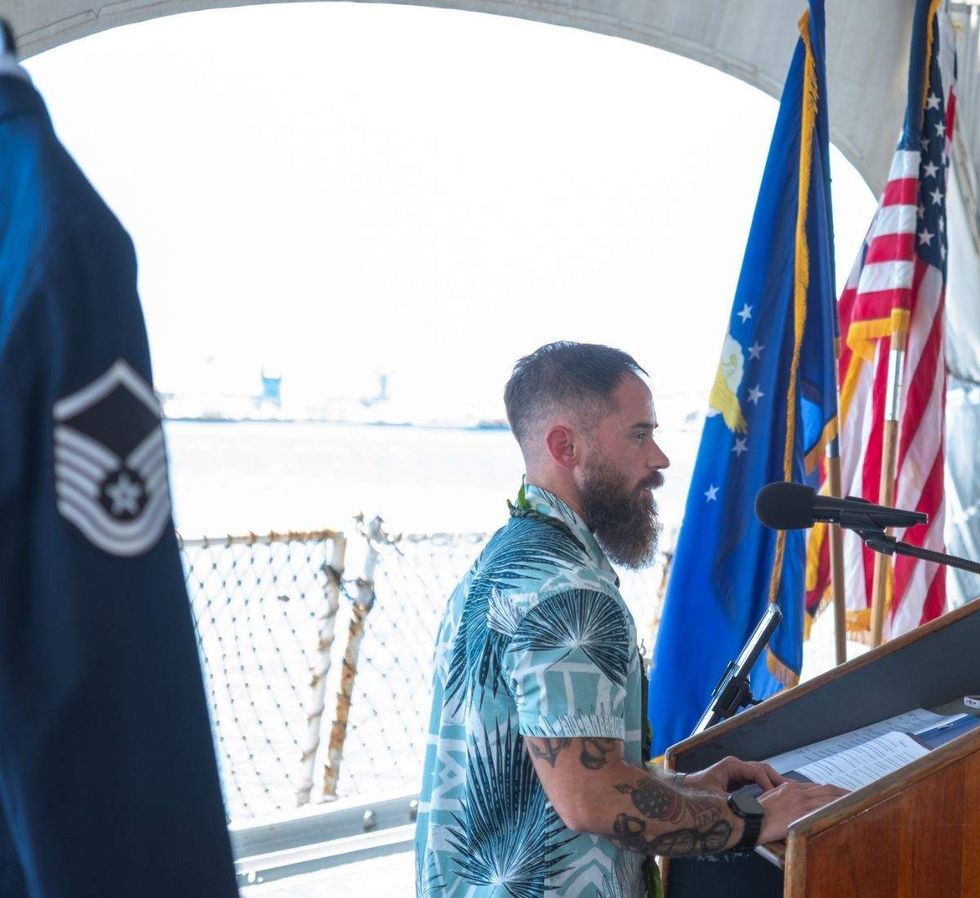 Master Sgt. Logan Ireland speaks at his retirement ceremony in Hawaii in May 2026.Logan Ireland
He did not want to leave. But after the Trump administration moved to push transgender people out of the armed forces, the man who had spent a decade and a half making himself indispensable was left to choose the least painful of a series of impossible options.
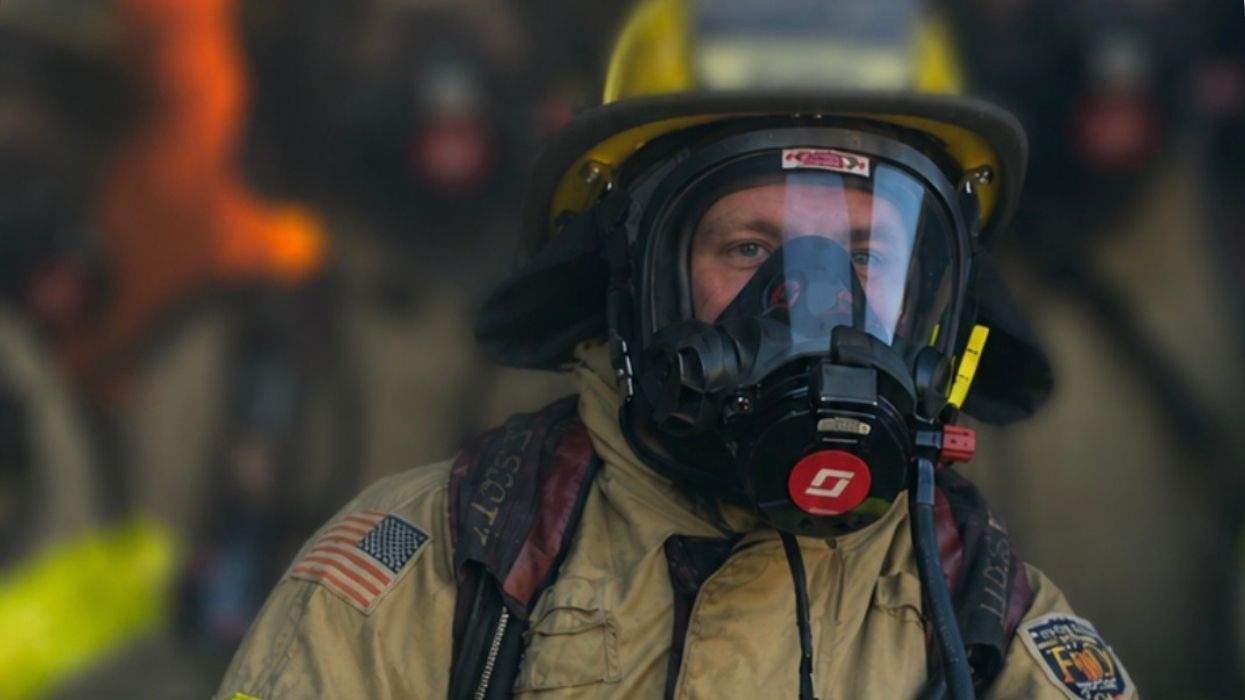
In the crowd was Clayton McCallister, a 25-year-old firefighter and EMT from Tennessee who still wants in.
McCallister had flown to Hawaii with his wife and daughter to honor a man he had known for years through SPARTA, the transgender military advocacy organization, but had never met in person until that week. Ireland had mentored him as McCallister pursued one of the most demanding career fields in the Air Force. Now Ireland’s career was closing, and McCallister’s was unfinished.
“He’s getting to do what ultimately I wish that I could have the opportunity to do,” Ireland told The Advocate. “So for him to come out here and to see my retirement amongst so many other things that happened during the retirement ceremony, it felt like it was coming full circle for me.”
Ireland wanted the day to be about that circle, not simply the end of his own service, but the question of who would carry it forward.
“A lot of us are not getting retirement, some are getting separated against their desires, but ultimately, all of us have this same common goal of passing the torch onto the next person,” he said. “The chapters that follow are still to be written. And it’s going to be Clay, people like Clay, to write those next chapters.”
Related: This trans Air Force recruit wants to jump out of planes to save others. He's suing Trump to serve
“A fair shot”
Ireland entered the Air Force in 2010 during the era of “Don’t Ask, Don’t Tell,” before he had the language to describe who he was. He enlisted for many of the same reasons others do: to serve, to travel, to finish his degree, to build a better life.
“I wasn’t trying to escape anything,” he said. “I just wanted to serve.”
Early in his career, he said, leaders saw what mattered before the institution did. They saw performance. They saw discipline. They saw an airman worth investing in.
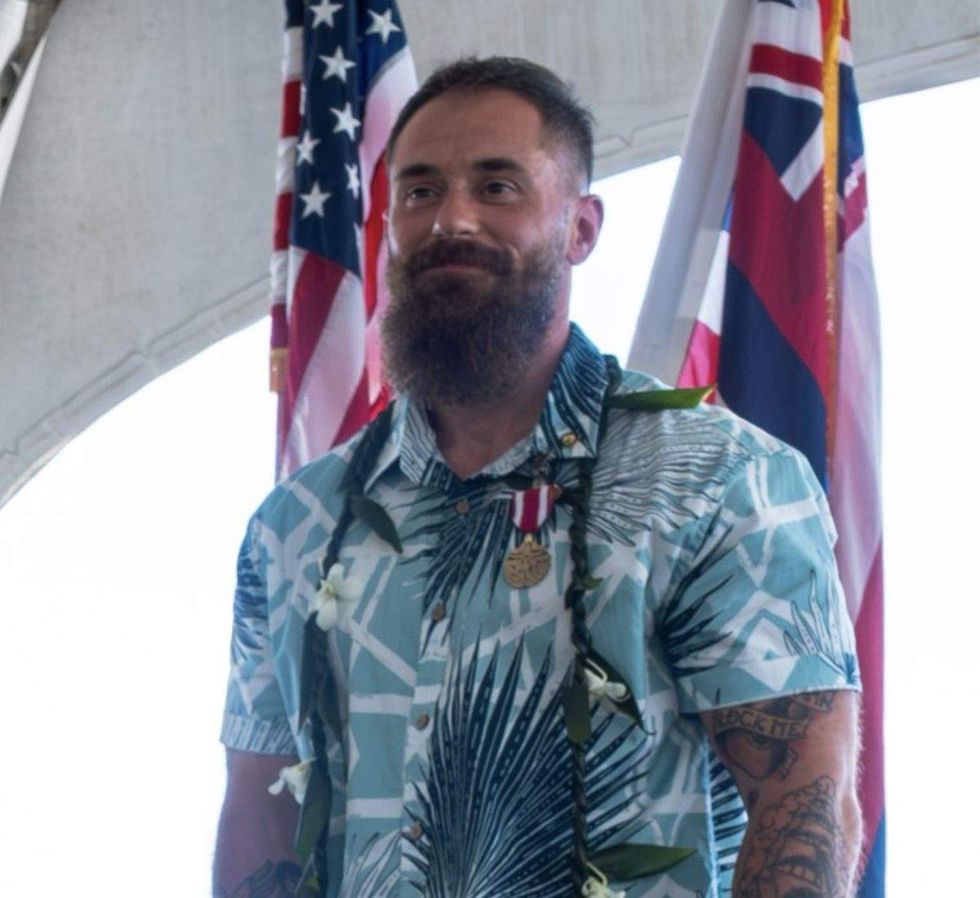 Master Sgt. Logan Ireland at his retirement ceremony.Logan Ireland
“Sometimes that is the greatest gift,” Ireland said, “just a chance and just an opportunity to succeed.”
He took that chance and made a vow. He would make the most of his career because so many others like him had not been allowed to do the same. He would become the best airman he could. He would open as many doors as possible for the people coming after him.
That mission followed him to Afghanistan. In 2014, while deployed as a lead convoy driver and gunner, Ireland attended a town hall with then-Defense Secretary Ash Carter. A friend asked what he would say if he had the chance to question the secretary. Ireland said, half-joking, that he would ask what Carter thought about transgender service members serving in an austere combat environment like the one they were standing in.
A few minutes later, the friend walked to the microphone and asked the question in a packed room full of brass, cameras, and reporters.
“I knew once he did that, my life had changed, period,” Ireland recalled.
Carter answered that nothing but suitability for service should determine whether someone could wear the uniform. A review followed. The ban that had forced transgender troops to serve in silence began to crack.
In his retirement speech, Ireland returned to that moment. “Visibility was never the goal — but it became necessary for those who couldn’t be visible,” he said.
After returning from Afghanistan, Ireland and his wife, Laila, a former Army combat medic who is also transgender, shared their story publicly. They appeared in documentaries, on national television, on red carpets, and in magazines.
“We never chose visibility for attention. We chose it as an act of service, not just for us, but for those who will come after us,” he said in his speech.
One line from Army veteran Sue Fulton, part of West Point’s first class to admit women, stayed with them: “Sometimes, you have to plant trees under whose shade you will never sit.”
At Ireland’s retirement ceremony, one of those trees had a name. Clay.
Related: Meet trans vet, husband, and dad, Clayton McCallister
The recruit who would not quit
McCallister was trying to outrun a political clock when he walked into an Air Force recruiter’s office in Tennessee. He told the recruiter that he was transgender and asked whether the recruiter was willing to help. Several had already stopped returning his calls once he disclosed. Finally, one said yes.
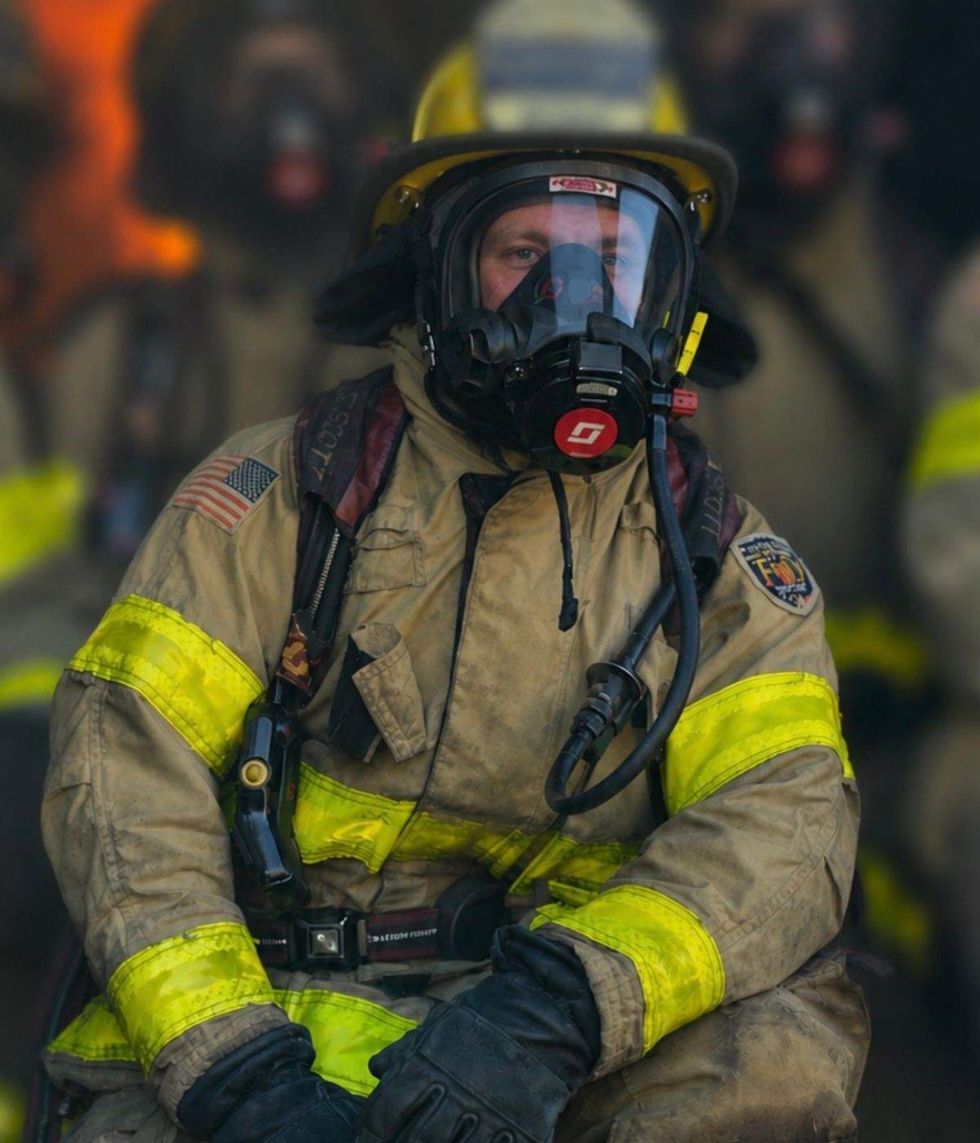 Firefighter Clayton McCallister is hoping to serve in the U.S. Air Force someday.Courtesy Clayton McCallister
What he wanted was not an easy path. He wanted to do pararescue, one of the most physically and mentally punishing career fields in the military. It’s a specialty with an attrition rate around 80 percent, built around water survival, parachuting into combat zones, and rendering medical aid to the wounded on the worst day of their lives. The mission appealed to him precisely because it combined medicine, rescue, endurance, and service.
“Honestly, I always feel like I have a drive to do more for more people,” McCallister told The Advocate. “There are people out there that need help. If not me, then who?”
He trained for more than a year, secured a special warfare contract, passed entrance processing, and shipped to basic training, finishing at the top of his class. But the Trump administration had reinstated the ban. McCallister graduated from basic training but was not allowed to continue into the Air Force career he had trained for. He took a voluntary separation, the same wrenching choice so many others were forced into, and went home to his wife and young daughter.
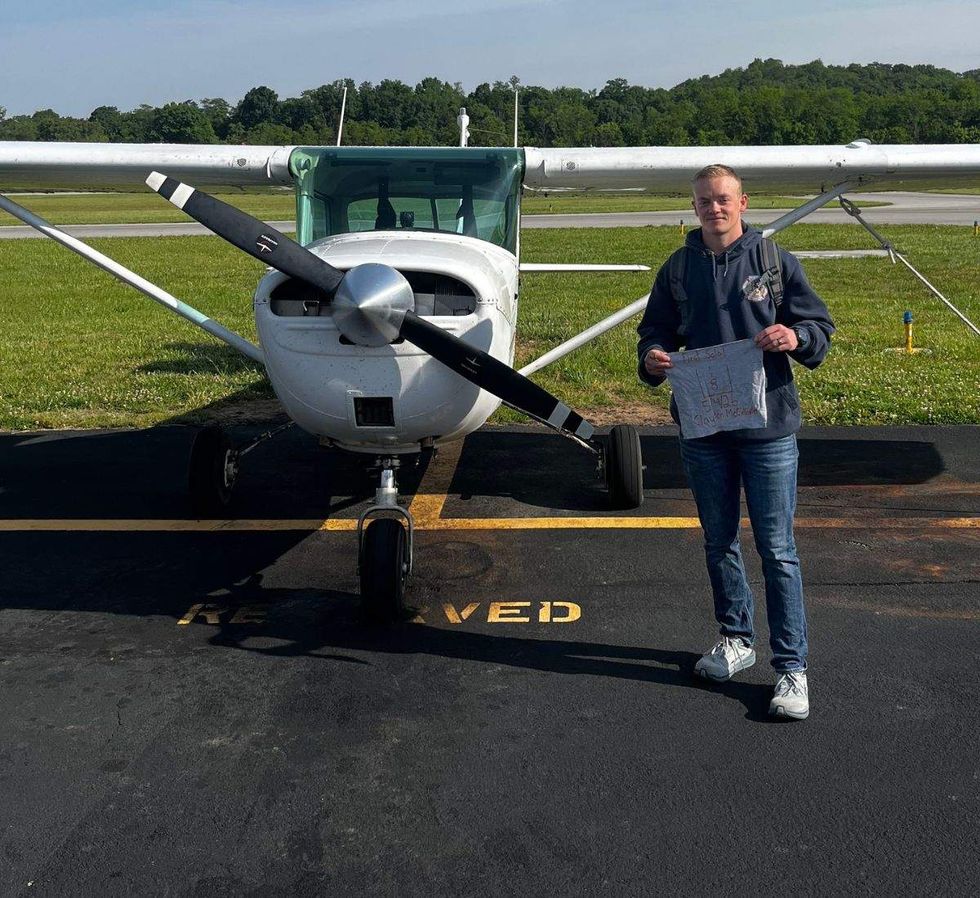 Clay McCallister is working to earn his pilot's license.Clayton McCallister
He is now one of the plaintiffs in Talbott v. United States, the federal lawsuit brought by the National Center for LGBTQ+ Rights and GLAD Law that challenges the ban.
“It still eats at me because it feels like I gave up in a way, even though it wasn’t a choice for us,” McCallister said. “It was either you take this, or you take this, but either way you’re kicked out.”
Before basic training, amid the uncertainty, he had applied to fire departments. Shortly after returning home, one invited him to test. He passed the physical fitness and written exams, completed the fire academy, and graduated as an EMT-Basic in March. He now works full-time on a fire truck, responding to structure fires and the most serious medical calls.
In his off hours, he keeps training — scuba certification, a private pilot’s license (he flew his first solo shortly before the trip to Hawaii), and advanced EMT testing in the fall. His three-year-old daughter, Remi, has memorized his schedule. When airplanes pass overhead, she points up and tells people, “Hey, that’s my dad,” even when he is standing right beside her.
The firefighting is real work, and he values it. But it is not the thing he trained for.
“Anytime my wife and I talk about our future, what’s coming, that’s our number one goal — get back in the Air Force, go do the things that I wanted to do,” McCallister said. He described the feeling of working a shift he genuinely values while knowing he is somewhere other than where he belongs. “I still feel this void of there’s a job out there that I’m supposed to be doing that I don’t get to do right now. One’s where my heart’s at, and one feels like it’s buying me time.”
Related: Transgender Air Force members sue Trump administration over revoked retirements
What Ireland sees in him
Ireland sees himself in McCallister so completely that he sometimes has to stop himself from speaking for the younger man.
“His legacy is, hey, he’s a dude who wants to be in the military and has a passion for being a pararescueman, for providing medical aid on someone’s worst day,” Ireland said. “That’s his passion. Has nothing to do with him being trans.”
That is the duality both men live with: being transgender is not the most interesting thing about either of them, and yet their lives have been repeatedly shaped by other people’s fixation on it.
As a transgender person, McCallister said, he often feels “guilty until I prove myself innocent.” If people know he is transgender before they know what he can do, he carries the pressure of proving himself twice over.
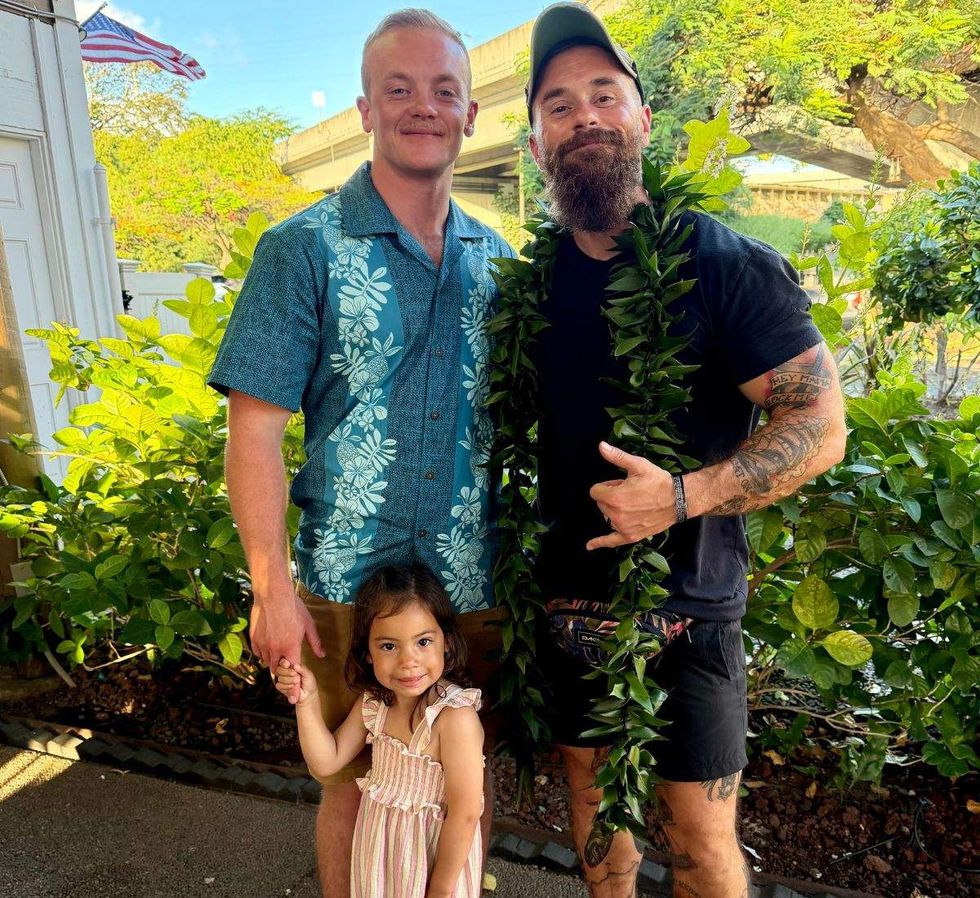 Clayton McCallister (left) with Logan Ireland and McCallister's daughter Remi.Clayton McCallister
But that pressure has a way of dissolving, one person at a time. In the fire academy, his classmates — “my brothers at this point” — did not know he was trans at first, and he’d sat through more than one group conversation about transgender people, including versions of the familiar “you can always tell” argument. Halfway through the fire academy, someone noticed the Progress Pride flag sticker on his water bottle and asked about it. He told them.
“I was like, ‘I’m trans,’ and everybody’s face just shifted,” McCallister recalled. “They were like, ‘No, you’re messing with us.’”
He was not. The silence broke into questions, then jokes, then conversations about the military ban and what it had cost him. Later, one coworker texted him to say he had completely changed his mind.
“Sometimes it’s the small wins like that that really push me,” McCallister said. “Inch by inch, I think that we make everywhere a space for us just by those small wins, by changing hearts, changing opinions.”
Ireland recognizes that too. During his own years in leadership, he said he tried to lead with education first. “The more authentic that I can be to my team, the more that they are willing to share a little piece of themselves,” he said. For Ireland, authenticity was operational. A team that trusts each other comes together faster when the work gets hard.
That is why he worries about the transgender troops still serving in silence now.
“Serving in silence sucks,” Ireland said. “I did it for many years, not being able to live authentically. But I knew that there would come a time when my serving in silence and my excelling at my job would matter, and it would matter to someone who would come after me. It would matter to someone like Clay.”
Related: Air Force rescinds early retirement approvals for transgender service members kicked out by Trump
Then came the letter
At the ceremony, amid the speeches and the gathering of people who had crossed oceans to be there, a letter was read.
It was dated November 14, 2025, printed on Barack Obama’s stationery and addressed to “Dear Logan.” The former president congratulated Ireland on his retirement after 15 years of service and wrote that most Americans would never know the sacrifices made by service members and their families. He told Ireland to reflect with pride on his Air Force service and on “the role you’ve played in defending the values that define who we are as a nation.”
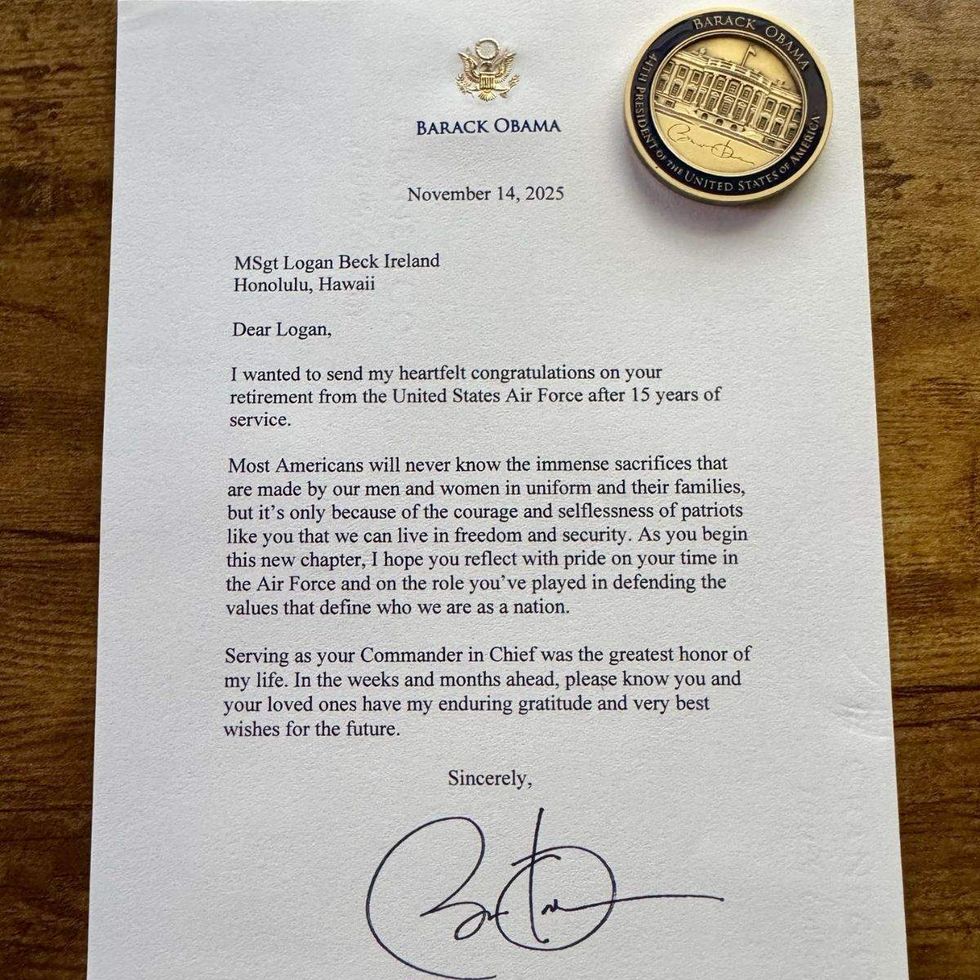 Former President Barack Obama sent a letter congratulating Master Sgt. Logan Ireland on his retirement.Courtesy Logan Ireland
Obama closed by writing that serving as commander in chief had been “the greatest honor” of his life, and offering Ireland and his loved ones “my enduring gratitude and very best wishes for the future.”
It was Obama’s administration that lifted the ban on open transgender military service in 2016. It is Trump’s administration that moved again to force transgender people out.
Mixed emotions
For McCallister, watching Ireland’s ceremony was beautiful and infuriating. “It was definitely a mix of emotions,” he said. “Both pride and anger at the same time.” Pride in everything Ireland had accomplished; anger that the same career could be used to disprove nearly every claim made against transgender troops while still being forced toward an ending Ireland did not seek.
“His military career speaks for itself,” McCallister said. “And then you add that to, OK, he’s a service member that happens to be trans, and he’s still accomplished all of this stuff. And while we have these politicians saying that we’re not capable or we’re dishonorable or we lack integrity, it’s a perfect contradiction of everything that they say.”
The research says much the same. A review of 58 empirical studies on transgender military service, published in the International Journal of Transgender Health and led by University of Nevada, Las Vegas professor Kati McNamara, found no evidence supporting the core claims used to justify excluding transgender people from service. The Pentagon spends roughly $5 million a year on care associated with transgender service members, which is a sliver of a health budget measured in the tens of billions, and far less than it spends on routine conditions like musculoskeletal injuries or childbirth. The review found no data showing trans troops are less deployable than peers recovering from a knee injury, and none showing they harm unit cohesion. McNamara told The Advocate she went looking for evidence behind the government’s assertions and “could not find a single study that said that.”
The courts have begun to say something similar. In Talbott v. United States, the U.S. Court of Appeals for the D.C. Circuit ruled this month that the Pentagon could not remove the currently serving named transgender plaintiffs while litigation continues, though it allowed the government to keep blocking new accessions for now. The decision followed earlier findings that the policy appeared unsupported by evidence and driven by discriminatory intent, including a federal judge’s conclusion that the ban was “soaked in animus and dripping with pretext.”
The ruling offered protection to some of the people already in uniform. It did not give McCallister back the career he had trained for. Still, he said, he has never doubted that transgender people will serve again.
“It will bend back our way at some point,” McCallister said. “It’s just a matter of when.”
Related: DOJ tells court transgender troops must be fired before suing over revoked retirements
What it costs
For Ireland and McCallister, the fight is about whether the country understands what it is losing. Ireland gave the Air Force 15 years. McCallister trained for a future that was taken from him before it could fully begin. One man is being pushed into life after uniform; the other is preparing for the day he can put one back on.
Both talk more about responsibility than about grievance.
McCallister often thinks about his daughter, and the answer he wants to give her one day when she asks what he did in this moment. “I wholeheartedly never want that answer to be, ‘Well, I just survived,’” he said. “I want to be able to tell her that I stood on my morals, I stood on principles, I did what was right, I fought as hard as I could, and I helped others and tried to bring people up with me.”
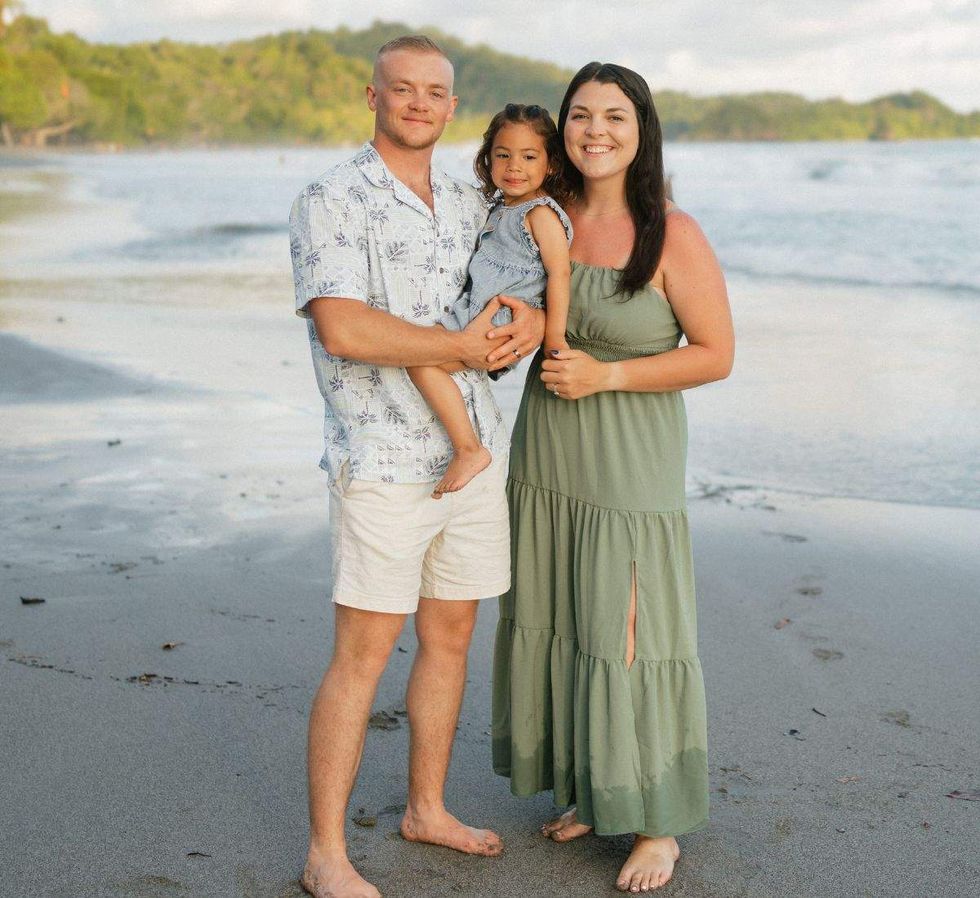 Clayton McCallister with his wife and daughter.Karina Ocampo Fotografía
When people ask why he would fight to serve a country whose government has told him he does not belong, McCallister returns to the same stubborn faith. “If we just take everybody out of a place where we’re not wanted, then we never get to build our stake there,” he said. “Everybody deserves a stake in the United States.”
Related: Trans service members have always been part of U.S. history
The inheritance
Near the end of his retirement speech, Ireland tried to introduce himself outside the structure that had defined his adult life.
“Hey, I’m Logan,” he said. A cat dad who likes warm hugs and long walks, a yoga practitioner who listens to Taylor Swift, someone who loves pumpkin spice, movies, the beach, and seeing other people succeed. “Just a dude trying to do guy things in this world with the time I have.”
That may be what makes their stories so difficult for the government’s arguments to contain. Neither man is asking to be treated as an abstraction. Neither wants to be a symbol, though both have become one. Ireland wanted to serve. McCallister still does. Both met the standards. Both built their lives around service. Both became visible because silence would have left too many others alone.
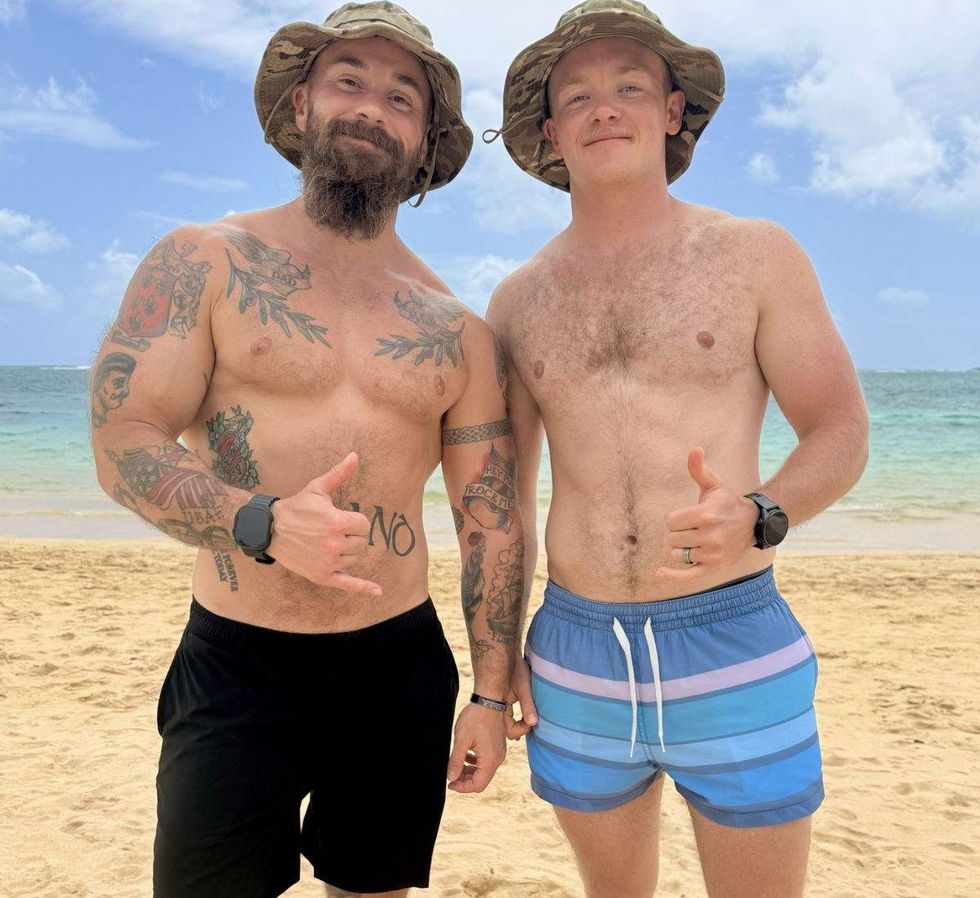 Logan Ireland (left) and Clayton McCallister (right).Courtesy Logan Ireland
At the ceremony, Ireland told the service members like him — past, present, and future — that the title of this chapter may already have been written.
“But we write the pages,” he said. “And the chapters that come next are waiting on us.”
The uniform is coming off. Ireland says the commitment is not. He wants to be there when McCallister gets the chance he was denied and to watch him graduate, serve, lead, and go places Ireland never got to go.
“I want to see him be better than me,” Ireland said.
When the door reopens, McCallister will be there.