'%3E%3Cpath d='M16.3574 35.6519H12.9537L15.0491 18.8873L16.3574 35.6519ZM30.4229 54.0093L22.309 0.994385H7.91795L0 54.0093H10.6634L11.5802 46.3855H17.4014L17.9914 54.0093H30.4229Z' fill='%23971B20'/%3E%3Cpath d='M48.2073 41.8813C48.2073 43.4049 47.4892 44.0011 46.1144 44.0011H43.7595V11.0687H46.1144C47.4892 11.0687 48.2073 11.6636 48.2073 13.1885V41.8813ZM59.5273 43.6695V11.3326C59.5273 3.71323 53.5729 0.994385 47.8157 0.994385H31.7213V54.0093H47.8157C53.5729 54.0093 59.5273 51.29 59.5273 43.6695Z' fill='%23971B20'/%3E%3Cpath d='M90.183 0.994385H78.6039L75.0711 30.6157L71.9955 0.994385H59.4346L69.2474 54.0093H80.373L90.183 0.994385Z' fill='%23971B20'/%3E%3Cpath d='M107.063 42.3448C107.063 43.7359 105.951 44.5974 104.643 44.5974C103.269 44.5974 102.157 43.7359 102.157 42.3448V12.658C102.157 11.2676 103.269 10.4058 104.643 10.4058C105.951 10.4058 107.063 11.2676 107.063 12.658V42.3448ZM119.233 43.2723V11.7312C119.233 6.36384 112.952 -3.8147e-06 104.643 -3.8147e-06C96.2667 -3.8147e-06 89.9867 6.36384 89.9867 11.7312V43.2723C89.9867 48.6393 96.2667 55 104.643 55C112.952 55 119.233 48.6393 119.233 43.2723Z' fill='%23971B20'/%3E%3Cpath d='M150.976 43.9349V33.7309H139.069V42.3448C139.069 43.7359 137.957 44.5974 136.582 44.5974C135.076 44.5974 133.964 43.7359 133.964 42.3448V12.658C133.964 11.2676 135.076 10.4058 136.582 10.4058C137.957 10.4058 139.069 11.2676 139.069 12.658V21.2723H150.976V11.0687C150.976 5.70107 145.283 -3.8147e-06 136.582 -3.8147e-06C127.75 -3.8147e-06 121.796 5.70107 121.796 11.0687V43.9349C121.796 49.3022 127.75 55 136.582 55C145.283 55 150.976 49.3022 150.976 43.9349Z' fill='%23971B20'/%3E%3Cpath d='M167.478 35.6519H164.076L166.17 18.8873L167.478 35.6519ZM181.544 54.0093L173.432 0.994385H159.037L151.123 54.0093H161.785L162.704 46.3855H168.523L169.114 54.0093H181.544Z' fill='%23971B20'/%3E%3Cpath d='M205.412 10.4058V0.994385H177.081V10.4058H185.392V54.0093H197.428V10.4058H205.412Z' fill='%23971B20'/%3E%3Cpath d='M230.002 54.0093V43.9349H218.914V31.8746H226.635V21.8028H218.914V10.4058H230.002V0.994385H206.875V54.0093H230.002Z' fill='%23971B20'/%3E%3C/g%3E%3Cdefs%3E%3CclipPath id='clip0_260_7080'%3E%3Crect width='230' height='55' fill='white'/%3E%3C/clipPath%3E%3C/defs%3E%3C/svg%3E)
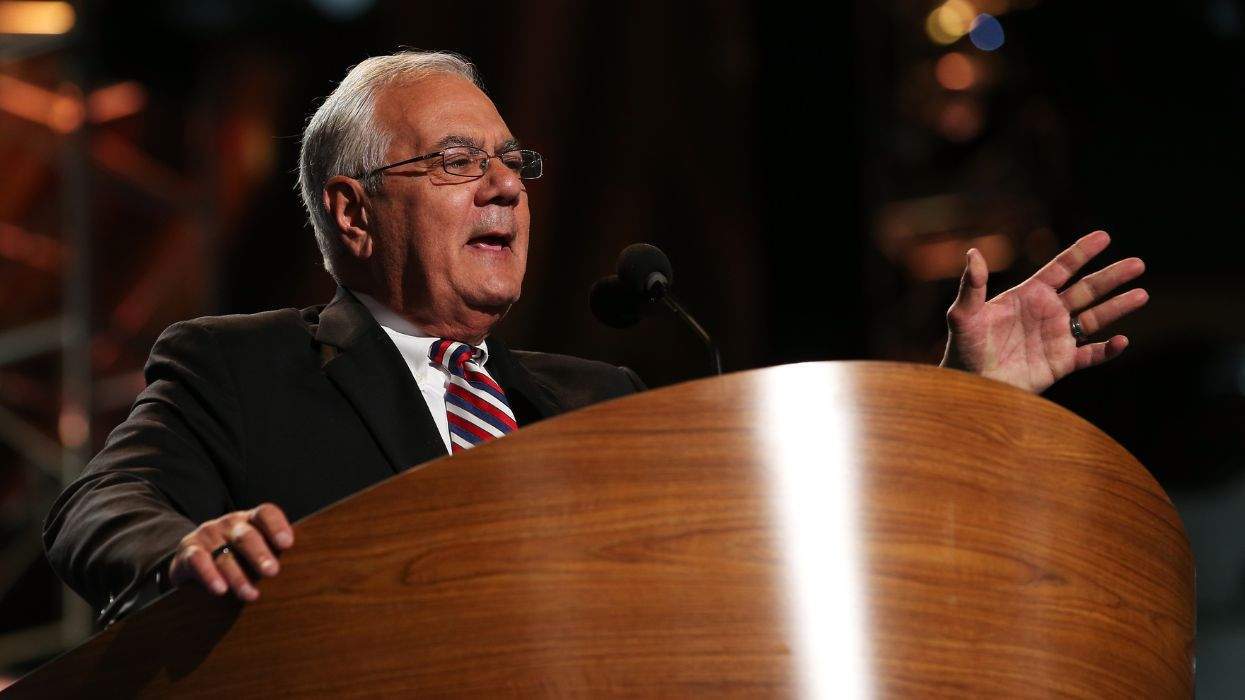
Barney Frank, the trailblazing Massachusetts congressman whose razor-sharp political instincts and unapologetic visibility helped reshape both American liberalism and LGBTQ+ representation in public life, has died at 86, according to The Boston Globe.
Frank died Tuesday night after recently entering hospice care at his home in Ogunquit, Maine, where he had been battling congestive heart failure, the Globe reported.
For more than three decades in Congress, Frank stood at the center of some of the country’s defining political battles, from the AIDS crisis and gay rights movement to the fallout of the 2008 financial collapse. Equal parts policy architect and cable news combatant, he became one of the Democratic Party’s most recognizable liberals while also emerging as one of the most consequential out gay politicians in American history.
"Former Member of Congress Barney Frank’s legacy stretches beyond the landmark Dodd-Frank Act to include many laws to advance prevention, detection, and treatment of HIV/AIDS. We remember Barney as a trailblazer who was the first Member of Congress to come out as gay, and who moved many pieces of civil rights legislation forward," PFLAG National President Brian K. Bond said in a statement to The Advocate. "Sadly, his legacy is also marred by his own actions and failures on behalf of transgender people."
Born Barnett Frank in Bayonne, New Jersey, on March 31, 1940, he graduated from Harvard College before later earning a law degree from Harvard Law School. He entered Massachusetts politics in the 1970s, serving in the state House before winning election to Congress in 1980.
Related: From hospice, Barney Frank urges Democrats to rethink trans rights approach
In 1987, at a time when few national politicians were openly gay, and the AIDS epidemic was devastating LGBTQ+ communities, Frank publicly came out, becoming the first member of Congress to voluntarily do so while in office. The decision transformed him into a symbol of a rapidly changing political era and helped push LGBTQ+ visibility deeper into mainstream American life.
Frank also became one of Congress’s most persistent advocates for federal LGBTQ+ civil rights protections. For years, he championed the Employment Non-Discrimination Act, known as ENDA, legislation intended to ban workplace discrimination based on sexual orientation and, later, gender identity. The effort consumed much of Frank’s congressional career but repeatedly stalled amid Republican opposition and divisions within the LGBTQ+ movement.
In one of the movement’s most contentious internal fights, Frank drew criticism from transgender advocates in 2007 after supporting a version of ENDA that protected sexual orientation but excluded gender identity protections. Frank argued at the time that a broader bill lacked enough support to pass Congress. Many LGBTQ+ activists viewed the compromise as a painful betrayal, while supporters defended it as a pragmatic attempt to secure at least partial federal protections in an openly hostile political environment.
Frank’s legislative influence stretched far beyond LGBTQ+ rights. As chair of the House Financial Services Committee during the Obama years, he became a principal architect of the Dodd-Frank Wall Street Reform and Consumer Protection Act, a financial regulatory overhaul passed after the Great Recession.
"At a time when being openly gay in public service could cost you everything, he chose visibility. At a time when our community was being devastated by AIDS, and too many leaders looked away, he demanded action," Human Rights Campaign President Kelley Robinson said in a statement. "He helped pave the way for the repeal of ‘Don’t Ask, Don’t Tell,’ stronger federal protections, marriage equality, and a future where LGBTQ+ people could see themselves not just represented but leading at the highest levels of government."
In his final weeks, Frank remained deeply engaged in the political arguments reshaping the Democratic Party and the LGBTQ+ movement.
In a series of interviews from hospice care earlier this month, including one with CNN’s Jake Tapper, Frank urged Democrats to rethink how they approach some transgender rights debates, particularly around sports participation and political messaging.
He argued that Democrats risked turning politically difficult issues into ideological “litmus tests” and suggested the gay rights movement succeeded by building public consensus incrementally over time.
Related: Barney Frank’s final interview from hospice was painful. His comments on trans people made it worse
The comments ignited criticism from some LGBTQ+ advocates and transgender activists, who accused Frank of validating Republican attacks on trans people during a period of escalating legislative and legal assaults nationwide. Others defended him as a veteran strategist of civil rights politics whose willingness to challenge his own political alliance had long defined his public life.
"PFLAG National has chosen a different path than Barney many times over the years to ensure trans, nonbinary, and intersex people are never left behind," Bond said. "This is why the LGBTQ+ people, parents, family members, and allies who are part of PFLAG continue to fight, from Capitol Hill to city council, to ensure every LGBTQ+ person has the freedom to be themselves and to thrive—always.”
Months earlier, Frank had appeared alongside longtime ally, California Congresswoman Maxine Waters, at a PFLAG National event in Washington, D.C., honoring Waters with the organization’s Champion of Justice award. Frank reflected on decades of coalition-building between Black and LGBTQ+ communities and praised what he called the failure of “efforts by advocates of either variety of bigotry to drive a wedge between the Black and LGBTQ+ communities.”
“No one deserves more credit for this than Maxine Waters,” Frank said at the event.
Frank retired from Congress in 2013 after 32 years in office. He married his longtime partner, Jim Ready, in 2012, becoming the first sitting member of Congress to enter a same-sex marriage, a year before the U.S. Supreme Court struck down key parts of the Defense of Marriage Act.
His career was not without controversy. In the late 1980s, Frank became embroiled in one of the most politically damaging episodes of his congressional career after revelations involving Stephen Gobie, a former partner who had operated a male escort service out of Frank’s Washington apartment. Republicans and conservative media figures seized on the scandal, casting it as both an ethics issue and a cultural flashpoint at a time when antigay stigma remained deeply entrenched in national politics.
A House ethics investigation ultimately found that Frank had improperly used his congressional office to intervene in parking tickets tied to Gobie but cleared him of more serious allegations involving prostitution or drug use. The House voted to formally reprimand Frank in 1990, a punishment less severe than censure. Frank publicly acknowledged what he called a “serious error in judgment” in allowing Gobie to stay in his home but denied knowingly facilitating illegal activity.
Over time, the episode became less defining than Frank’s reputation as one of the Democratic Party’s most effective legislative tacticians and fiercest liberal communicators.
To admirers, Frank represented an earlier model of Democratic politics: intellectually combative, coalition-minded, institutionally savvy, and willing to trade ideological purity for legislative victories. To critics, especially later in life, he appeared dismissive of the urgency of activism and of cultural change.
" Barney broke barriers for the LGBTQ+ community and helped push us closer to making true America’s promise of liberty, justice, and equality for all," said Democratic House Leader Hakeem Jeffries in a statement. "We are a better Caucus and country because of Barney Frank’s relentless leadership and candor. Though we are blessed with many memorable quips to remember him by, the House Democratic Caucus family will miss Barney deeply and mourn with his loved ones during this difficult time."
Frank is survived by his husband.