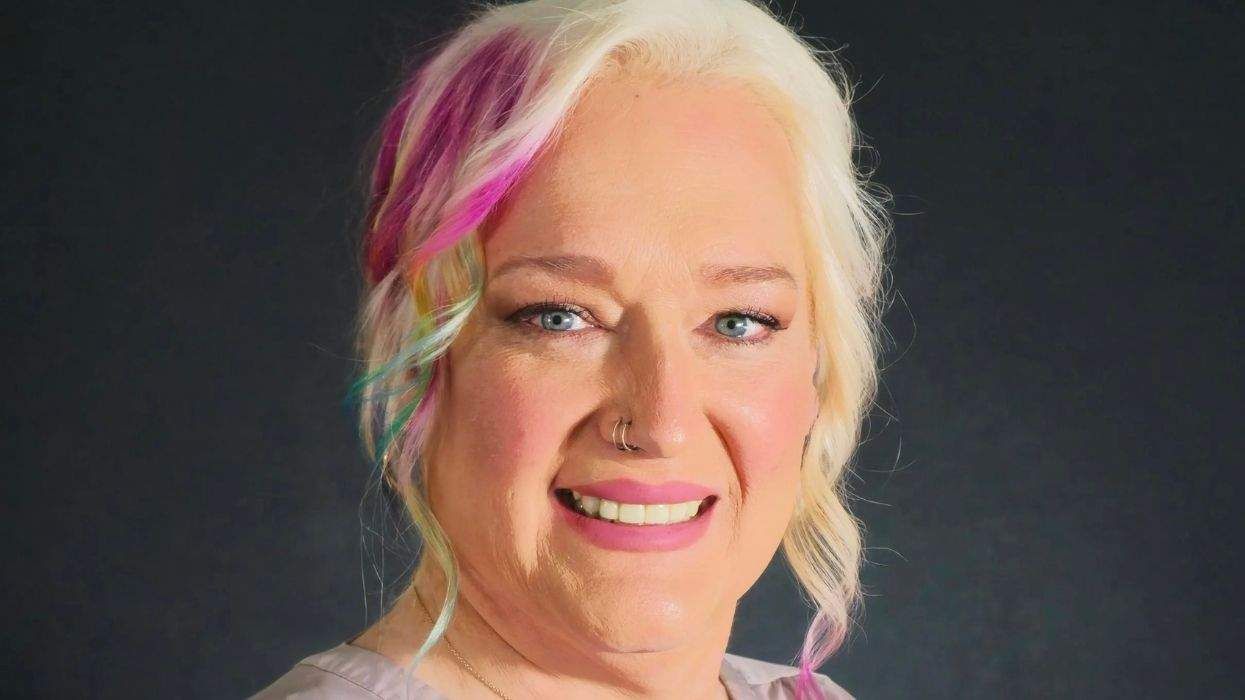
In one of Maryland’s most reliably Republican legislative districts, a fast-growing, exurban area just 40 miles from the nation’s capital, transgender U.S. Army veteran Alleria Stanley is mounting a campaign that challenges both political expectations and the boundaries of representation. With anti-trans legislation surging nationwide and local offices becoming flashpoints in the culture wars, her bid for the Maryland House of Delegates positions her at the crossroads of national tension and regional transformation.
Keep up with the latest in LGBTQ+ news and politics. Sign up for The Advocate's email newsletter.
Maryland’s Legislative District 4 is not the kind of place where Democrats usually launch insurgent bids, and certainly not the type of district where out transgender candidates emerge. Stretching across much of Frederick County, northwest of Washington, D.C., where Appalachian foothills meet the outer reaches of the capital’s commuter belt, the district has been a Republican stronghold for decades. In 2020, Republicans made up roughly 45 percent of the electorate, while Democrats accounted for 31 percent, and Republicans currently hold all three state House seats.
Related: Trans candidates demand their seat at the table in the Florida legislature
Into that terrain steps Stanley, a retired U.S. Army soldier, combat veteran, radiology technologist, mother of five, widow, advocate for transgender veterans, and now, a first-time Democratic candidate for state delegate. If she prevails in this district, she will not only make history but also demonstrate that a candidate whose life has spanned combat zones, health care systems, and multiple identities can reach voters across political divides simply by showing up.
“I enjoy serving,” she told The Advocate in an interview. “I did 20 years in the Army, serving my patients, my clinical staff, and my soldiers. After I got out of the Army, I started working in the advocacy field, and now it’s an opportunity to continue that service here for the people in my district, all the people in my district.”
Stanley’s campaign biography paints a picture of someone accustomed to responsibility: vice president of the Transgender American Veterans Association, board member of Mission Belonging, member of the policy team of Minority Veterans of America, facilitator of PFLAG’s national military family support group, and commissioner on the Frederick County Human Relations Commission. She also serves on the board of the United Democrats of Frederick County.
But her entry into the race is not just about service — it’s about a district she says has stopped hearing from its own lawmakers.
Stanley says she doesn't lead with identity, but she doesn’t hide from it either. “I’m not running on making my identity front and center,” she said. “It is a part of me, but it’s not the sole point. I’m also a veteran. I am a mom. I’ve been a single mom. I know what it’s like to really worry about the next paycheck.”
She knows what her candidacy will invite in a climate shaped by anti-trans rhetoric and misinformation.
“Is it something to be concerned about? Oh, absolutely,” she said, recalling prior harassment and violence directed at her family. “But that should not be a major reason” to step back. “I signed up to serve, and I will do so here again.”
Related: Muslim legislator running for governor says Georgia deserves leaders who reject scapegoating trans people
Her strategy is grounded in shared experience: affordability pressures, health care access, and the daily economic anxieties felt across Frederick County’s mix of suburban commuters, agricultural communities, and military families.
“I face the same grocery prices as everyone else does,” she said. “Affordable housing is an issue here, and we need to make sure people can afford to put food on the table.”
Her years in the military’s health care system sharpened her outlook. “In the Army, if you got sick, you just went to the hospital,” she said. “You didn’t worry about it." That’s the kind of peace of mind she wants for all Marylanders. “We need to make sure everything is less of a stress for our people,” she said.
District 4 is the kind of place where a Democrat has to work twice as hard to be taken seriously, and Stanley knows it. She is aware of the district’s roughly 9,000-voter Republican advantage and decades of GOP legislative dominance. The current delegates have not faced serious general election threats in years.
But Frederick County is not the same county it was 10 or 20 years ago. Rapid growth, rising housing costs, shifting suburban politics, and the influx of D.C.-area commuters have made parts of the county more competitive. Democrats have made gains in county-level offices, and while District 4 remains structurally red, it is less homogeneous than it once was.
Related: Despite Trump’s election, a glimmer of hope as transgender candidates win elections nationwide
Stanley’s branding, “purple, not blue,” she said, is intentional. “It’s a red and blue district,” she said. “I’m for everyone, whether red or blue.”
And she says she’s already seeing signs that her presence in the race is shifting behavior. One longtime Republican delegate, she said, recently attended a county human rights event for the first time. “It’s small,” she said. “But it’s a small win since the time is right for it.”
Her campaign ethos is built around the oldest organizing principle in democracy: go where the people are.
“The joy of being retired is that I have time,” she said. “I have time to go out and knock on a door.”
She is blunt about what she sees in local government and who is missing from it. “How many meetings are held, and the only people there are the ones on the committee?” she asked. “Your voice can be heard anywhere.” For LGBTQ+ young people watching her campaign, she offered a simple directive: “The first thing you have to do is look in the mirror and say, I can do this.”
Stanley is not pitching herself as a culture-war figurehead or a symbolic candidate. She told The Advocate that she’s campaigning as a veteran trained in service, a mother shaped by lived experience, and a neighbor willing to do the unglamorous work of knocking doors across a geographically sprawling district where many residents feel unseen.
“I want to make sure people’s voices are heard,” she said. “There are those who don’t speak up, and I will speak up for them. Some cannot be visible and live freely, and I will do so for them, as I have in the past.”
In District 4, where no Democrat needs to win outright, only to “place” in a multi-member contest, Stanley believes she has an absolute path to victory. But whether or not voters send her to Annapolis, she says the act of running matters.
“Decisions are made by those who show up,” she said.







































Charlie Kirk DID say stoning gay people was the 'perfect law' — and these other heinous quotes