'%3E%3Cpath d='M16.3574 35.6519H12.9537L15.0491 18.8873L16.3574 35.6519ZM30.4229 54.0093L22.309 0.994385H7.91795L0 54.0093H10.6634L11.5802 46.3855H17.4014L17.9914 54.0093H30.4229Z' fill='%23971B20'/%3E%3Cpath d='M48.2073 41.8813C48.2073 43.4049 47.4892 44.0011 46.1144 44.0011H43.7595V11.0687H46.1144C47.4892 11.0687 48.2073 11.6636 48.2073 13.1885V41.8813ZM59.5273 43.6695V11.3326C59.5273 3.71323 53.5729 0.994385 47.8157 0.994385H31.7213V54.0093H47.8157C53.5729 54.0093 59.5273 51.29 59.5273 43.6695Z' fill='%23971B20'/%3E%3Cpath d='M90.183 0.994385H78.6039L75.0711 30.6157L71.9955 0.994385H59.4346L69.2474 54.0093H80.373L90.183 0.994385Z' fill='%23971B20'/%3E%3Cpath d='M107.063 42.3448C107.063 43.7359 105.951 44.5974 104.643 44.5974C103.269 44.5974 102.157 43.7359 102.157 42.3448V12.658C102.157 11.2676 103.269 10.4058 104.643 10.4058C105.951 10.4058 107.063 11.2676 107.063 12.658V42.3448ZM119.233 43.2723V11.7312C119.233 6.36384 112.952 -3.8147e-06 104.643 -3.8147e-06C96.2667 -3.8147e-06 89.9867 6.36384 89.9867 11.7312V43.2723C89.9867 48.6393 96.2667 55 104.643 55C112.952 55 119.233 48.6393 119.233 43.2723Z' fill='%23971B20'/%3E%3Cpath d='M150.976 43.9349V33.7309H139.069V42.3448C139.069 43.7359 137.957 44.5974 136.582 44.5974C135.076 44.5974 133.964 43.7359 133.964 42.3448V12.658C133.964 11.2676 135.076 10.4058 136.582 10.4058C137.957 10.4058 139.069 11.2676 139.069 12.658V21.2723H150.976V11.0687C150.976 5.70107 145.283 -3.8147e-06 136.582 -3.8147e-06C127.75 -3.8147e-06 121.796 5.70107 121.796 11.0687V43.9349C121.796 49.3022 127.75 55 136.582 55C145.283 55 150.976 49.3022 150.976 43.9349Z' fill='%23971B20'/%3E%3Cpath d='M167.478 35.6519H164.076L166.17 18.8873L167.478 35.6519ZM181.544 54.0093L173.432 0.994385H159.037L151.123 54.0093H161.785L162.704 46.3855H168.523L169.114 54.0093H181.544Z' fill='%23971B20'/%3E%3Cpath d='M205.412 10.4058V0.994385H177.081V10.4058H185.392V54.0093H197.428V10.4058H205.412Z' fill='%23971B20'/%3E%3Cpath d='M230.002 54.0093V43.9349H218.914V31.8746H226.635V21.8028H218.914V10.4058H230.002V0.994385H206.875V54.0093H230.002Z' fill='%23971B20'/%3E%3C/g%3E%3Cdefs%3E%3CclipPath id='clip0_260_7080'%3E%3Crect width='230' height='55' fill='white'/%3E%3C/clipPath%3E%3C/defs%3E%3C/svg%3E)
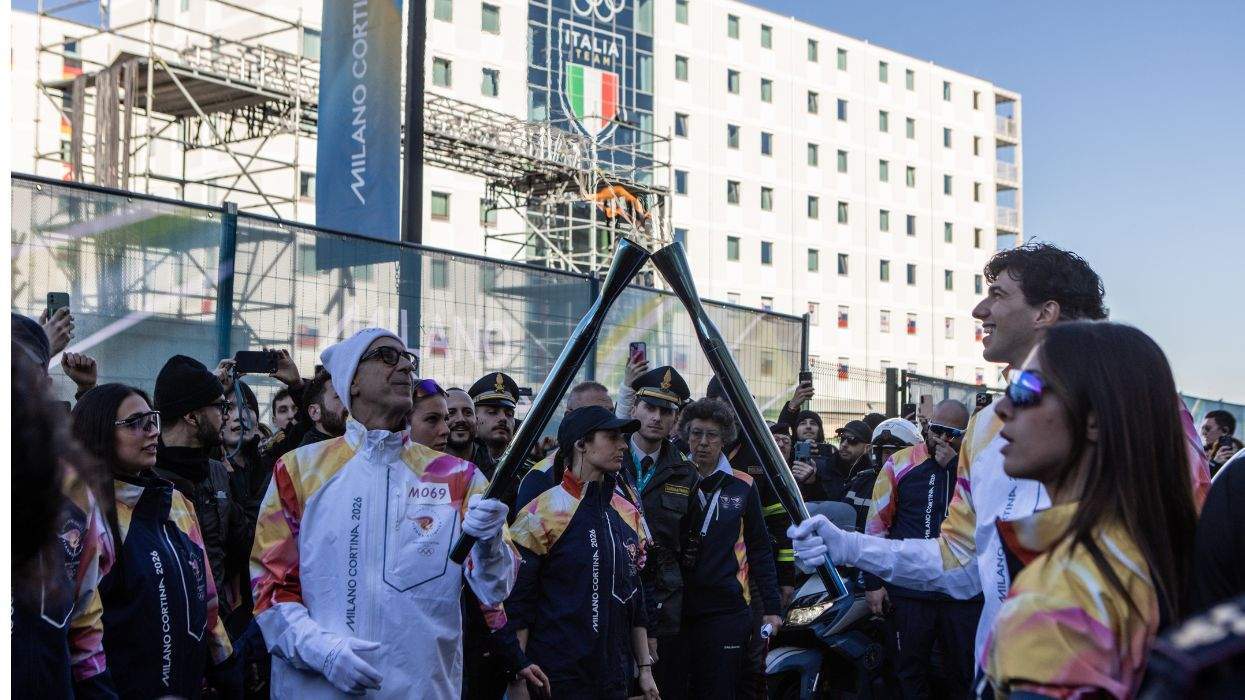

The 2026 Winter Olympics will have substantial LGBTQ+ representation — the most for any Winter Games — but the event is taking place in a country that lags behind much of Europe when it comes to LGBTQ+ rights.
Related: Meet all 41 LGBTQ+ Olympians at the 2026 Winter Olympics
The Milano Cortina Olympics are being held February 6-22 in Italy, primarily in Milan, a cosmopolitan city known for fashion and LGBTQ-friendliness. But the nation overall is a different story. It’s heavily influenced by its history and by the Roman Catholic Church.
Italy is led by Prime Minister Giorgia Meloni, a member of the Fratelli d’Italia (Brothers of Italy) party, “known for explicitly boasting about its fascist roots,” notes the International Institute for Strategic Studies. Meloni, elected in a landslide in 2022, is an admirer of Benito Mussolini, the fascist who was Italy’s dictatorial prime minister from 1922 to 1943.
A few months before the election, she spoke to members of a far-right party in Spain, saying her beliefs were “Yes to natural families, no to the LGBT lobby, yes to sexual identity, no to gender ideology, yes to the culture of life, no to the abyss of death.”
Since taking office, Meloni has shown moderation in foreign policy, but her domestic policy is something else again. Italy is the only country in Western Europe without marriage equality; in 2016, it established civil unions for same-sex couples, conferring all the rights of marriage except access to surrogacy and joint adoption. Despite the Catholic Church's power, then-Prime Minister Matteo Renzi advised the church to stay out of the debate.
Italy bans access to surrogacy for both same-sex and different-sex couples as well as single people under a law enacted in 2004. This ban was strengthened in 2024, making it illegal for Italians to become parents by surrogacy in another country and increasing criminal penalties. While it applies to all Italians equally, it disproportionately affects LGBTQ+ people.
“I continue to believe that surrogacy is an inhuman practice,” Meloni said at a conference while the bill, introduced by her party, was pending. “I support the bill that makes it a universal crime,” she added.
Joint adoption in Italy is limited to married couples, so since same-sex couples can’t marry, they’re shut out. However, courts can approve second-parent adoption.
Also in 2024, at the Group of Seven summit, led that year by Italy, the nation “raised the ire of its partners, particularly France, by insisting on having references to LGBTQ+ and abortion rights either expunged from or diluted in the G7’s final communiqué,” according to the International Institute for Strategic Studies. The Group of Seven is an association of nations that gather for forums on global issues. The group consists of the U.S., the U.K., Canada, France, Germany, Italy, and Japan. The European Union participates as well.
Italy has a national law against anti-LGBTQ+ discrimination in employment, but not in other aspects of life, such as housing, health care, and provision of goods and services. Some regional governments have more inclusive laws, notes international rights group Equaldex, which has a comprehensive database on the laws of Italy and other countries.
In 2021, Italy’s Senate quashed a bill that would have amended the country's hate-crimes law to cover LGBTQ+ people, women, and people with disabilities. There was strong opposition from the Catholic Church, which helped kill the legislation. The church’s influence is one of the main reasons the nation lags its neighbors in LGBTQ+ rights. Its headquarters, Vatican City, is an independent city-state, but it’s located within the borders of Rome.
Related: Lady Gaga: Italy's Failure to Pass LGBTQ+ Rights Bill 'Total Disaster'
Gender-affirming care is legal for adults in Italy but restricted for minors. Changing one’s gender on official documents requires a medical diagnosis; it used to require surgery. The nation does not recognize nonbinary identity. Gay, lesbian, and bisexual people can serve openly in the Italian military, but transgender people cannot — as in the U.S.
ILGA-Europe, an international LGBTQ+ rights organization, rated Italy below many European countries in its 2025 Rainbow Map. The map ranks 49 European countries on their legal and policy practices for LGBTQ+ and intersex people, from 0 to 100 percent. Italy had a score of 21.4 percent, putting it in 35th place among 42 countries rated. The average for European countries was 41.8 percent, the average for European Union members 51.1 percent. Not all European countries are members of the E.U.
Nevertheless, the associated organization ILGA World looks forward to welcoming LGBTQ+ athletes and fans. It is one of the partners in Pride House, designed to be a welcoming space for LGBTQ+ athletes, spectators, and allies, and will cohost an event there February 21. Under the theme “When Everyone Can Compete: Inclusion and the Power of Sport,” activists and athletes will discuss the importance of inclusivity in sports at all levels, especially for trans, intersex, and gender-diverse people. The U.S. Olympic Committee has barred trans women athletes from competing, while the International Olympic Committee is working on a policy that could end up in a ban.
However, ILGA World stresses hope and resilience. “No matter our walks of life, everyone wants to belong and to have community around them, and many of us find all this through sport, said a statement from Executive Director Julia Ehrt. “But lately, the bodies of many in our LGBTI communities — especially women in all their diversity — have become talking points for reactionary governments and people, who are choosing to strip us from the right to play, health, and dignity.
“But we know our communities are strong, and ILGA World is by their side every day – from the most remote ski slope to the Pride House and beyond. Because we know sport is too important to everyone’s sense of self and community to leave anyone on the sidelines. And together, we can create a world where everyone can enjoy the game they love.”