'%3E%3Cpath d='M16.3574 35.6519H12.9537L15.0491 18.8873L16.3574 35.6519ZM30.4229 54.0093L22.309 0.994385H7.91795L0 54.0093H10.6634L11.5802 46.3855H17.4014L17.9914 54.0093H30.4229Z' fill='%23971B20'/%3E%3Cpath d='M48.2073 41.8813C48.2073 43.4049 47.4892 44.0011 46.1144 44.0011H43.7595V11.0687H46.1144C47.4892 11.0687 48.2073 11.6636 48.2073 13.1885V41.8813ZM59.5273 43.6695V11.3326C59.5273 3.71323 53.5729 0.994385 47.8157 0.994385H31.7213V54.0093H47.8157C53.5729 54.0093 59.5273 51.29 59.5273 43.6695Z' fill='%23971B20'/%3E%3Cpath d='M90.183 0.994385H78.6039L75.0711 30.6157L71.9955 0.994385H59.4346L69.2474 54.0093H80.373L90.183 0.994385Z' fill='%23971B20'/%3E%3Cpath d='M107.063 42.3448C107.063 43.7359 105.951 44.5974 104.643 44.5974C103.269 44.5974 102.157 43.7359 102.157 42.3448V12.658C102.157 11.2676 103.269 10.4058 104.643 10.4058C105.951 10.4058 107.063 11.2676 107.063 12.658V42.3448ZM119.233 43.2723V11.7312C119.233 6.36384 112.952 -3.8147e-06 104.643 -3.8147e-06C96.2667 -3.8147e-06 89.9867 6.36384 89.9867 11.7312V43.2723C89.9867 48.6393 96.2667 55 104.643 55C112.952 55 119.233 48.6393 119.233 43.2723Z' fill='%23971B20'/%3E%3Cpath d='M150.976 43.9349V33.7309H139.069V42.3448C139.069 43.7359 137.957 44.5974 136.582 44.5974C135.076 44.5974 133.964 43.7359 133.964 42.3448V12.658C133.964 11.2676 135.076 10.4058 136.582 10.4058C137.957 10.4058 139.069 11.2676 139.069 12.658V21.2723H150.976V11.0687C150.976 5.70107 145.283 -3.8147e-06 136.582 -3.8147e-06C127.75 -3.8147e-06 121.796 5.70107 121.796 11.0687V43.9349C121.796 49.3022 127.75 55 136.582 55C145.283 55 150.976 49.3022 150.976 43.9349Z' fill='%23971B20'/%3E%3Cpath d='M167.478 35.6519H164.076L166.17 18.8873L167.478 35.6519ZM181.544 54.0093L173.432 0.994385H159.037L151.123 54.0093H161.785L162.704 46.3855H168.523L169.114 54.0093H181.544Z' fill='%23971B20'/%3E%3Cpath d='M205.412 10.4058V0.994385H177.081V10.4058H185.392V54.0093H197.428V10.4058H205.412Z' fill='%23971B20'/%3E%3Cpath d='M230.002 54.0093V43.9349H218.914V31.8746H226.635V21.8028H218.914V10.4058H230.002V0.994385H206.875V54.0093H230.002Z' fill='%23971B20'/%3E%3C/g%3E%3Cdefs%3E%3CclipPath id='clip0_260_7080'%3E%3Crect width='230' height='55' fill='white'/%3E%3C/clipPath%3E%3C/defs%3E%3C/svg%3E)
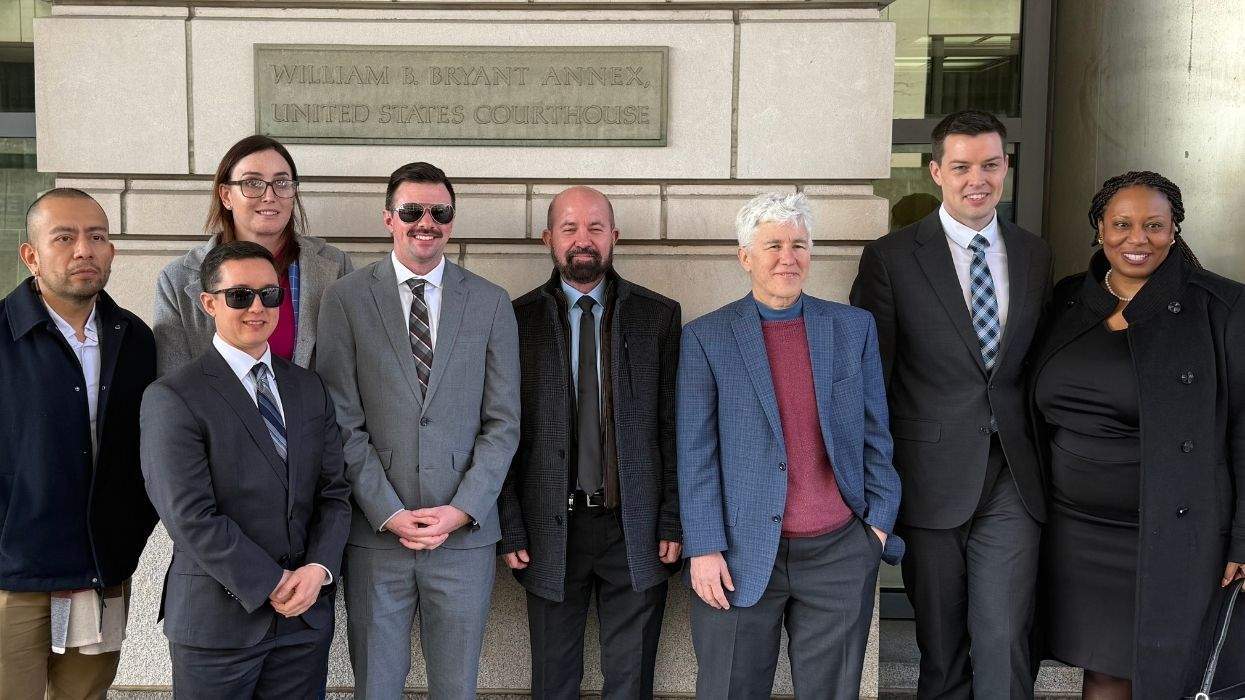

What was scheduled to be a tightly timed appellate hearing in Washington, D.C., on Thursday, instead turned into a nearly three-hour grilling of the Trump administration’s transgender military ban, as judges across ideological lines pressed government lawyers with pointed questions, voiced skepticism about the policy’s mechanics, and repeatedly zeroed in on whether the ban is designed to predetermine the removal of transgender troops already serving honorably.
At oral argument in Talbott v. USA, a panel of the U.S. Court of Appeals for the District of Columbia Circuit appeared deeply engaged, and often unconvinced, by the government’s claims that the ban is a neutral medical policy entitled to sweeping military deference. Instead, judges repeatedly questioned whether the policy’s waiver and separation processes are meaningful at all, or merely formalities masking a foregone outcome. The hearing did not address the ultimate legality of the ban itself. Instead, the judges were considering whether to uphold a preliminary injunction issued by the district court, a temporary order blocking enforcement of the policy while the full case proceeds.
For Nicolas Talbott, the case’s lead plaintiff, the tenor of the hearing mattered. Talbott traveled from Ohio to D.C. to sit in the courtroom and listen as judges debated whether people like him should be allowed to keep the jobs they are already doing.
“I feel like cautiously optimistic is becoming my catchphrase,” Talbott told The Advocate afterward. “I joked to a friend recently — I kind of need an action figure at this point. Pull the string, and that’s what it says.”
The three-judge panel included Judith Ann Wilson Rogers, appointed by President Bill Clinton; Robert L. Wilkins, appointed by President Barack Obama; and Justin R. Walker, appointed by President Donald Trump. The judges’ questioning repeatedly converged on the same concerns.
“Everybody could be fired today or tomorrow”
From the outset, Rogers grounded the argument in immediate consequences rather than abstractions. After government lawyers emphasized that no one has yet been discharged under the policy, she cut in.
Related: Federal judge blocks Trump's transgender military ban
Related: Pentagon says it will start kicking transgender people out of military this month
“I want to be clear,” Rogers said, “that while the government says no one’s been discharged, the way I read the policy, there’s absolutely nothing to prevent the government from discharging all the plaintiffs tomorrow.”
That observation framed much of the hearing. Rogers emphasized that every named plaintiff is currently serving and presumptively disqualified under the policy. When the government pointed to administrative separation boards and waiver procedures, she questioned whether those mechanisms could change anything.
“So it’s a meaningless process,” Rogers said. “It’s just moving paper around. There’s no chance that one of the plaintiffs could continue to serve.”
Abuse of discretion is not a blank check
Rogers also challenged the government’s claim that Judge Ana Reyes of the District Court of Washington, D.C., abused the court’s discretion by blocking the ban last year. When government counsel leaned heavily on the U.S. Supreme Court’s unexplained stay allowing the policy to proceed, she noted the absence of reasoning.
Related: Meet the transgender Army lieutenant who is challenging Donald Trump's military ban
Related: Trump's Justice Department files complaint about lesbian judge hearing trans military case
“Right. Okay. So we don’t know exactly for what reason,” she said.
Absent clear guidance from Congress or a reasoned Supreme Court opinion, Rogers suggested, appellate judges cannot simply discard the district court’s factual findings and balancing of harms in the name of deference.
Career harm, dignity, and the meaning of “honorable discharge”
Rogers was openly skeptical of the government’s argument that discharge causes no irreparable harm because service members would receive honorable discharges.
“When you lose your job, and you’re told that you’re all these terrible things,” she said, “that you couldn’t possibly serve honorably in trying to defend your country — that’s a whole other ball of wax.”
Related: Trump's DOJ struggles defending trans military ban during D.C. appeals court hearing
Those concerns echoed Talbott’s account of life under the policy. “We’re already seeing people, myself included, having our careers put on hold in this limbo area,” he told The Advocate.
Wilkins: where is the justification?
Wilkins focused on the government’s failure to explain why it abandoned earlier policies that allowed transgender troops to remain based on reliance interests.
“I found the only explanation … in a single paragraph,” he said, asking whether any other justification existed in the record.
“You have people who have been in for years and are serving fine, getting bronze stars and other commendations,” Wilkins added, “and you adopt a policy revoking a reliance exception … without even looking at data for how it’s worked.”
Walker probes inevitability and singling out
Walker, the panel’s lone conservative appointee, repeatedly pressed the government on whether gender dysphoria is uniquely targeted.
Related: Federal judge dismantles Trump's trans military ban in explosive hearing
“Putting aside the waiver process,” he said, “in both situations the conclusion is foregone.”
The government struggled to identify any other condition that would trigger automatic separation without an individualized medical evaluation.
Plaintiffs describe harm already underway
Another plaintiff, Gordon Herrero, described concrete damage he is already experiencing in an interview with The Advocate after the hearing.
“I was selected for promotion to major,” Herrero said, “but shortly after that … my scroll was withheld, and when my sequence number comes up, I will not be promoted with my peers.”
A third plaintiff, Jamie Hash, an active-duty Air Force senior master sergeant with more than 14 years of service, said the hearing underscored the substantial evidence already available that transgender service members strengthen the force.
“We have nearly a decade of evidence showing improved readiness and unit cohesion,” she said. “To have policies that specifically target us as a group of people — it’s hard not for it to feel personal.”
Attorneys: “This is not normal”
Lead attorney Shannon Minter of the National Center for LGBTQ+ Rights said the judges’ questions underscored just how far the policy departs from both military practice and constitutional norms, and why, he argued, courts should resist the temptation to treat it as routine.
“This is such a shocking policy,” Minter told The Advocate after the hearing. “One of the biggest challenges for all of us is resisting the urge to normalize it just because we’ve been living with it for a while. This is a complete departure from precedent. This is not normal. This is not how the military operates.”
Minter said he was encouraged that the panel appeared unwilling to gloss over the policy’s mechanics or accept the government’s characterizations at face value. Instead, he said, the judges repeatedly drilled into how the ban actually functions, and grew visibly frustrated when government lawyers offered shifting or imprecise explanations.
“I felt like they were really listening,” he said. “They were digging into the details. And honestly, I felt like there was frustration with the government saying things that were confusing, unclear, and in some cases just inaccurate.”
That frustration, he said, was not incidental. It went to what Minter described as the policy's central danger: that it attempts to reframe categorical exclusion as ordinary medical judgment, even though the military has never treated any other group of service members the same way.
Co-counsel Jennifer Levi of GLAD Law said the government’s difficulty answering basic questions about comparators only reinforced that point.
“Over days of argument below, months of briefing, and now hours of argument today, they have still never identified a single medical condition for which this is true,” Levi said, referring to the automatic routing of transgender service members into administrative separation without individualized medical review.
Levi said the confusion during the argument, including government efforts to conflate different review systems before walking those claims back, exposed what she called the policy’s core design.
“At the end of the day, they really can’t dispute what’s obvious on the face of the policy and in how it’s being implemented,” she said. “It’s designed to purge the military of transgender service members. They can try to make it sound complicated or technical, but it’s actually very straightforward.”
Levi also rejected the government’s insistence that the harm to plaintiffs is minimal or speculative, noting that the judges’ questions tracked closely with what service members are already experiencing.
“These are people who have committed decades of their lives to serving their country,” she said. “They’re being pulled out of operations, placed on administrative leave, denied promotions, and forced into separation proceedings meant for misconduct cases, even though the government agrees they’ve done nothing wrong. That’s devastating harm, and it’s happening right now.”
The panel gave no indication when it will rule.
“There’s always that nervousness about the unknown,” Talbott said. “It’s just very hard to predict what this is going to look like moving forward.”