'%3E%3Cpath d='M16.3574 35.6519H12.9537L15.0491 18.8873L16.3574 35.6519ZM30.4229 54.0093L22.309 0.994385H7.91795L0 54.0093H10.6634L11.5802 46.3855H17.4014L17.9914 54.0093H30.4229Z' fill='%23971B20'/%3E%3Cpath d='M48.2073 41.8813C48.2073 43.4049 47.4892 44.0011 46.1144 44.0011H43.7595V11.0687H46.1144C47.4892 11.0687 48.2073 11.6636 48.2073 13.1885V41.8813ZM59.5273 43.6695V11.3326C59.5273 3.71323 53.5729 0.994385 47.8157 0.994385H31.7213V54.0093H47.8157C53.5729 54.0093 59.5273 51.29 59.5273 43.6695Z' fill='%23971B20'/%3E%3Cpath d='M90.183 0.994385H78.6039L75.0711 30.6157L71.9955 0.994385H59.4346L69.2474 54.0093H80.373L90.183 0.994385Z' fill='%23971B20'/%3E%3Cpath d='M107.063 42.3448C107.063 43.7359 105.951 44.5974 104.643 44.5974C103.269 44.5974 102.157 43.7359 102.157 42.3448V12.658C102.157 11.2676 103.269 10.4058 104.643 10.4058C105.951 10.4058 107.063 11.2676 107.063 12.658V42.3448ZM119.233 43.2723V11.7312C119.233 6.36384 112.952 -3.8147e-06 104.643 -3.8147e-06C96.2667 -3.8147e-06 89.9867 6.36384 89.9867 11.7312V43.2723C89.9867 48.6393 96.2667 55 104.643 55C112.952 55 119.233 48.6393 119.233 43.2723Z' fill='%23971B20'/%3E%3Cpath d='M150.976 43.9349V33.7309H139.069V42.3448C139.069 43.7359 137.957 44.5974 136.582 44.5974C135.076 44.5974 133.964 43.7359 133.964 42.3448V12.658C133.964 11.2676 135.076 10.4058 136.582 10.4058C137.957 10.4058 139.069 11.2676 139.069 12.658V21.2723H150.976V11.0687C150.976 5.70107 145.283 -3.8147e-06 136.582 -3.8147e-06C127.75 -3.8147e-06 121.796 5.70107 121.796 11.0687V43.9349C121.796 49.3022 127.75 55 136.582 55C145.283 55 150.976 49.3022 150.976 43.9349Z' fill='%23971B20'/%3E%3Cpath d='M167.478 35.6519H164.076L166.17 18.8873L167.478 35.6519ZM181.544 54.0093L173.432 0.994385H159.037L151.123 54.0093H161.785L162.704 46.3855H168.523L169.114 54.0093H181.544Z' fill='%23971B20'/%3E%3Cpath d='M205.412 10.4058V0.994385H177.081V10.4058H185.392V54.0093H197.428V10.4058H205.412Z' fill='%23971B20'/%3E%3Cpath d='M230.002 54.0093V43.9349H218.914V31.8746H226.635V21.8028H218.914V10.4058H230.002V0.994385H206.875V54.0093H230.002Z' fill='%23971B20'/%3E%3C/g%3E%3Cdefs%3E%3CclipPath id='clip0_260_7080'%3E%3Crect width='230' height='55' fill='white'/%3E%3C/clipPath%3E%3C/defs%3E%3C/svg%3E)

Brown University’s leafy Rhode Island campus once felt like a safe haven. But that isn't the case anymore for some trans students after the Ivy League institution signed a binding agreement with the Trump administration that redefines who belongs in gendered spaces.
Keep up with the latest in LGBTQ+ news and politics. Sign up for The Advocate's email newsletter.
The agreement, signed July 30, restores more than $50 million in frozen federal research funding, but requires Brown to adopt the federal government’s binary definition of “male” and “female” across all single-sex campus facilities. Clause 11(c) of the resolution, which was not spelled out in the university’s public messaging, explicitly applies the definition to dorms, restrooms, locker rooms, and other intimate spaces, not just athletics.
“I had to screenshot the actual language of the agreement and send it to multiple people and point out this Clause 11(c),” one transgender student in their 30s told The Advocate on the condition of anonymity to avoid retaliation. “Everyone I talked to thought it only applied to sports. But it applies to everything.”
Related: Trump threatens to yank California’s federal funding over one transgender student’s sports participation
They said that even students on campus who consider themselves informed were unaware of the policy’s scope. “Pretty much everyone I talked to went by what the university said rather than read the full agreement.”
In a July 30 campus-wide email shared with The Advocate, Brown President Christina H. Paxson told students and faculty that the agreement would allow the university to “move forward after a period of considerable uncertainty” while protecting its academic mission and core values. Paxson emphasized that the deal preserved Brown’s control over curriculum and academic speech, restored suspended research funding, and involved no admission of wrongdoing. But her message offered no specifics about the agreement’s treatment of trans students across campus, which applies the federal definition of sex to all single-sex facilities, not just housing and athletics, which were mentioned. Instead, Paxson urged recipients to read the full 9-page agreement themselves.
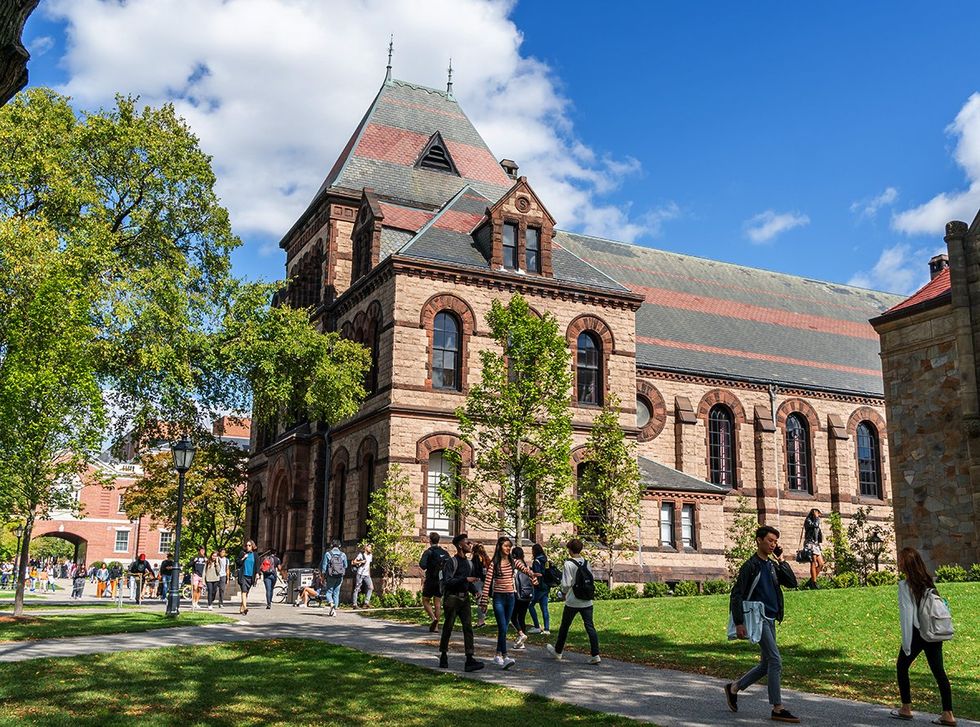 Students passing Sayles Hall at Brown University, Providence, Rhode IslandKen Wolter/Shutterstock
The agreement also includes a clause that empowers the federal government to take “further action” to enforce compliance. That clause, the student said, introduces a chilling new level of risk. “Functionally, transgender people, anytime they now want to use a single-sex facility on campus, there’s now this risk involved not just for themselves, but for the university as a whole.”
Though they’ve been medically transitioning for more than a decade, have updated documentation, and typically don’t get asked about their gender identity, the student said none of that offers protection under the new framework. “Even I, as a stealth person, do not feel comfortable using single-sex facilities on campus,” they said. “It would open up my peers and me to potential repercussions.”
They emphasized that the campus community remains affirming, but the policy shift feels destabilizing. “I definitely feel unsafe,” they said. “Not because of the university’s community, but I feel unsafe in the sense that there’s the implication that my university can invade the privacy of not just myself, but any transgender person.”
Related: Trump doesn't recognize Pride Month, but declares June Title IX Month
The funding freeze that led to the agreement began in April, when the Trump administration halted reimbursements and suspended new federal research awards to Brown as part of a series of civil rights investigations. The Department of Education launched three compliance reviews focused on allegations of antisemitism and racial bias in admissions, along with scrutiny of Brown’s adherence to Title IX. The new definition of sex was mandated by Executive Order 14186, signed by President Donald Trump on Jan. 20, 2025. That order directs all federal agencies to interpret “sex” as immutable and biological, explicitly excluding gender identity, and revokes recognition of LGBTQ-inclusive Title IX protections issued under the previous administration.
In an emailed statement to The Advocate, Brown Vice President for News and Strategic Campus Communications Brian Clark said the agreement “does not address Brown’s ability to continue to implement gender-inclusive measures on campus.” Clark noted that Brown will continue offering gender-inclusive housing and restrooms and allow students to specify pronouns and chosen names in university systems. “Brown remains fully committed to serving the needs of all students and community members in a manner consistent with our long-established policy of nondiscrimination,” he added.
But the student who spoke with The Advocate said the university’s public communications minimized the implications of the agreement. “The university put out this statement, which made it seem like everything was fine and under control, but left a lot of gaps,” they said. “There has been no clear guidance on how this will be enforced. Just silence. And that silence is terrifying.”
They said they are now working with their department to finish their program off campus and limit time spent at the university. “If I have to be on campus, I’ll only use single-stall, gender-inclusive restrooms,” they said. “But there’s usually only one per building.”
Though Brown’s agreement follows similar federal settlements, including a $221 million deal signed by Columbia University, this one appears to go further. Columbia’s restrictions were limited to athletic participation. Brown’s apply to all single-sex spaces. The agreement also bars Brown from providing gender-affirming care to minors, prohibits the use of race or “proxy” factors in admissions, mandates a climate survey focused on Jewish students, and requires renewed partnerships with Israeli institutions.
In a joint statement, GLAD Law, the American Civil Liberties Union of Rhode Island, and the Rhode Island Center for Justice called the agreement “profoundly disturbing.”
Related: Donald Trump signs new executive order affecting transgender military members
“We are especially alarmed by the university’s seeming willingness to use transgender people as a bargaining chip by adopting the narrow definition of sex from the administration’s discriminatory executive order that denies transgender people’s existence,” the groups wrote. “It is shocking that an institution that has long welcomed, celebrated, and protected LGBTQ+ people on campus would so quickly cave in to the administration’s cruel and coercive agenda.”
They encouraged students affected by the policy to reach out for legal help. “We hope other universities and educational institutions will stand strong against this administration’s bullying and coercion to protect the core values of the pursuit and protection of knowledge and understanding, academic freedom, freedom of expression, and openness.”
The Human Rights Campaign also condemned the agreement. “No one should feel ostracized for navigating their life as their most authentic self — especially when the barriers involve something as basic as using a restroom or having a safe place to sleep,” HRC senior press secretary Jarred Keller told The Advocate. “With the federal government’s mandates on single-sex spaces on college campuses, we’re witnessing another attempt by this administration to control the lives of people who are simply trying to pursue their education.”
Related: Here are all of Trump's executive orders that have targeted transgender people — so far
Keller said the policy fits a broader political pattern. “The backlash facing the trans community is not new,” he said. “But it is especially disheartening in today’s politically charged and socially tense climate shaped by policies that claim to protect people while attacking others.”
The student said the public must not ignore the scope of what is happening.
“This isn’t even the beginning of the national attack on trans rights; we are somewhere in the middle,” they said. “More people need to draw attention and to actively resist against agreements like this, speak out, organize in whichever ways you can, and make sure that hopefully for the rest of this administration we can stay somewhere in the middle and not fall fully off this cliff that we’re going down.”
They added that the initial sense of betrayal could have been mitigated with honesty. “Of course, there is the feeling of shock and betrayal at having read the actual agreement,” they said. “But they wouldn’t be as heightened if the university had communicated this at the outset.”
The U.S. Department of Education did not respond to The Advocate’s request for comment.