'%3E%3Cpath d='M16.3574 35.6519H12.9537L15.0491 18.8873L16.3574 35.6519ZM30.4229 54.0093L22.309 0.994385H7.91795L0 54.0093H10.6634L11.5802 46.3855H17.4014L17.9914 54.0093H30.4229Z' fill='%23971B20'/%3E%3Cpath d='M48.2073 41.8813C48.2073 43.4049 47.4892 44.0011 46.1144 44.0011H43.7595V11.0687H46.1144C47.4892 11.0687 48.2073 11.6636 48.2073 13.1885V41.8813ZM59.5273 43.6695V11.3326C59.5273 3.71323 53.5729 0.994385 47.8157 0.994385H31.7213V54.0093H47.8157C53.5729 54.0093 59.5273 51.29 59.5273 43.6695Z' fill='%23971B20'/%3E%3Cpath d='M90.183 0.994385H78.6039L75.0711 30.6157L71.9955 0.994385H59.4346L69.2474 54.0093H80.373L90.183 0.994385Z' fill='%23971B20'/%3E%3Cpath d='M107.063 42.3448C107.063 43.7359 105.951 44.5974 104.643 44.5974C103.269 44.5974 102.157 43.7359 102.157 42.3448V12.658C102.157 11.2676 103.269 10.4058 104.643 10.4058C105.951 10.4058 107.063 11.2676 107.063 12.658V42.3448ZM119.233 43.2723V11.7312C119.233 6.36384 112.952 -3.8147e-06 104.643 -3.8147e-06C96.2667 -3.8147e-06 89.9867 6.36384 89.9867 11.7312V43.2723C89.9867 48.6393 96.2667 55 104.643 55C112.952 55 119.233 48.6393 119.233 43.2723Z' fill='%23971B20'/%3E%3Cpath d='M150.976 43.9349V33.7309H139.069V42.3448C139.069 43.7359 137.957 44.5974 136.582 44.5974C135.076 44.5974 133.964 43.7359 133.964 42.3448V12.658C133.964 11.2676 135.076 10.4058 136.582 10.4058C137.957 10.4058 139.069 11.2676 139.069 12.658V21.2723H150.976V11.0687C150.976 5.70107 145.283 -3.8147e-06 136.582 -3.8147e-06C127.75 -3.8147e-06 121.796 5.70107 121.796 11.0687V43.9349C121.796 49.3022 127.75 55 136.582 55C145.283 55 150.976 49.3022 150.976 43.9349Z' fill='%23971B20'/%3E%3Cpath d='M167.478 35.6519H164.076L166.17 18.8873L167.478 35.6519ZM181.544 54.0093L173.432 0.994385H159.037L151.123 54.0093H161.785L162.704 46.3855H168.523L169.114 54.0093H181.544Z' fill='%23971B20'/%3E%3Cpath d='M205.412 10.4058V0.994385H177.081V10.4058H185.392V54.0093H197.428V10.4058H205.412Z' fill='%23971B20'/%3E%3Cpath d='M230.002 54.0093V43.9349H218.914V31.8746H226.635V21.8028H218.914V10.4058H230.002V0.994385H206.875V54.0093H230.002Z' fill='%23971B20'/%3E%3C/g%3E%3Cdefs%3E%3CclipPath id='clip0_260_7080'%3E%3Crect width='230' height='55' fill='white'/%3E%3C/clipPath%3E%3C/defs%3E%3C/svg%3E)
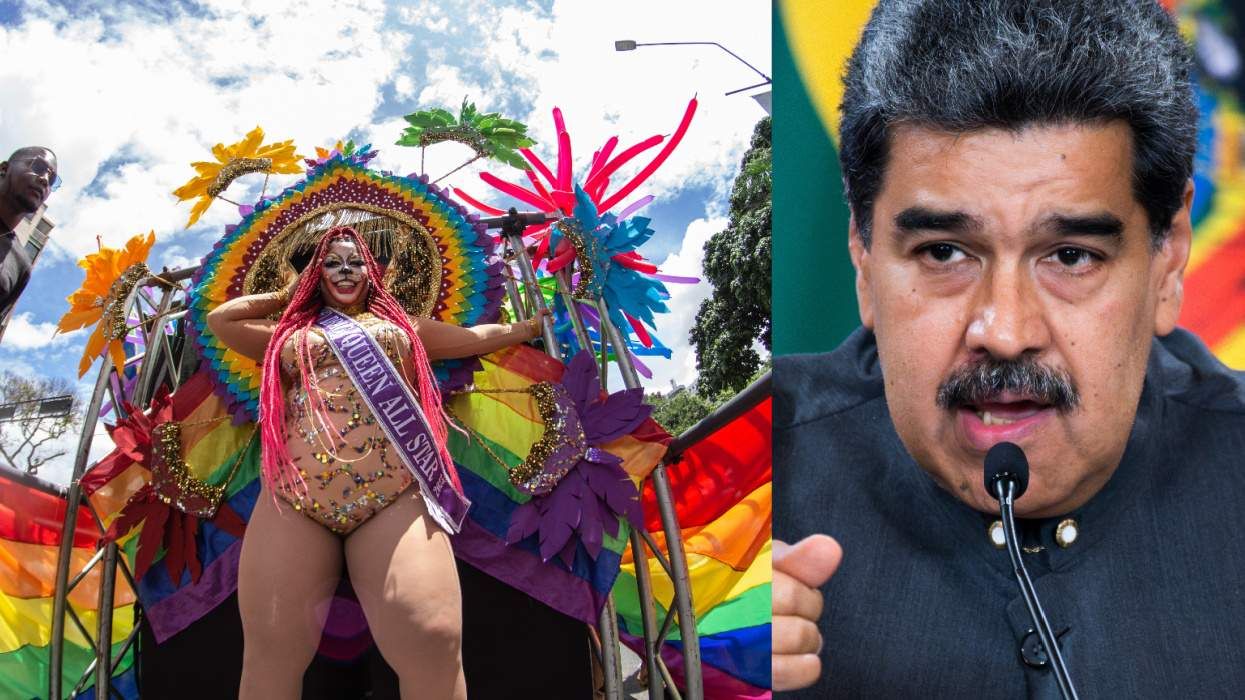

Despite what he claims, human rights in Venezuela aren't what Donald Trump cares about, according to the president's critics.
U.S. forces captured Venezuelan President Nicolás Maduro and his wife, Cilia Flores, on Saturday in an unprecedented military operation ordered by Trump without congressional approval. The two appeared in U.S. District Court in New York City Monday and pleaded not guilty to charges of narco-terrorism conspiracy, cocaine importation conspiracy, and weapons offenses.
Venezuela’s Supreme Court has appointed Maduro’s vice president, Delcy Rodríguez, as interim president. Trump said that the U.S. will remain “in charge” of Venezuela and warned Rodríguez that she must cooperate or she will fare “probably worse” than Maduro and Flores.
Related: 'Reckless and illegal': LGBTQ+ politicians blast Trump's military strike on Venezuela
The U.S. takeover of Venezuela has ignited debate over the country's human rights record, though Democratic Rep. Sarah McBride of Delaware noted in a post on Facebook that "while Trump’s decision would be reckless and illegal regardless of the motivation, it’s clear that this isn’t about fostering democracy for the Venezuelan people or combating drug trafficking."
"If this was about democracy, then Donald Trump would not be willing to keep Moduro’s vice president in power nor would he have dismissed and disrespected María Corina Machado," McBride wrote. "If this was really about drugs, then Donald Trump would not have pardoned a former Honduran leader for drug trafficking crimes."
In Venezuela, while LGBTQ+ people do have some protections, Outright International reports that queer Venezuelans "continue to face systemic discrimination."
"The erosion of democratic institutions and the rule of law [in Venezuela and under Maduro] has enabled the government to impose increasing restrictions on civic space, including harassment and criminalization of organizations working on human rights and equality," the organization writes on its website.
Here's everything to know about Venezuela's record when it comes to LGBTQ+ rights.
Marriage equality in Venezuela
Venezuela does not have marriage equality, nor does it offer legal recognition for same-sex couples. Same-sex adoption is also not legal, though single adoption is.
The Cyrus R. Vance Center for International Justice points out that Article 77 of the country's constitution states, "Marriage, which is based on free consent and absolute equality of rights and obligations of the spouses, is protected. A stable de facto union between a man and a woman which meets the requirements established by law shall have the same effects as marriage."
Same-sex sexual relations are not — and have never been — formally criminalized in the country, though LGBTQ+ people have often been targeted under decency laws.
Venezuela's LGBTQ+ protections
The Venezuelan Constitution protects against hate crimes, with offenses motivated by sexual orientation or gender identity considered aggravating circumstances. Legal protections exist in employment, banking, and housing based on sexual orientation, but protections based on gender identity only exist in housing.
"No discrimination based on race, sex, creed or social standing shall be permitted, nor, in general, any discrimination with the intent or effect of nullifying or encroaching upon the recognition, enjoyment or exercise, on equal terms, of the rights and liberties of every individual," Article 21 states.
Men who have sex with men are still banned from donating blood in Venezuela, but the Supreme Court of Justice annulled section 565 of the Military Justice Code in 2023, which banned armed forces members from engaging in consensual same-sex sexual activities.
Transgender rights in Venezuela
Venezuela does not currently allow citizens to change their gender on identification documents, though few cases have been granted following medical and psychological examinations. From 1977 to 1998, the country permitted transgender individuals legal recognition so long as they had undergone surgery, though this ended when Hugo Chavez imposed a new constitution.
Gender-affirming care such as hormone replacement therapy is not widely available in Venezuela. A 2023 report from the Department of State under Joe Biden found that "transgender and intersex persons [are] not provided adequate medical services, including hormone therapy and psychological support."
"Maduro representatives systematically denied recognition to transgender, intersex, and nonbinary persons by refusing to issue them identity documents in their preferred gender," the report stated. "As identity documents were required for access to education, employment, housing, health care, and other services, these discriminatory actions often led transgender and intersex persons to become victims of human trafficking."
Venezuela's first transgender legislator
Tamara Adrian, an out trans woman who worked as a lawyer and university professor, was elected to the National Assembly of Venezuela in 2015 at the age of 61, becoming the first out trans elected official in the country and the second out trans legislator within the Americas. She is a member of the progressive pro-LGBTQ+ Popular Will party, which stands in opposition to Maduro's PSUV.
After traveling to Thailand in 2002 to receive gender-affirming surgery, Adrian appealed to the Venezuelan Constitutional Chamber of the Supreme Court to recognize her gender identity in May 2004. She has yet to receive a reply to her appeal.
"Despite the euphoria of being part of such a historic moment, to be a politician — transgender or not — in the new Venezuela can be described in one word: frustrating," Adrian wrote in a 2017 essay for The Advocate. "As a human rights activist and now an elected leader, I find it endlessly frustrating that no single legislative advancement regarding LGBTI rights has been achieved during the 17 years of Chavist domination of the National Assembly. And given the state of the country today, it has been impossible to push forward the much-needed laws granting equal rights to our communities."
LGBTQ+ activists targeted in Venezuela
Despite same-sex sexual relations being legal in Venezuela, authorities have used vagrancy laws to disproportionately target the LGBTQ+ community. One notable example is the 2023 raid of popular queer sauna Avalon Club, which resulted in 33 being arrested on noise level and public indecency charges.
Multiple LGBTQ+ activists were detained by Venezuelan authorities in 2024 without charge. Yendri Velásquez, coordinator of the Venezuelan Observatory of LGBTIQ+ Violence, was arrested at an airport in August and held incommunicado for six hours after being told his passport was nullified. The same month, activist Kody Campos was almost arrested when officials conducted a warrantless search of his home, leaving only after they realized he was live-streaming the raid.
What LGBTQ+ legislators are saying about Trump's takeover
LGBTQ+ U.S. lawmakers have been among some of the most vocal in condemning Trump's abduction of Maduro and invasion of Venezuela. Democratic Rep. Sarah McBride of Delaware, the first out trans member of Congress, continued to say that "I fully support a renewed and urgent push for new War Powers Resolutions to prevent further military action in Venezuela and to forbid the expansion of this reckless pursuit of other countries' natural resources."
"Health care premiums are skyrocketing, housing is too expensive, groceries and prescription drugs too often break the bank — and now Donald Trump wants to put American lives and money on the line so that his billionaire buddies can get even richer off of other country’s oil and minerals," McBride wrote. "The American people do not want another generation of forever wars — and neither do I."
Democratic Rep. Robert Garcia of California, co-chair of the Congressional Equality Caucus, said in a post online that "this war against Venezuela is unconstitutional and a dangerous action from an out of control President."
"Trump has now made it clear: this is about the oil, and he intends for the United States to run the country," Garcia wrote. "Maduro is a brutal dictator, but that does not justify these actions without Congressional approval. Instead of focusing on costs and affordability here at home, Trump wants more foreign wars. Congress must vote on a war powers action immediately."
Democratic Rep. Becca Balint of Vermont said in a statement that the decision "brings us further down the dangerous path of abandoning our democratic principles, consolidating power, and destroying our Constitution."
“Nicolás Maduro is a brutal, illegitimate dictator, and Venezuelans have suffered greatly under his regime. That does not diminish the fact that President Trump has zero authority to use military force to remove the leader of another sovereign country," Balint said. "This unilateral military action was reckless, illegal and taken without any congressional briefing, approval or oversight."