'%3E%3Cpath d='M16.3574 35.6519H12.9537L15.0491 18.8873L16.3574 35.6519ZM30.4229 54.0093L22.309 0.994385H7.91795L0 54.0093H10.6634L11.5802 46.3855H17.4014L17.9914 54.0093H30.4229Z' fill='%23971B20'/%3E%3Cpath d='M48.2073 41.8813C48.2073 43.4049 47.4892 44.0011 46.1144 44.0011H43.7595V11.0687H46.1144C47.4892 11.0687 48.2073 11.6636 48.2073 13.1885V41.8813ZM59.5273 43.6695V11.3326C59.5273 3.71323 53.5729 0.994385 47.8157 0.994385H31.7213V54.0093H47.8157C53.5729 54.0093 59.5273 51.29 59.5273 43.6695Z' fill='%23971B20'/%3E%3Cpath d='M90.183 0.994385H78.6039L75.0711 30.6157L71.9955 0.994385H59.4346L69.2474 54.0093H80.373L90.183 0.994385Z' fill='%23971B20'/%3E%3Cpath d='M107.063 42.3448C107.063 43.7359 105.951 44.5974 104.643 44.5974C103.269 44.5974 102.157 43.7359 102.157 42.3448V12.658C102.157 11.2676 103.269 10.4058 104.643 10.4058C105.951 10.4058 107.063 11.2676 107.063 12.658V42.3448ZM119.233 43.2723V11.7312C119.233 6.36384 112.952 -3.8147e-06 104.643 -3.8147e-06C96.2667 -3.8147e-06 89.9867 6.36384 89.9867 11.7312V43.2723C89.9867 48.6393 96.2667 55 104.643 55C112.952 55 119.233 48.6393 119.233 43.2723Z' fill='%23971B20'/%3E%3Cpath d='M150.976 43.9349V33.7309H139.069V42.3448C139.069 43.7359 137.957 44.5974 136.582 44.5974C135.076 44.5974 133.964 43.7359 133.964 42.3448V12.658C133.964 11.2676 135.076 10.4058 136.582 10.4058C137.957 10.4058 139.069 11.2676 139.069 12.658V21.2723H150.976V11.0687C150.976 5.70107 145.283 -3.8147e-06 136.582 -3.8147e-06C127.75 -3.8147e-06 121.796 5.70107 121.796 11.0687V43.9349C121.796 49.3022 127.75 55 136.582 55C145.283 55 150.976 49.3022 150.976 43.9349Z' fill='%23971B20'/%3E%3Cpath d='M167.478 35.6519H164.076L166.17 18.8873L167.478 35.6519ZM181.544 54.0093L173.432 0.994385H159.037L151.123 54.0093H161.785L162.704 46.3855H168.523L169.114 54.0093H181.544Z' fill='%23971B20'/%3E%3Cpath d='M205.412 10.4058V0.994385H177.081V10.4058H185.392V54.0093H197.428V10.4058H205.412Z' fill='%23971B20'/%3E%3Cpath d='M230.002 54.0093V43.9349H218.914V31.8746H226.635V21.8028H218.914V10.4058H230.002V0.994385H206.875V54.0093H230.002Z' fill='%23971B20'/%3E%3C/g%3E%3Cdefs%3E%3CclipPath id='clip0_260_7080'%3E%3Crect width='230' height='55' fill='white'/%3E%3C/clipPath%3E%3C/defs%3E%3C/svg%3E)
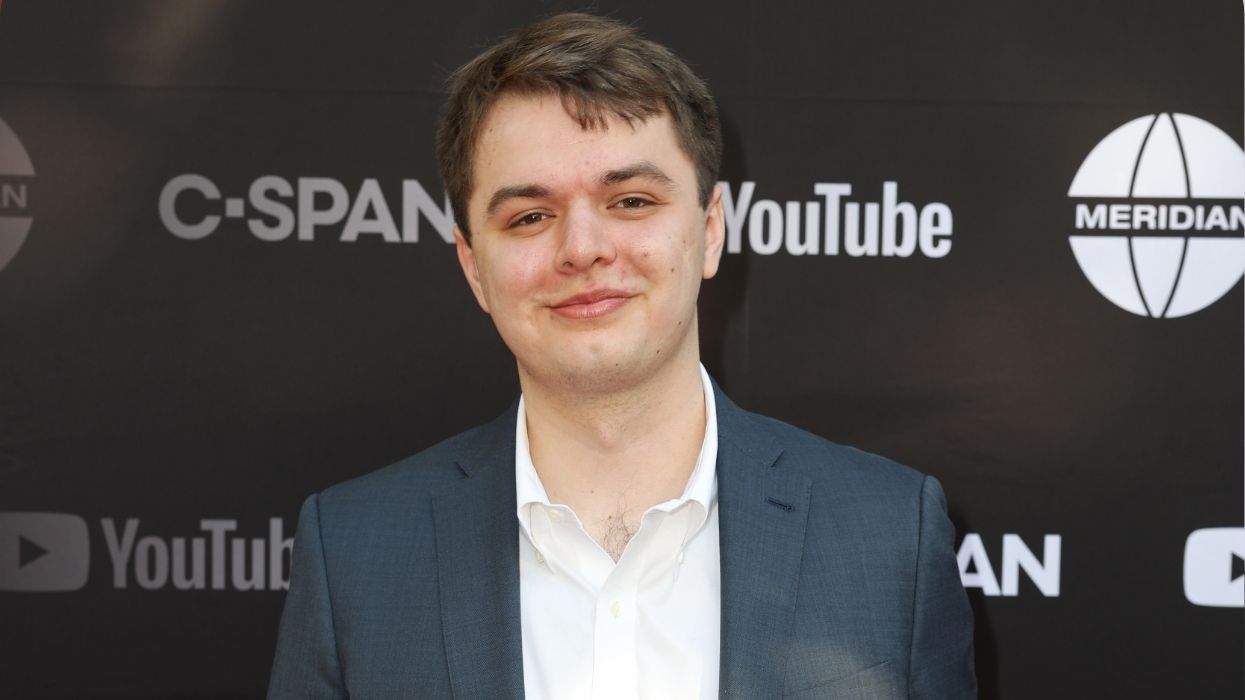

Adam Mockler was standing on the red carpet of one of Washington, D.C.’s glossier White House Correspondents’ Dinner weekend parties in late April when he said something that, within days, would become unintentionally hilarious.
The 23-year-old progressive content creator and increasingly ubiquitous cable TV panel guest had been talking about CNN’s Scott Jennings, the conservative strategist who has become one of cable television’s most controversial MAGA combatants. Jennings, Mockler explained, was not actually the snarling partisan viewers saw on TV every night. Not entirely, anyway.
“I find him to be a pretty affable person behind the scenes,” Mockler told The Advocate at the time. “He’s obviously kind of an asshole on TV, but he’s a nice guy.”
One week later, Jennings would scream, “Get your fucking hand out of my face” at him on live television.
By the time Mockler sat down with The Advocate for a second, much longer interview after the CNN blowup went viral, he already understood the irony. “The naïveté of me,” Mockler said with a laugh, “to think that I could go on camera and say he’s a nice guy, and then that not just blow up on me.”
The moment became one of those cable news clips that now ricochet across the internet ecosystem before the segment has even ended.
During a heated CNN debate about the Iran war on NewsNight with Abby Phillip, Mockler pressed Jennings on shifting Republican justifications for the conflict. Jennings, who had already tried to make fun of Mockler for being “up past your bedtime,” finally snapped when Mockler raised his hand while making a point that wasn’t going well for Jennings. Mockler’s hands, for the record, were never in Jennings’ face.
For younger progressive audiences already skeptical of traditional cable news punditry, Mockler, who also works with the MeidasTouch Network, has emerged as a kind of Gen Z anti-establishment avatar that’s impatient with consultant-approved Democratic messaging, fluent in internet culture, and willing to confront older conservative media figures in a language designed for virality as much as persuasion.
The host of The Adam Mockler Show has an enormous audience. Mockler has amassed more than 4 million followers and subscribers across platforms, including 2.9 million YouTube subscribers and hundreds of thousands more followers on Instagram, TikTok, X, and Bluesky.
But beneath the viral clips and internet discourse is a young political communicator trying to figure out how Democrats can talk about masculinity, LGBTQ+ rights, war, liberalism, and cultural backlash in a media environment increasingly built around outrage as entertainment.
And unlike some Democrats now openly debating retreat on trans rights, he insists the party should not throw transgender people under the bus in the process.
Before the blowup
The Advocate’s initial interview took place during White House Correspondents’ Dinner weekend, in the ecosystem of media parties where rising political creators now mingle with television executives, lawmakers, journalists, influencers, campaign operatives, and celebrities.
“A lot of ground gets broken at these events,” he said at the CSPAN/YouTube pre-party. “I can’t tell you how many times I’ve made a connection at this event that carries me for years and years.”
He described the weekend as a networking opportunity for the next generation of political media figures. Creators like Mockler no longer arrive in Washington hoping cable television will discover them. They arrive with millions of views already attached to their names.
At the time, Mockler defined himself as someone frustrated by what he saw as Democrats’ unwillingness to push back aggressively enough against conservative media narratives.
“I remember turning on the TV and being like, ‘I wish somebody would just go a little bit harder against this person,’” Mockler said. “And I’m very grateful that I’ve had the opportunity to be that person.”
When asked about transgender rights and Republican attacks on trans Americans, Mockler rejected the idea that Democrats should retreat from defending the community. Instead, he argued for a kind of populist-progressive messaging style that’s unapologetic on principle, but less academic and more emotionally intuitive.
“We need to hold the line on trans identity,” he said. At the same time, he argued that liberals sometimes fail to communicate effectively with people who are confused rather than openly hostile.
“If I have a friend who’s like 19 and he’s a bit confused, or for example, not to throw my grandpa under the bus, but there was a time when my grandpa was like, ‘Can you explain to me what this means?’” Mockler said.
Mockler repeatedly said that conservatives strategically weaponize confusion around gender identity and that Democrats often respond in language ordinary people do not instinctively understand.
“With the trans stuff, there’s a lot to explain,” he said. “The difference between sex and gender is something that is rather nuanced and that a lot of Americans conflate,” he added.
He criticized parts of the left for what he called an “overacademic problem,” arguing that progressive spaces can become alienating or punitive toward people still learning.
“If I logged into Bluesky and tried to have a good-faith conversation about some disagreement, I would get eaten alive,” he said. “There are definitely spaces that come down pretty hard on people who sometimes don’t understand.”
His critique speaks to broader Democratic anxiety about political messaging. According to a new ABC News/Washington Post/Ipsos poll, the most common criticism Americans offered about Democrats was not ideology, but weakness. People found that the party does not stand up strongly enough to Republicans or to President Donald Trump.
Today’s communicators
Mockler represents a generation of political communicators raised on YouTube algorithms rather than Sunday morning talk shows. Their instincts are different. Their pacing is different. Their understanding of audience engagement is radically different from the consultant-heavy cable news culture they are entering.
And unlike many Democratic operatives who spent years avoiding cultural confrontation, Mockler seems increasingly convinced that liberals must become more forceful and emotionally direct in defending marginalized groups.
He pointed to Congresswoman Sarah McBride of Delaware as an example of successful political communication around trans identity.
“She’s just a woman in Congress who’s fighting,” Mockler said. “That’s how you break ground.” McBride is the first out trans member of Congress, but she has said that she refuses to give the GOP a “Bravo TV moment,” meaning she won’t engage with some of the loudest voices when they attack her.
Mockler’s praise for McBride reflects a broader theory he has about where Democrats failed in 2024 and where they could recover heading into the midterms. He believes Republicans successfully turned transgender people into political villains while distracting voters from worsening economic conditions and broader institutional failures.
At the same time, he argues Democrats too often allowed themselves to get trapped in defensive, hyper-online conversations disconnected from how ordinary Americans actually process political issues. “The average person is a little bit confused, and the right takes advantage of that confusion and tries to paint everyone as a scapegoat,” Mockler said.
He warned that Democrats need to become more emotionally accessible without surrendering on principle — to defend trans people clearly and unapologetically while also grounding those arguments in broader values like dignity, freedom, and access to medical care.
Mockler argued that Republicans deliberately distort trans people into cultural caricatures while ignoring broader economic failures.
“Republicans claimed that trans people and immigrants were the problem,” he said. “Well, Republicans got into power. They enacted their most authoritarian immigration and trans policy, and all of the issues got worse.”
What comes next
Mockler insists he has “zero interest, negative interest” in running for office himself. The future he imagines is in the media space.
Specifically, he wants to build a large-scale debate platform independent of traditional television networks — something built for the digital-first political era that shaped him. In Mockler’s vision, creators would not need to wait for invitations from cable bookers or permission from legacy institutions to shape political discourse. They would build their own audiences, their own infrastructure, and eventually their own influence.
Younger commentators increasingly move fluidly between YouTube, TikTok, livestreams, podcasts, and cable television, often attracting audiences larger than those of many traditional news programs. Television no longer exclusively manufactures political stars. Increasingly, it absorbs them after they have already built loyal online followings elsewhere.
Mockler understands that.
“I’m working on building a debate show, and I want it to be one of the largest debate shows in the country, perhaps the world,” Mockler said. He pointed to the longevity of figures like Jon Stewart and, when you “remove ideology,” even Bill Maher, as examples of people who built durable media platforms that lasted for decades.
“It’s about building my own thing now,” he said.