'%3E%3Cpath d='M16.3574 35.6519H12.9537L15.0491 18.8873L16.3574 35.6519ZM30.4229 54.0093L22.309 0.994385H7.91795L0 54.0093H10.6634L11.5802 46.3855H17.4014L17.9914 54.0093H30.4229Z' fill='%23971B20'/%3E%3Cpath d='M48.2073 41.8813C48.2073 43.4049 47.4892 44.0011 46.1144 44.0011H43.7595V11.0687H46.1144C47.4892 11.0687 48.2073 11.6636 48.2073 13.1885V41.8813ZM59.5273 43.6695V11.3326C59.5273 3.71323 53.5729 0.994385 47.8157 0.994385H31.7213V54.0093H47.8157C53.5729 54.0093 59.5273 51.29 59.5273 43.6695Z' fill='%23971B20'/%3E%3Cpath d='M90.183 0.994385H78.6039L75.0711 30.6157L71.9955 0.994385H59.4346L69.2474 54.0093H80.373L90.183 0.994385Z' fill='%23971B20'/%3E%3Cpath d='M107.063 42.3448C107.063 43.7359 105.951 44.5974 104.643 44.5974C103.269 44.5974 102.157 43.7359 102.157 42.3448V12.658C102.157 11.2676 103.269 10.4058 104.643 10.4058C105.951 10.4058 107.063 11.2676 107.063 12.658V42.3448ZM119.233 43.2723V11.7312C119.233 6.36384 112.952 -3.8147e-06 104.643 -3.8147e-06C96.2667 -3.8147e-06 89.9867 6.36384 89.9867 11.7312V43.2723C89.9867 48.6393 96.2667 55 104.643 55C112.952 55 119.233 48.6393 119.233 43.2723Z' fill='%23971B20'/%3E%3Cpath d='M150.976 43.9349V33.7309H139.069V42.3448C139.069 43.7359 137.957 44.5974 136.582 44.5974C135.076 44.5974 133.964 43.7359 133.964 42.3448V12.658C133.964 11.2676 135.076 10.4058 136.582 10.4058C137.957 10.4058 139.069 11.2676 139.069 12.658V21.2723H150.976V11.0687C150.976 5.70107 145.283 -3.8147e-06 136.582 -3.8147e-06C127.75 -3.8147e-06 121.796 5.70107 121.796 11.0687V43.9349C121.796 49.3022 127.75 55 136.582 55C145.283 55 150.976 49.3022 150.976 43.9349Z' fill='%23971B20'/%3E%3Cpath d='M167.478 35.6519H164.076L166.17 18.8873L167.478 35.6519ZM181.544 54.0093L173.432 0.994385H159.037L151.123 54.0093H161.785L162.704 46.3855H168.523L169.114 54.0093H181.544Z' fill='%23971B20'/%3E%3Cpath d='M205.412 10.4058V0.994385H177.081V10.4058H185.392V54.0093H197.428V10.4058H205.412Z' fill='%23971B20'/%3E%3Cpath d='M230.002 54.0093V43.9349H218.914V31.8746H226.635V21.8028H218.914V10.4058H230.002V0.994385H206.875V54.0093H230.002Z' fill='%23971B20'/%3E%3C/g%3E%3Cdefs%3E%3CclipPath id='clip0_260_7080'%3E%3Crect width='230' height='55' fill='white'/%3E%3C/clipPath%3E%3C/defs%3E%3C/svg%3E)
By the time Jake Rosmarin finally lowered the curtains in his room, most of the satellite trucks outside had disappeared.
“I’m in good spirits,” Rosmarin said during a video interview with The Advocate on Monday from inside quarantine. “I feel good. I have no symptoms.”
A week into his federally mandated six-week isolation at the National Quarantine Unit at the University of Nebraska Medical Center in Omaha, Rosmarin still has not tested positive for hantavirus, the rare and potentially deadly virus linked to an outbreak aboard the expedition cruise ship MV Hondius that killed three passengers. So far, blood tests have returned negative results.
For days, television cameras had camped near the facility, where Jake Rosmarin, a 29-year-old gay travel influencer from Boston, was living after accidentally becoming the public face of the outbreak. At one point, he realized photographers could potentially zoom directly into his room.
“I’m happy to talk to the media,” he said. “But I want it to be on my terms.”
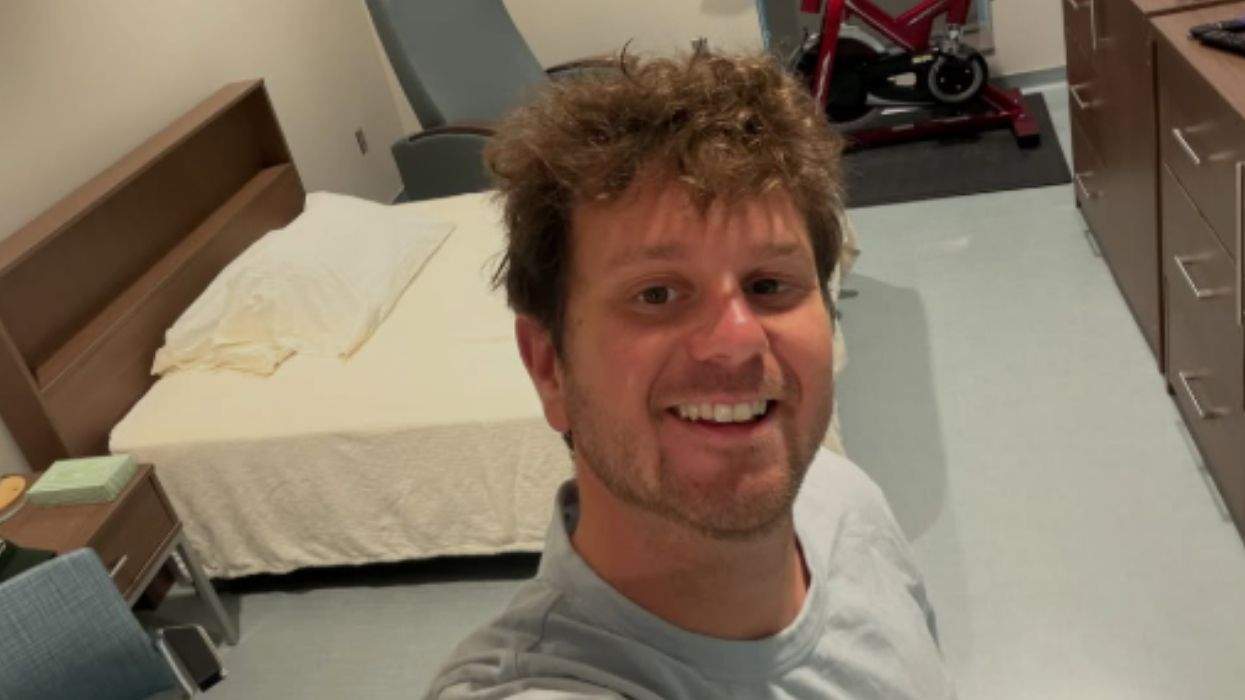
Now, a week into his 42-day quarantine, Rosmarin has begun constructing a life inside the room.
Related: Travel blogger pleads ‘We’re not just headlines, we’re people’ aboard hantavirus-plagued cruise ship
Making a quarantine unit a home
The sterile medical space has slowly softened into something closer to a temporary studio apartment. Fresh bedsheets and pillows ordered from Amazon have replaced the institutional ones. Printed photographs from the voyage — penguins, islands, sunsets — are on the walls. Packages arrive almost daily. There is a stationary bike in the corner. A refrigerator hums nearby. A smart TV glows late into his “movie nights.”
The room is comfortable enough, if surreal in its boundaries. He cannot leave, and only medical staff wearing full personal protective equipment can. “Masks and face shields, not the full bio-hazards suit,” he clarifies, can enter.
Rosmarin said federal funds cover the quarantine stay itself, including the room, meals, and medical monitoring. The National Quarantine Unit is the only federally funded quarantine facility of its kind in the United States. Personal comforts, though, are largely his responsibility. He has spent the week ordering pillows, bedsheets, workout clothes, snacks, and other items to make the room feel more livable.
Nurses knock before dropping off meals and packages. Once a week, a phlebotomist enters to draw blood and administer PCR tests. Otherwise, Rosmarin exists largely alone with his thoughts, his phone, and the internet that overnight transformed him from a niche travel creator into a viral quarantine protagonist.
“I’m just trying to turn a positive into this situation,” Rosmarin said. “Because if I don’t do that, it’s going to be a really rough time.”
He is, by any measure, not where he expected to be.
A life-changing voyage
Rosmarin boarded the Dutch-flagged MV Hondius in Ushuaia, Argentina, on April 1 as part of a content partnership with Oceanwide Expeditions. His compensation was the voyage itself. It was to be a bold trans-Atlantic expedition through some of the most remote places on Earth.
For most of the journey, it felt magical, he said.
As Rosmarin described the voyage, his face visibly brightened. He rattled off facts about penguin colonies, volcanic islands, and seabird migrations with enthusiasm. South Georgia Island, he explained, remains one of his favorite places on Earth. At St. Andrews Bay, he watched sunset spill across what he called the world’s largest king penguin colony, home to between 300,000 and 500,000 penguins, a landscape so massive that “your mind can’t even really comprehend how big it is.” He spoke about the moment with joy, recalling mountains glowing gold behind the colony while Antarctic fur seals moved along the shoreline. “I think it was one of my top favorite travel moments of my whole life,” he said.
He traveled through Tristan da Cunha, an isolated volcanic archipelago in the South Atlantic, roughly midway between South America and southern Africa, and considered the most remote inhabited island chain on Earth, where ships arrive only a handful of times each year. He sailed past Ascension Island, another volcanic British territory near the equator in the central South Atlantic, while seabirds spiraled overhead and dolphins rode the ship's bow through protected Atlantic waters.
“I was telling everyone, I’m never going to get the opportunity to go on a trip like this again,” he said. “Up until the last two days, it was a really amazing trip.”
Trapped on a ship with a deadly virus
Then people started dying.
At first, passengers rationalized the illnesses. Cruise ships carry older travelers. Pneumonia happens. Medical emergencies happen. But after multiple people became gravely ill and a third passenger died, fear spread through the ship.
When officials disclosed that one passenger had tested positive for hantavirus, Rosmarin retreated almost entirely into isolation.
“Once we found out it was hantavirus, I basically didn’t leave my room again at all,” he said. “I left my room for ten to 15 minutes a day.”
The virus was later confirmed to be the Andes strain, the only known hantavirus capable of limited person-to-person transmission. Three people ultimately died aboard the voyage.
Rosmarin describes those final seven days stranded at sea, after authorities in Cape Verde, an island nation off the west coast of Africa, declined to allow passengers to disembark, and before Spanish officials ultimately permitted the ship to dock in Tenerife in Spain’s Canary Islands, as bleak.
“I was in a really dark place those seven days,” he said. It was during that period that he posted the video.
Sitting on his bunk, visibly emotional, Rosmarin pleaded for compassion and reminded viewers that the ship's passengers were not abstractions or headlines but people terrified for their lives.
The backlash
The internet responded with mixed reactions.
Some viewers sympathized. Others mocked him. Conspiracy theorists accused him of being a “crisis actor,” claiming he was reading from a script because he had admitted, “I wrote a few things down,” as he began his video, and that he appeared to use a prompting tool, which is common for content creators to maintain their train of thought. Social media users dissected his fear frame by frame.
“That hate that was happening from both sides of the aisle,” Rosmarin said, “that was hard.”
But one part of the fallout still visibly affects him.
Before the outbreak, Rosmarin had quietly hoped to reach 50,000 followers in 2026 through the travel storytelling and photography work he loved. It’s his full-time job. Instead, his account surged past the milestone almost immediately after the quarantine video went viral.
As he spoke about it during the interview, his voice softened, and he grew emotional.
“That whole day following, it just made me so sad,” he said through tears. “Because I never wanted to have my account grow from something like this.”
He’s now got more than 154,000 followers on Instagram and 177,000 on TikTok.
“Something that was supposed to bring me so much joy,” he said, “brought me so much pain.”
What's it like inside quarantine in Nebraska?
Inside quarantine, life now moves according to ritual.
Temperature checks. Weekly blood draws. PCR tests are conducted every Monday. Exercise. Videos documenting the experience.
The stationary bike in the corner has become part of Rosmarin’s daily routine. Before the trip, he regularly attended Orangetheory classes and had recently shifted toward biking workouts after developing tendonitis during a fitness challenge earlier this year. Now, in quarantine, he streams live PrideFit classes from inside the room to stay active and preserve some sense of normalcy.
He laughed as he explained that he doesn’t actually know how to ride a real bicycle, but has grown attached to the stationary one. Hospital staff even offered to swap it out for a treadmill if he wanted. Rosmarin initially declined because he had arrived wearing only slip-on Merrell shoes, which were unsuitable for running, though he recently ordered sneakers online in case he changes his mind.
He jokes about the highlights with surprising appreciation. Domino’s cheesy bread. DoorDash and Starbucks deliveries. Same-day Amazon shipping.
“Under normal circumstances, they just would’ve been fine,” he said of garlic cheesy bread and chicken wings he ordered days ago. He had shared his excitement with his followers in a video. “But under these circumstances, they were so good.”
There are harder moments, too. The facility has a psychologist on hand to provide emotional support to any patient who needs it.
New perspectives
Rosmarin’s fiancé remains home in Boston, managing their apartment while Rosmarin waits out quarantine 1,400 miles away. He has already had to cancel a planned trip to Italy for his cousin’s wedding. His luggage, excluding his electronics, camera equipment, and memory cards filled with photographs from the voyage, remains stranded somewhere in transit and may not be returned for weeks.
Photography, he says, was always the original dream. “I really wanted to pursue it,” he said. And yet, for all the solitude, Rosmarin does not sound bitter.
“The outpouring of love from the local community has just been amazing,” Rosmarin said.
The content creator has started thinking about the experience in chapters. The voyage was one chapter. The week stranded at sea was another. The government evacuation flight to Nebraska was its own chapter. For now, it’s quarantine.
Rosmarin said officials discussed the possibility that some passengers could eventually self-isolate at home, but he decided early that he wanted to remain inside the Nebraska quarantine facility for the entire monitoring period. The decision, he said, was about peace of mind. “I knew before I even got here that I wanted to stay the full 42 days,” he said. Knowing he has immediate access to specialized medical care if symptoms emerge has helped calm some of the anxiety left over from the ordeal at sea. “I know what’s right for me,” he said. “I’m staying here, and I knew it before I even got on that plane.”
He still plans to travel again. There is an Australia trip tentatively scheduled for August, though he admits boarding another plane — let alone another ship — may require courage he does not yet fully possess.
“I could sit in my bed all day and sulk and be sad,” he said. “Or I could just go day by day, stay positive, keep myself busy, hope for the best, and get through it.”
He will turn 30 in September. And he already knows this story will stay with him forever.
“I’m going to be telling this story for generations,” he said.