'%3E%3Cpath d='M16.3574 35.6519H12.9537L15.0491 18.8873L16.3574 35.6519ZM30.4229 54.0093L22.309 0.994385H7.91795L0 54.0093H10.6634L11.5802 46.3855H17.4014L17.9914 54.0093H30.4229Z' fill='%23971B20'/%3E%3Cpath d='M48.2073 41.8813C48.2073 43.4049 47.4892 44.0011 46.1144 44.0011H43.7595V11.0687H46.1144C47.4892 11.0687 48.2073 11.6636 48.2073 13.1885V41.8813ZM59.5273 43.6695V11.3326C59.5273 3.71323 53.5729 0.994385 47.8157 0.994385H31.7213V54.0093H47.8157C53.5729 54.0093 59.5273 51.29 59.5273 43.6695Z' fill='%23971B20'/%3E%3Cpath d='M90.183 0.994385H78.6039L75.0711 30.6157L71.9955 0.994385H59.4346L69.2474 54.0093H80.373L90.183 0.994385Z' fill='%23971B20'/%3E%3Cpath d='M107.063 42.3448C107.063 43.7359 105.951 44.5974 104.643 44.5974C103.269 44.5974 102.157 43.7359 102.157 42.3448V12.658C102.157 11.2676 103.269 10.4058 104.643 10.4058C105.951 10.4058 107.063 11.2676 107.063 12.658V42.3448ZM119.233 43.2723V11.7312C119.233 6.36384 112.952 -3.8147e-06 104.643 -3.8147e-06C96.2667 -3.8147e-06 89.9867 6.36384 89.9867 11.7312V43.2723C89.9867 48.6393 96.2667 55 104.643 55C112.952 55 119.233 48.6393 119.233 43.2723Z' fill='%23971B20'/%3E%3Cpath d='M150.976 43.9349V33.7309H139.069V42.3448C139.069 43.7359 137.957 44.5974 136.582 44.5974C135.076 44.5974 133.964 43.7359 133.964 42.3448V12.658C133.964 11.2676 135.076 10.4058 136.582 10.4058C137.957 10.4058 139.069 11.2676 139.069 12.658V21.2723H150.976V11.0687C150.976 5.70107 145.283 -3.8147e-06 136.582 -3.8147e-06C127.75 -3.8147e-06 121.796 5.70107 121.796 11.0687V43.9349C121.796 49.3022 127.75 55 136.582 55C145.283 55 150.976 49.3022 150.976 43.9349Z' fill='%23971B20'/%3E%3Cpath d='M167.478 35.6519H164.076L166.17 18.8873L167.478 35.6519ZM181.544 54.0093L173.432 0.994385H159.037L151.123 54.0093H161.785L162.704 46.3855H168.523L169.114 54.0093H181.544Z' fill='%23971B20'/%3E%3Cpath d='M205.412 10.4058V0.994385H177.081V10.4058H185.392V54.0093H197.428V10.4058H205.412Z' fill='%23971B20'/%3E%3Cpath d='M230.002 54.0093V43.9349H218.914V31.8746H226.635V21.8028H218.914V10.4058H230.002V0.994385H206.875V54.0093H230.002Z' fill='%23971B20'/%3E%3C/g%3E%3Cdefs%3E%3CclipPath id='clip0_260_7080'%3E%3Crect width='230' height='55' fill='white'/%3E%3C/clipPath%3E%3C/defs%3E%3C/svg%3E)


A new policy implemented by the Trump administration, which further abandons transgender veterans who rely on the Department of Veterans Affairs for medical care they earned through years of military service, raises questions about the Republican Party's targeted cruelty toward groups the GOP disfavors. The Advocate has learned that the VA quietly changed its internal policy to ban its doctors from completing forms and letters of support for gender-affirming surgeries for transgender veterans seeking care at their own expense outside of the government health care system.
Keep up with the latest in LGBTQ+ news and politics. Sign up for The Advocate's email newsletter.
Doctors at the VA tell The Advocate that the policy is cruel, unethical, and saves no money. Advocacy groups and insiders warn that blocking transgender veterans from accessing medically necessary care is about punishment and bigoted anti-trans ideology.
The change, finalized in July, amends Veterans Health Administration Directive 1134(3), which governs how VA clinicians provide medical statements and fill out VA and non-VA forms. Since 2016, providers have been directed to assist veterans in completing documentation for various purposes, including Social Security disability benefits and private insurance applications. Now, only one category, for only one specific group of veterans, has been explicitly carved out and forbidden.
“In accordance with VHA Notice 2025-01(1), providers are not permitted to complete non-VA documentation for the purpose of gender alteration surgery,” the amended directive reads.
 U.S. Department of Veterans Affairs in Ft. Wayne, INJonathan Weiss/Shutterstock
Related: Transgender vets deserve access to gender-affirming care, Veterans Affairs providers say (exclusive)
A contradiction in policy
The amendment has created a sharp contradiction inside the nation’s largest health system. Publicly, according to VA medical providers who spoke with The Advocate on condition of anonymity out of fear of retaliation, VA officials continue to insist that nothing has changed in the availability of transgender people's health care. Privately, providers describe a steady erosion of services, from prosthetics and voice training to, now, the simple paperwork that allows veterans to access care outside VA walls. Veterans who previously sought care at the VA previously told The Advocate that they are looking elsewhere and opting for telehealth appointments to avoid feeling discriminated against inside the government facilities.
Related: Trump administration to limit abortion for veterans after restricting gender-affirming care
“VA just revised their policy to prohibit completion of forms and letters of support for gender-affirming surgeries,” one VA doctor told The Advocate on Friday. “This was still technically allowed up until now. On the one hand, VA continues to push the message that there are no changes to care, and yet there have been several harmful changes (this one being the newest).”
Because the VA does not perform gender-affirming surgeries, transgender veterans have long relied on private hospitals and clinics for those procedures. But outside providers and insurers typically require documentation from a patient’s existing physician before approving surgery. The VA provider told The Advocate that preventing VA clinicians from filling out those forms effectively cuts off access not only within the VA but also in the private health system.
Related: Trump’s VA rescinds policy treating transgender vets with dignity (exclusive)
“This isn’t a theoretical restriction,” the doctor said. “It will stop some veterans from getting care altogether.”
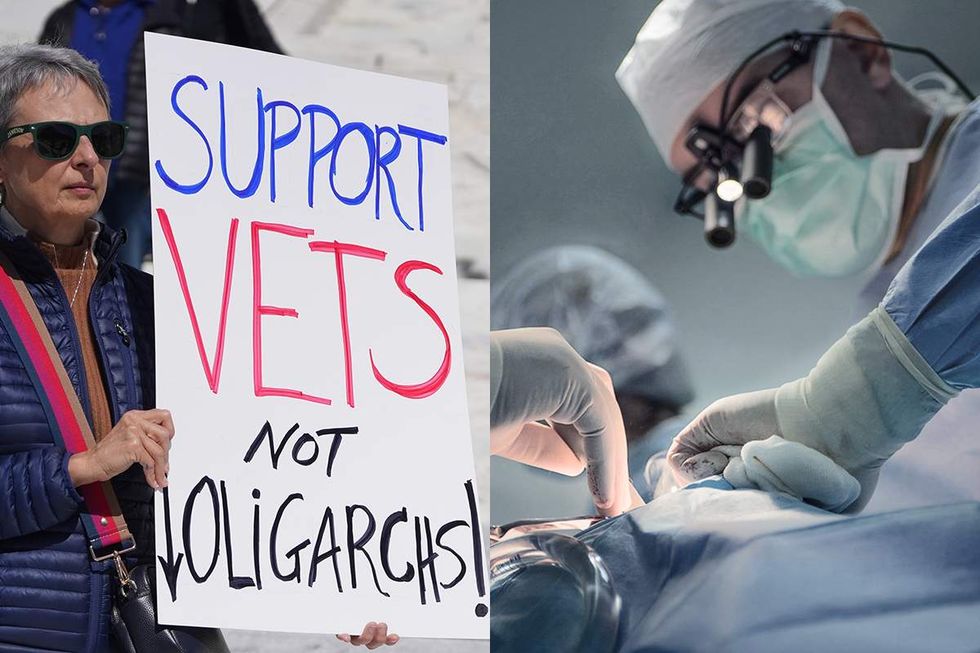 (from left) Rally for veteran's rights in Providence, RI, March 2025; Surgeons performing gender affirming careAnthony Ricci/Shutterstock; Shutterstock Creative
The July amendment was not announced publicly. It was quietly inserted into a directive originally published in 2016 and circulated internally to staff. Initially, VA health providers reported that they were informed informally not to complete the forms before the policy was formally codified. The amendment came just months after the VA formally rescinded a 2018 directive that had governed health care for transgender and intersex veterans.
In March, the agency issued a notice complying with a Trump executive order that sharply curtailed access to gender-affirming hormone therapy, limiting it only to veterans who were already receiving it through the VA or who had started treatment upon leaving the military. It further affirmed that the VA would not provide any surgical interventions for gender dysphoria
“The communication rollout was terrible,” the doctor recalled. “They were only sharing it with LGBTQ+ veteran care coordinators at first, saying, ‘Do not do this.’ And then the policy came out. It was just buried in the documents.”
In March, VA Secretary Doug Collins outlined the department’s plan to eliminate hormone therapy, prosthetics, and most other gender-affirming medical care for transgender veterans who are not already receiving treatment. He justified the rollback by claiming, without evidence, that most veterans support ending care for transgender vets, and he contended that the decision was a budget-saving measure that would allow funds to be redirected to paralyzed and severely disabled veterans.
Inside the system
In a Monday interview with The Advocate, the VA doctor described the new prohibition as both senseless and cruel.
“There’s no rationale that I could point to other than it’s just simply an attack on transgender people for the sake of attacking,” they said. “Why else? Because it’s not costing you anything. It’s just getting in the way of their care.”
 Vetarns Affairs Hospital in Phoenix, AZPam Anders/Shutterstock
The medical professional explained that writing a support letter for surgery takes minimal time. “For the endocrinology side, what, a few minutes? You simply write a letter to confirm that this person is under my care and that I support them. Mental health letters may take a bit longer if a full evaluation is conducted, but if a provider is already seeing the veteran in therapy, it doesn’t require much extra time to write a simple letter. It’s not hard. It’s not costly. But now it’s prohibited."
Asked about VA claims that restrictions are motivated by financial considerations, the provider responded, “Make it make sense. There is no financial reason. There is no medical reason. It’s ideology, not medicine.”
Silence from the VA, but advocates and lawmakers respond
The Advocate contacted VA press secretary Pete Kasperowicz for comment on the amendment. Kasperowicz initially said he would provide a response and asked for more time, but did not follow through after being offered additional time to reply before an early afternoon publication deadline.
Late Tuesday, Kasperowicz responded by citing earlier remarks from VA Secretary Collins, who defended the rollback in blunt terms. Asked what a transgender veteran should do if they receive primary care at a VA facility but need documents to access care unavailable in the system, Kasperowicz pointed at Collins, saying, “If Veterans want to attempt to change their sex, they can do so on their own dime.”
Pressed on whether VA physicians are barred from completing referrals for any other medical condition, Collins said, “VA health care providers may complete non-VA medical forms to the extent they are authorized to do so. The press office also rejected allegations that the administration previously cited financial considerations contributing to the restrictions, insisting, “That’s false. VA never said that.”
The March 17 press release that Kasperowicz referred The Advocate to states, “all savings VA achieves by stopping specific medical treatments for gender dysphoria will be redirected to help severely injured VA beneficiaries — such as paralyzed Veterans and amputees — regain their independence."
The Modern Military Association of America condemned the amendment as “a deeply concerning step backward for transgender veterans.” In a statement to The Advocate, the group said, “For years, VA providers have been a critical bridge—helping veterans complete the medical documentation required to access gender-affirming surgery through outside providers and insurers. By abruptly prohibiting VA physicians from completing this paperwork, the VA is creating new barriers to essential, often life-saving care.”
MMAA added that the change “sends a painful message: that [trans veterans’] needs are secondary, and that their place in the VA system is conditional. Many of these veterans rely on VA providers for primary care. Stripping away their ability to use that trusted care team for necessary documentation forces them into an impossible situation—either start over with new providers outside the VA or face indefinite delays in accessing life-saving care.”
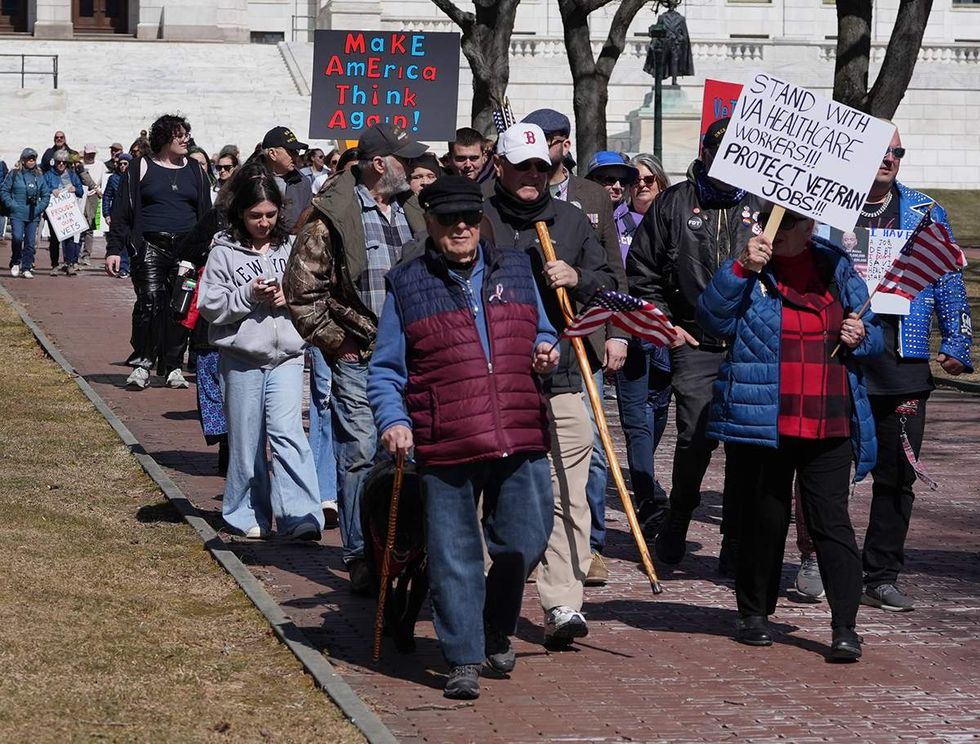 Rally for veteran's rights in Providence, RI, March 2025Anthony Ricci/Shutterstock
The group warned that the policy “undermines trust” in the VA system at a time when transgender service members and veterans already face heightened health disparities, higher rates of discrimination, and systemic barriers. “Instead of closing those gaps, this decision widens them,” MMAA said.
Related: VA psychologist resigns over worry about Trump’s ‘unethical’ orders restricting care for trans vets
Lindsay Church, executive director of Minority Veterans of America, was even more direct. “Gender-affirming care saves lives, the data shows it time and again. For over a decade, VA providers have written pre-surgical letters just as doctors do for countless other medical procedures, from organ transplants to spinal cord stimulators,” Church told The Advocate.
They added, “Stripping that basic medical function away is not about cost or bureaucracy, it’s about punishment. By banning VA providers from writing these letters, the agency is deliberately severing transgender veterans from the care they need, not only inside VA, but anywhere they can. This isn’t policy nuance or administrative housekeeping; it is targeted discrimination, a calculated form of medical eugenics that uses denial of care as a weapon to decide which veterans are allowed to survive.”
"The Trump Administration's directive prohibiting VA providers from filling out paperwork transgender veterans need to receive non-VA gender affirming care is beyond disgraceful. It proves once again this Administration’s disinterest in delivering for all who served,” said Rep. Mark Takano, Chair of the Congressional Equality Caucus and Ranking Member of the House Committee on Veterans’ Affairs. “The Administration has remained set on targeting transgender veterans’ healthcare. They have rescinded vital protections and are now attempting to obstruct veterans’ autonomy, cutting them off from care they’d pay for with their own dime. We can’t stand by as these attacks continue. That’s why I’m proud to join Rep. Kennedy in introducing the Veterans Healthcare Equality Act today. This measure protects transgender veterans’ access to healthcare, so all veterans can access medically necessary care from the Veterans Health Administration without discrimination. All veterans deserve access to comprehensive healthcare, regardless of the political whims of Republicans on their ‘anti-woke’ crusade.”
Fear and moral injury
The provider described a climate of fear inside VA hospitals, where clinicians worry that offering evidence-based care could cost them their jobs.
“I feel like every day I could lose my job because I’m doing clinically indicated, ethical care,” they said. “What they’re asking us to do goes against our clinical guidance and ethical codes. You’re forcing us into a position where we have to deny services, which then puts our veterans more at risk. That’s counterintuitive to the work we’re here to do.”
Across VA hospitals, clinicians have described a growing “underground resistance,” helping trans veterans in whispered corridors as leadership cracks down on affirming care. In one dramatic protest, a VA psychologist resigned rather than comply with directives that she said conflicted with her ethical duty to patients. Dozens of VA clinicians also signed a letter accusing leadership of abandoning their commitment to serve the veterans who rely on them.
The provider characterized the effect on staff as “moral injury.” Clinicians who entered the VA to serve veterans now find themselves constrained by directives that contradict their professional ethics. “We want to provide good quality patient care, but we’re being silenced,” the provider said. “Even if you’re doing the right thing, you could lose your job over what you write in the record. People are afraid.”
The human cost
The consequences for veterans are immediate. Without paperwork from their VA physicians, transgender veterans are left unable to access surgeries at private hospitals or get insurance coverage approved.
“What I fear is that if you cause more barriers to care, suicide rates are going to go up,” the provider said. “But I don’t think this administration responds to data. They literally do not care if the data doesn’t suit their beliefs. They’ll disregard it.”
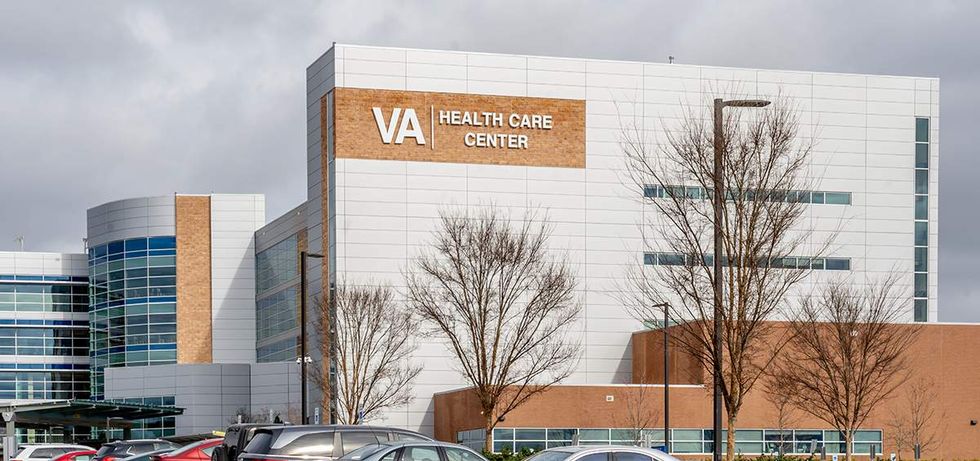 VA Health Care Center in Charlotte, NCJHVEPhoto/Shutterstock
They added that the policy doesn’t just undermine access. It also undermines trust. “Why would you trust an organization that is actively seeking to harm you and removing your care while telling you otherwise?” the provider asked. “It totally destabilizes the trust that’s essential in any therapeutic relationship.”
A broader rollback
The directive is the latest in a series of consequential changes that have reshaped transgender health care at the VA. In 2021, the Biden administration announced it would begin the rulemaking process to cover gender-affirming surgeries. That process stalled. When President Donald Trump took office for a second time in January, support for trans vets stopped entirely. Since then, providers report services being stripped away, LGBTQ+ care coordinator roles diminished, and veterans left confused or misled.
“There are so many things that are gender-affirming that we don’t think of that way,” the provider said. “If a cis woman has cancer and has a mastectomy, and then she gets reconstructive surgery, is that not gender-affirming? Of course it is. But right now, they’re targeting transgender veterans. And once you normalize this kind of rollback, it won’t stop there.” The provider pointed to recent Trump rule changes that strip veterans of access to abortion care.
The provider connected the trend to a wider ideological campaign. “If this care doesn’t fit with their political or religious ideology, they don’t want it,” they said. “It’s unraveling and getting bigger and bigger. This is going to affect all veterans in ways we can’t even quantify yet."
For the provider, the stakes are larger than a single directive. “I think about that poem, First they came, and how it fits this moment,” they said. “Right now, it’s transgender veterans being targeted. But this is going to affect everybody. If you’re a veteran receiving care at the VA, this could affect what you have access to down the road as well. We should all care about this.”
They added, “This isn’t just about transgender veterans. It’s about the VA disregarding science, disregarding ethics, disregarding the humanity of the people it’s supposed to serve.”
Editor’s note: This story has been updated to include a response from Veterans Affairs press secretary Peter Kasperowicz.