'%3E%3Cpath d='M16.3574 35.6519H12.9537L15.0491 18.8873L16.3574 35.6519ZM30.4229 54.0093L22.309 0.994385H7.91795L0 54.0093H10.6634L11.5802 46.3855H17.4014L17.9914 54.0093H30.4229Z' fill='%23971B20'/%3E%3Cpath d='M48.2073 41.8813C48.2073 43.4049 47.4892 44.0011 46.1144 44.0011H43.7595V11.0687H46.1144C47.4892 11.0687 48.2073 11.6636 48.2073 13.1885V41.8813ZM59.5273 43.6695V11.3326C59.5273 3.71323 53.5729 0.994385 47.8157 0.994385H31.7213V54.0093H47.8157C53.5729 54.0093 59.5273 51.29 59.5273 43.6695Z' fill='%23971B20'/%3E%3Cpath d='M90.183 0.994385H78.6039L75.0711 30.6157L71.9955 0.994385H59.4346L69.2474 54.0093H80.373L90.183 0.994385Z' fill='%23971B20'/%3E%3Cpath d='M107.063 42.3448C107.063 43.7359 105.951 44.5974 104.643 44.5974C103.269 44.5974 102.157 43.7359 102.157 42.3448V12.658C102.157 11.2676 103.269 10.4058 104.643 10.4058C105.951 10.4058 107.063 11.2676 107.063 12.658V42.3448ZM119.233 43.2723V11.7312C119.233 6.36384 112.952 -3.8147e-06 104.643 -3.8147e-06C96.2667 -3.8147e-06 89.9867 6.36384 89.9867 11.7312V43.2723C89.9867 48.6393 96.2667 55 104.643 55C112.952 55 119.233 48.6393 119.233 43.2723Z' fill='%23971B20'/%3E%3Cpath d='M150.976 43.9349V33.7309H139.069V42.3448C139.069 43.7359 137.957 44.5974 136.582 44.5974C135.076 44.5974 133.964 43.7359 133.964 42.3448V12.658C133.964 11.2676 135.076 10.4058 136.582 10.4058C137.957 10.4058 139.069 11.2676 139.069 12.658V21.2723H150.976V11.0687C150.976 5.70107 145.283 -3.8147e-06 136.582 -3.8147e-06C127.75 -3.8147e-06 121.796 5.70107 121.796 11.0687V43.9349C121.796 49.3022 127.75 55 136.582 55C145.283 55 150.976 49.3022 150.976 43.9349Z' fill='%23971B20'/%3E%3Cpath d='M167.478 35.6519H164.076L166.17 18.8873L167.478 35.6519ZM181.544 54.0093L173.432 0.994385H159.037L151.123 54.0093H161.785L162.704 46.3855H168.523L169.114 54.0093H181.544Z' fill='%23971B20'/%3E%3Cpath d='M205.412 10.4058V0.994385H177.081V10.4058H185.392V54.0093H197.428V10.4058H205.412Z' fill='%23971B20'/%3E%3Cpath d='M230.002 54.0093V43.9349H218.914V31.8746H226.635V21.8028H218.914V10.4058H230.002V0.994385H206.875V54.0093H230.002Z' fill='%23971B20'/%3E%3C/g%3E%3Cdefs%3E%3CclipPath id='clip0_260_7080'%3E%3Crect width='230' height='55' fill='white'/%3E%3C/clipPath%3E%3C/defs%3E%3C/svg%3E)


LGBTQ+ Americans vote overwhelmingly Democratic — 86 percent of voters from the community chose Kamala Harris as president in 2024, according to NBC News exit polls, and just 12 percent went for Donald Trump. But there are LGBTQ+ Republicans, and for decades, the chief organization speaking for them has been the Log Cabin Republicans. Today, it has a record 80 chapters in 40 states and is an enthusiastic backer of Trump, who has a record of anti-LGBTQ+ policies and comments.
Here’s a look at who Log Cabin is, how it came to be, and how it’s evolved over the years.
Starting in California, fighting a proposal to fire gay and lesbian teachers
The organization has its roots in the fight against a 1978 ballot initiative that sought to bar gays and lesbians from teaching in the public schools (very few people thought much about bisexual or transgender people at the time), along with anyone who supposedly supported homosexuality. It was proposed by John Briggs, an ultraconservative Republican state senator, so hence it was known as the Briggs Initiative (formally, Proposition 6). Former California Gov. Ronald Reagan, close to mounting his 1980 presidential campaign, became the most prominent Republican opponent of the Briggs Initiative (with some persuasion from Democratic gay activist David Mixner). In a newspaper column, quoted on the Log Cabin website, Reagan wrote that the measure was unnecessary and that it might lead to chaos. “It has the potential for real mischief,” he wrote. “What if an overwrought youngster, disappointed by bad grades, imagined it was the teacher’s fault and struck out by accusing the teacher of advocating homosexuality? Innocent lives could be ruined.” The initiative was defeated by a million votes.
After the initiative’s defeat, gay Republicans in California formed the Log Cabin Clubs, named in honor of Abraham Lincoln, the first Republican president. Similar clubs were founded across the nation as well.
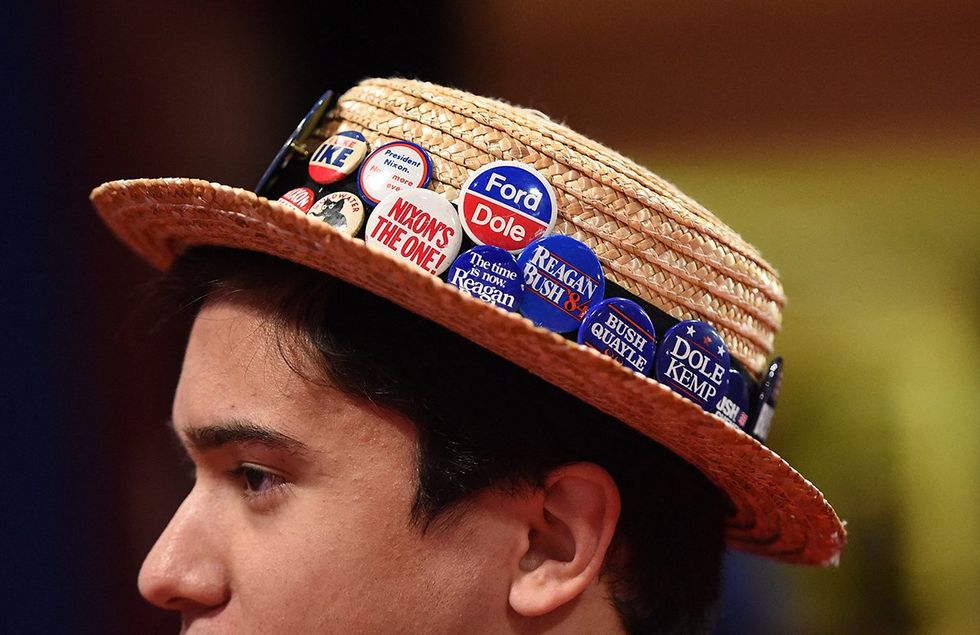 Alternate delegate from Pennsylvania Jonathan Hayes, an ally of the Log Cabin Republicans, at the the Republican National Convention, 2016ROBYN BECK/AFP via Getty Images
Forming a national network
An early attempt to form a national gay Republican group took place at the 1988 GOP convention. The group was called United Republicans for Equality and Privacy, and F. Stanley Berry, an activist from San Diego, was its chairman. It did some lobbying in Washington, D.C., meeting with congressional Republicans. However, Berry soon died of AIDS complications, and the organization foundered.
Then the Log Cabin Federation was founded in 1990 as an outgrowth of United Republicans. It was a volunteer association of gay Republican clubs. Its founding president was the Rev. Rich Tafel, then assistant minister at Memorial Church at Harvard University. (Tafel went on to be an Advocate opinion writer for several years, and he has provided much information on Log Cabin’s history.) An organization called Log Cabin Republicans formed in 1993, and in 1995 the federation dissolved and merged with it. Tafel was the group’s executive director for a decade, but he is no longer affiliated with it.
Progress and challenges
The Log Cabin Republicans found some allies in the GOP in the 1990s, such as Govs. William Weld of Massachusetts, Christine Todd Whitman of New Jersey, and George Pataki of New York, along with New York City Mayor Rudy Giuliani and Los Angeles Mayor Richard Riordan. However, in 1996, Bob Dole, then a U.S. senator and the Republican nominee for president, returned a $1,000 contribution from the group. “Eventually, he accepted the money, but the episode showed how much work remained in transforming the GOP,” the Log Cabin website notes.
Log Cabin faced further challenges in the 2000s, during the presidency of George W. Bush. Bush had positioned himself as a “compassionate conservative” and “a uniter, not a divider,” and for a while it seemed to Log Cabin that he was. “He kept in place an executive order from the Clinton Administration which prohibited discrimination against gay and lesbian federal workers,” the group’s website points out. “He appointed gay people throughout his administration. Also, the federal government provided benefits to the partners of gay and lesbian people who died on September 11th. In 2002, President Bush proposed an ambitious $15 billion plan to tackle the global AIDS pandemic.” That became the President’s Emergency Plan for AIDS Relief, or PEPFAR, which continues today. (Now it's under threat from the Trump administration and Republicans in Congress.)
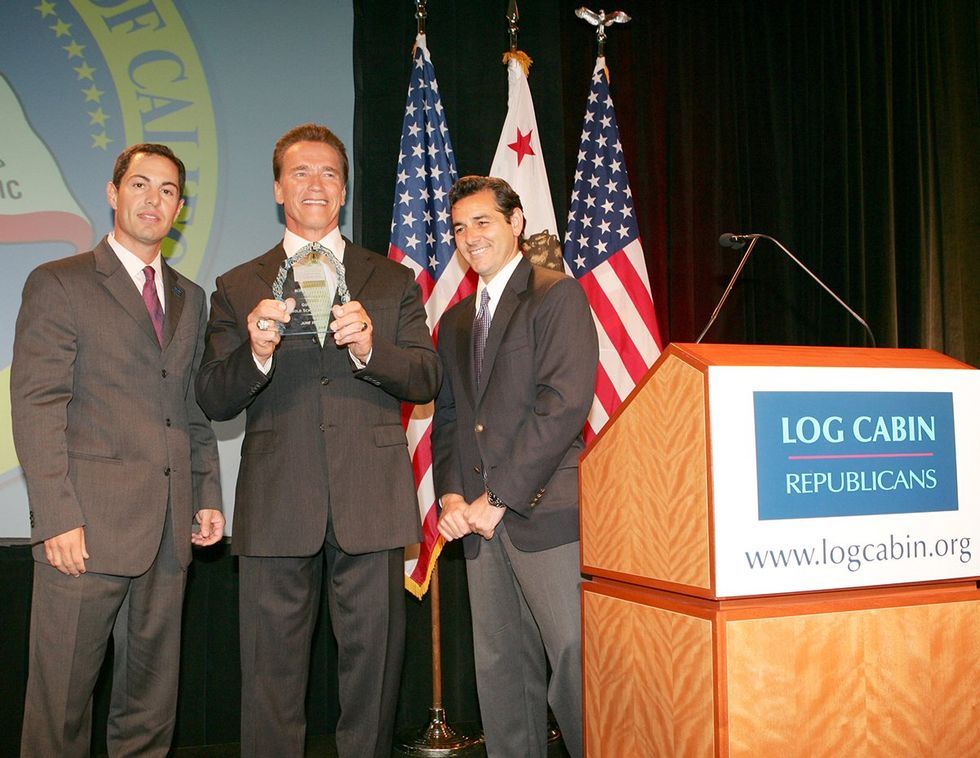 (L-R) Patrick Guerriero, President of Log Cabin Republicans, giving an award to California Governor Arnold Schwarzenegger with Jim Arnone, June 2006Mathew Imaging/FilmMagic
But in 2004, Bush endorsed an amendment to the U.S. Constitution to ban same-sex marriage. This came after a Massachusetts Supreme Judicial Court ruling made that state the first with marriage equality, enraging social conservatives and building support for federal action. To fight the amendment, Log Cabin ran its first advertising campaign, targeting D.C. as well as swing states around the nation. In the end, both the U.S. House and Senate rejected the amendment. “The constitutional amendment we’re debating today strikes me as antithetical in every way to the core philosophy of Republicans,” GOP U.S. Sen. John McCain said at the time. The outcome wasn’t so great at the state level; in the 2004 election, voters in 13 states approved amending their constitutions to ban same-sex marriage. These and other state-level bans were eventually struck down by federal court decisions, with the Supreme Court’s 2015 Obergefell v. Hodges ruling finishing the job.
Presidential endorsements and going all in for Trump
Log Cabin endorsed McCain in his run for president in 2008, largely because of his opposition to the federal constitutional amendment. He lost to Democrat Barack Obama. The group then endorsed Mitt Romney as he tried to unseat Obama in 2012, hoping to change some of his anti-LGBTQ+ stances. He too lost.
In 2016, the group decided not to endorse Donald Trump. “The overarching reason ... was the high degree of uncertainty about what a Trump administration would look like for Log Cabin Republicans and LGBT Americans in general,” Gregory T. Angelo, then Log Cabin's president, told The Advocate. But he also said members should do everything in their power to defeat Democratic nominee Hillary Clinton. “Withholding endorsement is not the same thing as opposing our nominee,” he said. Angelo went on to work in the Trump administration.
Log Cabin did endorse Trump in his 2020 reelection campaign, even announcing the endorsement a year before the election. In a Washington Post commentary, Robert Kabel and Jill Homan, Log Cabin chair and vice chair, respectively, praised Trump as “moving past the culture wars that dominated the 1990s and early 2000s, in particular by removing gay rights as a wedge issue from the old Republican playbook.” (Nonetheless, Trump and his administration had taken many anti-LGBTQ+ actions, and it could be argued that transgender rights are the new wedge issue.) They lauded his record on taxes and foreign policy as well, including a program aimed at decriminalizing homosexuality around the world, although that program ended up accomplishing little. Log Cabin’s first female executive director, Jerri Ann Henry, resigned over the op-ed.
Charles Moran, then Log Cabin's president, told The Advocate in 2020 that he didn’t think Trump was anti-LGBTQ+, and he echoed that sentiment in the 2024 election cycle. Log Cabin endorsed Trump in January 2024. “We will continue working to build a stronger, more inclusive Republican Party based on the principles of freedom and fairness for all Americans,” its website states. “We are proud to endorse President Trump and look forward to working with his administration.”
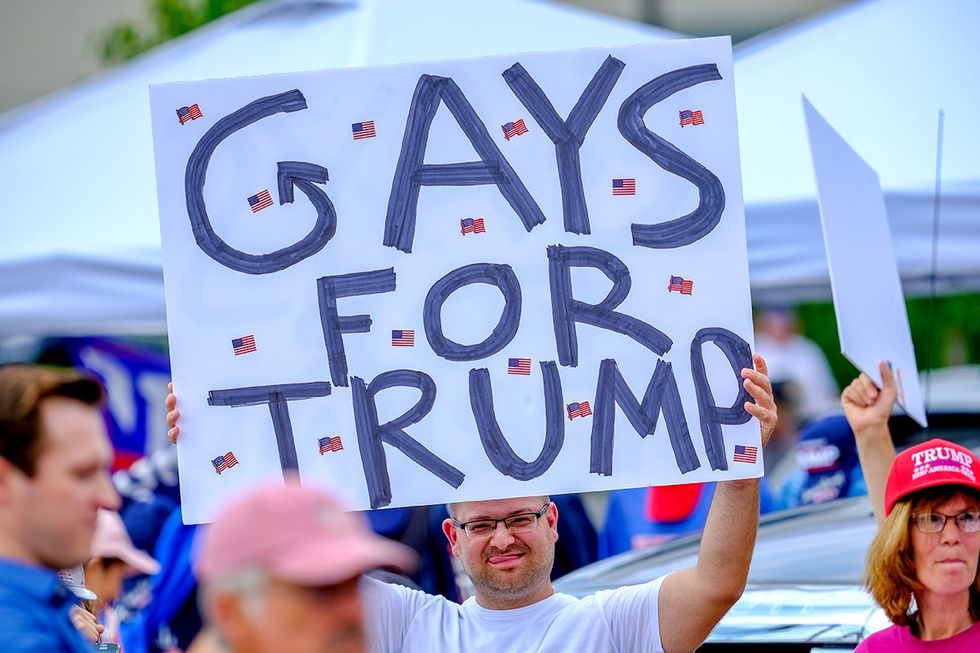 A Trump supporter holds a Gays for Trump sign in New Hampshire, 2019Preston Ehrler/SOPA Images/LightRocket via Getty Images
Log Cabin even sent out a tweet in 2022 likening the FBI raid on Trump's Mar-a-Lago estate, due to his unauthorized possession of classified documents, to the police raid on the Stonewall Inn.
The group held a fundraising event in April 2024 at Mar-a-Lago, hosted by Melania Trump. Among the attendees were the former Olympic athlete and trans Republican Caitlyn Jenner and Richard Grenell, a gay man who was Trump’s ambassador to Germany and later his acting director of national intelligence — the highest-ranking out official in the first Trump administration. (Grenell is now a special presidential envoy and president of the Kennedy Center, where Trump overhauled the board and staff.) The money raised backed Trump and other Republicans around the nation. Melania Trump also did a fundraiser with Log Cabin at Trump Tower in New York City. Every member of the Trump family, except Donald and Melania's son, Barron, who is too young, has done something for Log Cabin, Moran told The Advocate.
Moran was a California delegate for Trump at last year's Republican National Convention. To The Advocate, he reiterated that he finds Trump accepting of LGBTQ+ people — "he has left the culture wars behind" — and he praised the national party platform for excluding language that explicitly opposes marriage equality. "We have seen a 180-degree turn" since the days of George W. Bush, he said.
As for the party's stance on trans issues, Moran said, "We believe in equality for the L’s, the G’s, the B’s, and the T’s, but there are guardrails." These include "no permanent gender transition under age 18," he said, and that includes no puberty blockers, which he said can have lasting effects. (Medical professionals generally say they do not.) Another guardrail is "preservation of women's sports," he said. There should be a path for trans people to participate in sports, but trans women shouldn't be competing against cisgender women, he said.
The second Trump administration
Ed Williams, who succeeded Moran as head of Log Cabin this year — his title is executive director — praises most of Trump's actions in his second term as president. "Basically, the last 48 years Log Cabin has been around, it’s been advocating for equality for all Americans," he told The Advocate in a recent interview. Because of that, the Republican Party has become more welcoming to LGBTQ+ people, he said, and he sees Trump as the "culmination" of that.
Of Trump's efforts to keep trans women out of women's sports, he responded with an anti-trans comment, saying, "We don’t believe there’s a place for men in women’s sports." He also applauded the U.S. Supreme Court's decision in U.S. v. Skrmetti, in which the court ruled that states can ban gender-affirming care for trans youth. He issued a statement at the time saying the decision is not anti-trans but simply protects children from undergoing life-altering medical procedures. Additionally, he wrote an op-ed in the Washington Examiner this year saying Trump is "leading a massive course correction to reverse the radical and insane excesses that extremist, gender-obsessed elements of the Left have quietly and quickly imposed upon our government and our country, yielding no results while fostering more division."
Log Cabin has likewise praised, among other things, Trump's efforts to cut government spending, even those fighting HIV, saying it's necessary to root out waste while maintaining effective programs like PEPFAR. PEPFAR funding that has already been approved shouldn't be cut, Williams said in a July statement, adding that "we look forward to working with Congress to protect the U.S. commitment to fighting HIV/AIDS while safeguarding taxpayers’ dollars."
Of the anti-LGBTQ+ rhetoric still being spewed by many Republicans, he told The Advocate, "We are the party of free speech, so there will always be people we disagree with." At the same time, he said, Log Cabin continues to try to change hearts and minds.